Recognizing Mouse Activity in Sugar Hill Homes

House Mouse Overview
Mouse control cost Sugar Hill homeowners should understand often depends on how quickly an infestation is identified and how established the mouse population has become. The common house mouse (Mus musculus) is a tiny, adaptable rodent that thrives in suburban neighborhoods like Sugar Hill, Georgia. Its natural habitat includes fields, grain stores, and woodpiles, but the abundance of food, shelter, and warmth in homes makes residential areas ideal. In Sugar Hill’s humid climate, mice can multiply quickly—each female can produce up to ten litters a year, with an average of six pups per litter.
Key Visual Clues
Early detection hinges on spotting the tell‑tale signs that mice leave behind:
- Droppings: Small, dark, rice‑shaped pellets about ¼ inch long. Look along baseboards, behind appliances, and in cabinets.
- Gnaw marks: Fresh, clean cuts on wood, plastic, or wiring. Mice have a “V”‑shaped bite with sharp edges.
- Shredded insulation: Mice love to nest in attic insulation, leaving it torn and compacted.
- Urine “cheese trail”: A faint, oily sheen that may appear on surfaces; it can stain fabrics and emit a musky odor.
Distinguishing Mice from Rats
While both are rodents, mice and rats leave different footprints:
- Dropping size: Mouse droppings are ¼‑inch long; rat droppings are ½‑inch or larger.
- Bite marks: Mice gnaw in neat, shallow bites; rats create deeper, irregular chew scars.
- Foraging patterns: Mice travel along walls and use tight pathways, whereas rats tend to follow larger, more open routes.
Health Risks of a Mouse Infestation
Beyond property damage, mice pose serious health threats. They can carry Hantavirus, which spreads through inhalation of contaminated dust, and Salmonella, often transmitted via droppings on food surfaces. Their dander and urine can also trigger allergic reactions and asthma attacks, especially in children and the elderly.
Financial Impact of Ignoring the Problem
Mouse control cost Sugar Hill homeowners face can rise rapidly when infestations are ignored. Unchecked mouse activity can quickly become costly. Chewed electrical wiring raises fire hazards and may require expensive rewiring. Food contamination leads to waste and possible food-borne illness. Structural wood, once gnawed, can weaken support beams, demanding professional repairs. In many Sugar Hill homes, a minor infestation can balloon into a six-figure repair bill if left unaddressed.
Quick DIY Inspection Checklist
Use this simple walkthrough to catch a problem before it spreads:
- Inspect the attic for shredded insulation and gnaw marks on joists.
- Check the basement for droppings near walls, pipes, and stored boxes.
- Open kitchen cabinets and pantry shelves; look for droppings, urine stains, and chewed packaging.
- Examine exterior entry points—cracks around windows, doors, and utility openings should be sealed.
- Listen for faint scratching sounds at night, especially behind walls and under floors.
Why Early Detection Matters
Finding these signs early lets you act before mice establish a permanent nest. Prompt action reduces health risks, limits damage, and keeps treatment costs low. The EPA guidelines on rodent control stress the importance of inspection, exclusion, and sanitation as the first line of defense.
How Mice Enter Sugar Hill Homes and Seasonal Activity Patterns
In Sugar Hill’s humid subtropical climate, mice are opportunistic invaders that exploit even the smallest openings. Understanding the most common entry routes lets you seal the door before the problem starts.
Typical Entry Points
- Utility gaps: Openings around water, gas, and electric lines often go unnoticed. Even a ¼‑inch crack can become a mouse highway.
- Foundation cracks: Settling foundations create fissures that lead straight to your attic or crawl space.
- Vent openings: Dryer vents, attic fans, and HVAC ducts are designed for airflow, not for rodents.
- Poorly sealed doors and windows: Weather‑stripping that’s worn or missing gives mice a direct path inside, especially when you open windows for fresh air.
Landscaping and Outdoor Clutter
Outside the house is just as important as the interior. Stacks of firewood, dense shrubbery, and piles of leaves create sheltered corridors that lead straight to your foundation. Mice love the cover and the easy access to food sources such as fallen fruit or garden waste.

Seasonal Activity Patterns
Mouse activity in Sugar Hill follows a predictable rhythm driven by temperature and food availability. The table below breaks down the typical peaks.
| Month | Activity Level | Typical Behavior |
|---|---|---|
| January – March | Low | Mostly nesting indoors, limited foraging. |
| April – September | High | Rapid breeding, increased foraging, frequent indoor incursions. |
| October – December | Moderate | Preparation for winter nests, occasional indoor entry. |
Why Temperature Drives Behavior
When daytime highs climb above 70°F, mice reproduce quickly—up to five litters per year. Warm, moist conditions also keep food sources abundant, prompting them to explore new entry points. As temperatures dip in winter, they retreat to established nests, reducing visible activity but still seeking shelter inside homes.
Homeowner Habits That Align With Peaks
- Spring: Opening windows for fresh air and storing garden harvests provide easy access and food.
- Summer: Outdoor barbecues, pet food left outside, and frequent yard work create abundant crumbs.
- Fall: Stacking firewood and raking leaves near the foundation gives mice ready‑made cover.
- Winter: Closed windows limit entry, but indoor heating can attract mice seeking warmth.
Seasonal Preventative Actions
- Spring: Inspect and seal all foundation cracks, utility gaps, and vent openings. Replace worn weather‑stripping on doors and windows.
- Summer: Keep outdoor food (pet bowls, compost) in sealed containers. Trim dense shrubs away from the house and remove debris that could hide mice.
- Fall: Store firewood at least 12 inches off the ground on a rack, away from the house. Continue regular yard clean‑up to eliminate hiding spots.
- Winter: Reduce indoor clutter where mice can nest, and maintain a tidy pantry. Check for new gaps caused by settling foundations.
Climate Influence on Breeding Cycles
Sugar Hill’s humid subtropical climate means warm, moist summers and mild winters. This environment shortens the gestation period and extends the breeding season, allowing mice to produce multiple litters from April through September. The combination of heat and humidity also accelerates food spoilage, making outdoor garbage an irresistible buffet.
For a comprehensive, science‑backed approach to seasonal rodent management, refer to the EPA rodent‑control best practices. Following these guidelines alongside Anthem Pest Control’s local expertise will keep your home mouse‑free year round.
Proven Treatment Methods for Mouse Control

Integrated Pest Management (IPM): The Gold Standard
Integrated Pest Management (IPM) blends prevention, monitoring, and targeted treatment to keep mouse populations below damaging levels. Rather than relying on a single chemical, IPM uses a step‑by‑step process: identify entry points, eliminate food and water sources, set up monitoring devices, and apply the least‑toxic control method needed. This systematic approach reduces the chance of resistance, protects pets and children, and delivers long‑term results—making it the industry’s preferred framework for rodent control in Sugar Hill.
Professional Treatment Options
Interior Bait Stations
Licensed technicians install tamper‑proof bait stations in walls, under cabinets, and along baseboards. Placement follows a “hot‑spot” strategy—stations are positioned where mouse activity is highest, typically near walls and near food storage areas. Modern stations feature child‑ and pet‑resistant locks and use EPA‑approved anticoagulant baits that are slow‑acting, allowing mice to return to their nests and share the poison with the colony.
Exterior Perimeter Treatments
For homes surrounded by mulch, landscaping, or a crawl space, professionals apply granular baits and perimeter sprays along the foundation, garage doors, and utility entries. Granular baits are broadcast in a thin layer and remain effective for weeks, while perimeter sprays create a chemical barrier that deters mice from crossing into the structure. Both methods are calibrated to local regulations, ensuring no runoff into storm drains.
One‑Time Heat or Fogging Applications
Severe infestations—often indicated by multiple droppings, gnaw marks, or audible activity—may require a short‑term heat or fogging treatment. Heat‑based foggers vaporize a rodenticide that penetrates hidden voids, while traditional foggers disperse a fine mist of EPA‑approved product. These applications are performed by certified crews wearing full personal protective equipment (PPE) and are followed by a thorough post‑treatment inspection.
DIY Alternatives
Homeowners who prefer a hands‑on approach can start with snap traps, electronic traps, and natural repellents. Snap traps provide instant kill and are reusable, but they must be placed perpendicular to walls for maximum effectiveness. Electronic traps deliver a quick, humane shock and feature indicator lights that confirm a catch. Natural repellents—such as peppermint oil soaked cotton balls or steel wool packed into entry gaps—can deter mice, though they rarely eradicate an established population on their own.
Safety Considerations
Whether you choose a professional or DIY route, safety is paramount. Bait stations should be installed out of reach of children and pets; many models lock with a key that only technicians possess. When handling rodenticides, wear disposable gloves, goggles, and a mask to avoid inhalation or skin contact. All rodenticides used in Sugar Hill must be EPA‑registered, and applicators are required to follow state‑specific disposal guidelines to protect the environment.
Success Metrics: What to Expect
After a professional IPM treatment, most homeowners see a noticeable drop in mouse sightings within 7‑10 days. Follow‑up inspections are typically scheduled at 14‑day intervals for the first month, then monthly for the next two months to verify that activity has ceased. Monitoring devices—such as non‑toxic glue boards or electronic counters—help track progress. If activity persists beyond three weeks, additional bait stations or a targeted fogging may be necessary.
When DIY Isn’t Enough
DIY methods work well for isolated incidents, but certain warning signs signal that a professional should step in: multiple sightings in different rooms, gnawed electrical wiring, large or multiple nests, and evidence of fecal pellets in hidden areas like attics or crawl spaces. These indicators suggest a colony that has breached several entry points, and only a licensed technician can safely seal the structure and apply the comprehensive IPM plan required to protect your home’s integrity.
Anthem Pest Control’s Proven Approach
Anthem Pest Control combines the rigor of IPM with local expertise in Sugar Hill. Their licensed technicians conduct a thorough inspection, identify every possible entry, and install EPA‑compliant bait stations with child‑proof locks. Exterior treatments are customized to your property’s layout, and any heat or fogging application follows strict safety protocols. Anthem backs its work with a 100‑day guarantee—if mice return within that period, they’ll re‑treat at no extra cost, giving homeowners peace of mind and a clear path to a mouse‑free home.
Understanding Mouse Control Pricing in Sugar Hill
When you call a pest‑control professional, the quote you receive is rarely a single line item. Most companies break the price down into several components, each reflecting a specific service that protects your home from mice. In Sugar Hill, the typical structure looks like this:
- Inspection fee: A one‑time charge (often $50‑$75) for a certified technician to assess entry points, activity levels, and the extent of infestation.
- One‑time treatment: The core extermination service, usually priced between $150 and $250, covering bait placement, dust applications, and sealing obvious gaps.
- Monthly monitoring: Ongoing visits or remote checks that cost $30‑$45 per month, ensuring new mice don’t slip back in.
- Optional bait stations: Refillable stations placed around the perimeter; each station runs $15‑$25 per quarter.
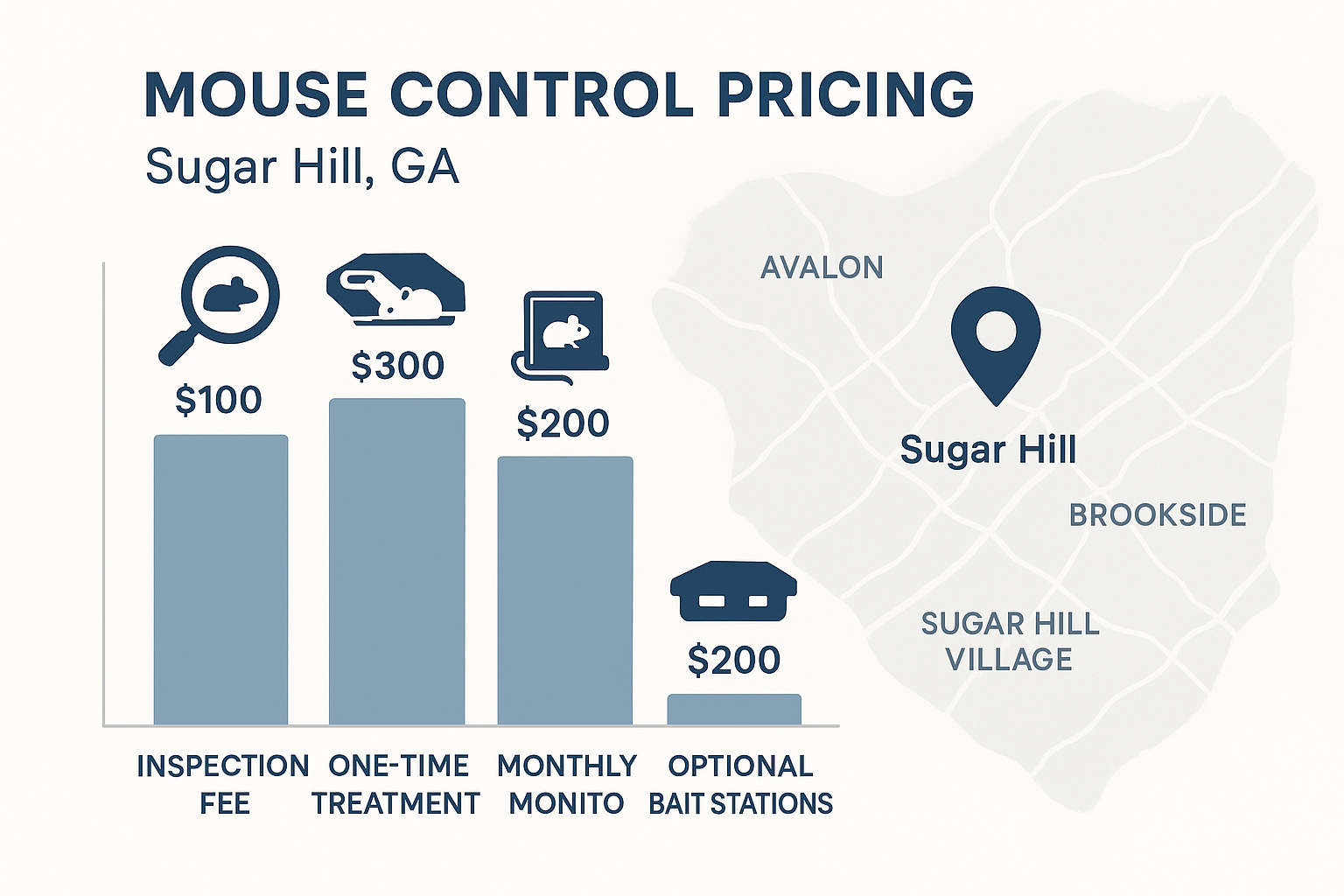
The infographic above divides pricing into three tiers: Basic (inspection + one‑time treatment), Standard (adds monthly monitoring), and Premium (includes quarterly bait refills). Homeowners in the Basic tier typically spend $200‑$300 upfront, while the Premium tier averages $500‑$650 annually, reflecting the added peace of mind from continuous protection.
| Service Component | Sugar Hill Avg. | National Avg. |
|---|---|---|
| Inspection fee | $60 | $70 |
| One‑time treatment | $190 | $210 |
| Monthly monitoring | $35/month | $40/month |
| Quarterly bait stations | $20/station | $25/station |
Bundling services often delivers the best value. A package that pairs monthly monitoring with quarterly bait refills can shave 10‑15% off the total cost compared to purchasing each service separately. Plus, you gain a coordinated strategy—monitoring alerts technicians to new activity, and bait stations act as a long‑term deterrent.
Transparent pricing isn’t just a marketing buzzword; it’s a trust builder. Companies that list every fee up front eliminate surprise charges for “extra visits” or “emergency call‑outs.” Look for quotes that clearly itemize inspection, treatment, monitoring, and any optional add‑ons.
How to evaluate a mouse‑control quote
Before you sign on, verify three key credentials:
- Licensing: The provider should hold a Georgia pest‑control license and display it on their website or paperwork.
- Warranty: A written guarantee—typically 30‑90 days—shows confidence in the treatment’s effectiveness.
- EPA compliance: Ensure all chemicals used are approved by the Environmental Protection Agency and applied by certified technicians.
When a company meets these standards and presents a clear, itemized estimate, you’re far less likely to encounter hidden fees later on.
Anthem Pest Control’s transparent pricing model follows this exact formula. Homeowners receive a free on‑site estimate, a detailed breakdown of each service, and no surprise add‑ons. Call 877‑371‑8196 or visit anthempest.com to schedule your inspection and see how straightforward mouse control can be in Sugar Hill.
Protect Your Home Today with Anthem Pest Control
Early detection, seasonal awareness, and proper treatment are the three pillars that keep mouse invasions at bay. Spotting droppings, gnaw marks, or hearing scurrying sounds early lets you act before a small problem becomes a costly infestation. Knowing when mice are most active—typically in the cooler months—helps you schedule preventive measures at the right time.
- Early detection: Catch signs before damage spreads.
- Seasonal awareness: Target treatment when mice seek shelter.
- Proper treatment: Use safe, EPA‑approved methods for lasting results.
Anthem Pest Control brings that expertise directly to Sugar Hill homeowners. Our technicians are fully licensed and trained in the latest rodent‑control techniques, ensuring every job complies with EPA standards. We pride ourselves on transparent, affordable pricing—no hidden fees, just a clear quote that matches the scope of work.
If you’ve noticed any of the signs discussed or simply want peace of mind, our team is ready to deliver a thorough inspection and a customized mouse‑control plan—no pressure, just a free, no‑obligation quote. We’ll walk you through the recommended steps, answer all your questions, and set up a schedule that fits your lifestyle.
For immediate scheduling, call us at 877‑371‑8196. Our friendly staff will book a convenient appointment and provide the details you need to protect your home.
Want more resources or prefer to book online? Visit our website for a wealth of pest‑prevention guides, pricing information, and an easy online booking portal. Visit Anthem Pest Control today and take the first step toward a mouse‑free home.