Why Knowing Mouse Control Costs Matters for Grayson Homeowners
In Grayson, a tiny mouse can become a big problem fast. These rodents carry diseases such as hantavirus and salmonella, which can contaminate countertops, pantry items, and even your family’s water supply. Beyond health risks, mice chew through insulation, electrical wiring, and wooden structures, creating hidden damage that often goes unnoticed until it turns costly.

When an infestation is left untreated, the financial fallout can snowball. Repairing chewed wires may require a licensed electrician, while replacing contaminated food stocks and repairing structural damage can quickly add up to several hundred dollars. Homeowners who ignore early signs often face emergency repairs that far exceed the price of a preventive treatment.
For Grayson residents, the typical price range from local providers like PestZone falls between $250 and $650. This baseline reflects a thorough inspection, customized treatment plan, and a follow‑up visit to ensure the mice are gone for good. Knowing this range helps you set a realistic budget and avoid surprise fees later on.
Before you sign a contract, ask for a clear, itemized estimate. A transparent quote should outline the number of visits, the type of bait or traps used, and any warranties or guarantees. Having that information up front empowers you to compare options, choose a service that fits your pocket, and protect your home before the problem escalates.
Understanding the health and property stakes, as well as the typical cost spectrum, prepares you for the deeper dive into treatment methods and seasonal considerations that follow in the next sections.
Common Mouse Species and Their Habits in Gwinnett County
In Gwinnett County, two rodent species dominate the homeowner‑to‑rodent conflict: the house mouse (Mus musculus) and the roof rat (Rattus rattus). Both are small enough to slip through a crack the width of a pencil, yet their feeding habits and breeding cycles can quickly turn a single sighting into a full‑blown infestation.
Key Species
- House mouse – prefers walls, basements, and kitchen cabinets; hoards crumbs and grain; reproduces every three weeks, producing up to eight pups per litter.
- Roof rat – excellent climbers that favor attics, eaves, and any structure offering a clear path to the roof; diet includes fruit, nuts, birdseed, and pet food.
Nationally, the Centers for Disease Control and Prevention reports roughly 7.6 million rodent‑related incidents each year, ranging from allergic reactions to disease transmission. The most recent 2023‑2024 data can be found on the CDC’s rodent‑borne disease page (CDC). While not every incident involves a mouse, the sheer volume underscores how common these encounters are across the United States, and why a proactive approach matters in Georgia.
Grayson’s mild winters play a surprisingly large role in driving these rodents indoors. When temperatures hover above freezing for extended periods, mice and rats lose the need to burrow deep outdoors. Instead, they seek the steady warmth of a heated home, especially around the holidays when doors are left open for guests and food scraps accumulate. This seasonal shift is why many residents notice a surge in activity during November and December.
A concrete example from East Grayson illustrates the pattern: after Thanksgiving, local pest‑monitoring reports showed a 42 % increase in mouse sightings compared with the same week in September. Homeowners reported finding droppings in pantry corners and hearing faint scurrying in attic insulation. Those spikes are not random; they align with the combination of abundant food waste and the county’s temperate climate, creating the perfect invitation for both house mice and roof rats.
What Influences the Price Tag?
When you ask why mouse‑control quotes differ from one neighbor to the next, the answer lies in a handful of concrete variables. Understanding each factor helps you compare estimates and choose a plan that fits both your budget and your peace of mind.
Property Size
A 2,500‑sq‑ft family home typically needs more bait stations, longer perimeter runs, and extra interior placement than a 1,200‑sq‑ft condo. In Grayson, larger homes often see a base‑service increase of $50‑$100 simply to cover the additional materials and labor.
Infestation Severity
Severity is measured by sighting frequency and nest activity. A “light” situation—just a few mouse sightings—might be handled with a single bait line and a quick interior inspection, costing around $120‑$150. A “heavy” infestation, where multiple nests are discovered, triggers PestZone’s tiered pricing, pushing the bill to $250‑$350 because technicians must set up more stations, replace them more often, and perform thorough sealing.
Service Scope
Some homeowners only need exterior bait stations to keep mice from entering, while others request a combined interior/exterior treatment that addresses current activity and future entry points. Adding interior work usually adds $80‑$120 to the overall price, reflecting the extra time spent inside walls, attics, and crawl spaces.
Seasonal Demand
Winter months, especially January, bring a spike in mouse activity as rodents seek warmth. Local providers in Grayson report a 10‑15 % premium during this period because demand outpaces technician availability. For example, a standard interior/exterior package that costs $200 in the fall may rise to $220‑$230 in January.
Follow‑Up Frequency
One‑time treatments are the cheapest option, but most homeowners benefit from a recurring plan. Monthly visits keep bait stations fresh and allow technicians to spot new entry points, typically adding $30‑$40 per month. Quarterly plans average $90‑$110 per visit, while an annual contract that includes two follow‑ups usually lands between $180‑$220 for the year.
| Factor | Cost Range (USD) |
|---|---|
| Property Size (small condo) | $120‑$150 |
| Property Size (large home) | $170‑$250 |
| Infestation Severity – Light | $120‑$150 |
| Infestation Severity – Heavy | $250‑$350 |
| Service Scope – Exterior Only | $100‑$130 |
| Service Scope – Interior & Exterior | $180‑$260 |
| Seasonal Premium (January) | +10‑15 % on base price |
| Monthly Follow‑Up Plan | $30‑$40 per month |
| Quarterly Follow‑Up Plan | $90‑$110 per visit |
| Annual Plan (2 visits) | $180‑$220 per year |
By cross‑checking local quotes with these benchmarks, you’ll see why a $250 estimate in January for a 2,500‑sq‑ft home with a heavy infestation aligns with market norms, while a $130 quote for a modest condo in the summer reflects a lighter problem and reduced seasonal pressure.
From Inspection to Ongoing Protection: A Line‑Item Look
When you call Anthem Pest Control, the first thing we send is a technician for a free, 30‑minute inspection. This no‑obligation walk‑through lets us confirm whether mice are present, identify entry points, and map out the most effective treatment zones. Companies such as PestZone and Active Pest Control use the same approach, but Anthem adds a detailed report that includes a customized prevention plan for your specific home.
During the inspection our tech records every potential harbor, takes photos, and provides a written action plan. Homeowners receive a checklist of simple tasks—like trimming vegetation away from the foundation or storing food in sealed containers—that help the chemical side of the treatment work faster.
Initial Treatment – What’s Included and How Prices Vary
After the inspection, the technician will set up a complete initial treatment package. The core components are:
- Bait stations placed along walls, behind appliances, and in any suspected travel corridors.
- Entry‑point sealing using steel‑wool, caulk, or expanding foam to block gaps as small as a quarter‑inch.
- Indoor traps – either snap traps or live‑catch devices, positioned in hidden corners to reduce the chance of accidental contact with children or pets.
We use low‑dose, EPA‑registered rodent baits that are placed in tamper‑proof stations, so children and pets are safe. The bait matrix stays effective for up to three months, reducing the need for frequent re‑application.
Pricing depends largely on the size of the home and the number of stations required. For a typical small residence (up to 1,500 sq ft), the initial treatment usually falls between $250 and $450. Larger properties (1,500–2,500 sq ft) often need more bait stations and additional sealing work, pushing the range to $450–$650. These figures include all labor, materials, and the first set of monitoring reports.
Follow‑Up Visits – Keeping Mice Out for Good
Rodents are persistent, so a single treatment rarely guarantees long‑term success. Anthem offers two primary follow‑up options:
- Quarterly visits – A technician returns every three months to inspect bait stations, replace consumables, and re‑seal any new gaps. Each visit costs between $75 and $120, depending on the amount of work required.
- Annual Maintenance Package – This bundled option includes four scheduled visits (one per season) for a flat fee of $300–$500. The package also provides a discounted rate on any extra services, such as attic insulation repairs or additional bait stations.
Quarterly visits also include a thorough inspection of attics, crawl spaces, and garage areas, which are common hidden routes for mice in the humid Georgia climate. Any new entry points discovered are sealed on the spot, keeping the barrier intact.
| Service | Price Range |
|---|---|
| Inspection (Free) | $0 |
| Initial Treatment – Small Home | $250–$450 |
| Initial Treatment – Large Home | $450–$650 |
| Quarterly Follow‑Up (per visit) | $75–$120 |
| Annual Maintenance Package (4 visits) | $300–$500 |
When you compare these local figures to the National Pest Management Association (NPMA) 2024 national average of $300–$600 for a full mouse‑control program, you’ll see that Anthem’s pricing sits comfortably within the industry norm while offering transparent line‑item detail. For the full NPMA report, see the 2024 Rodent Control Cost Survey. Anthem has verified that the NPMA data reflects the most recent market trends, ensuring our customers receive an up‑to‑date benchmark.
By breaking the service into clear stages—free inspection, targeted initial treatment, and scheduled follow‑ups—you can budget with confidence and avoid surprise charges. Most Grayson homeowners find that the quarterly or annual options provide the best balance of protection and cost‑effectiveness, especially during the cooler months when mice are most active indoors.
How Grayson Stacks Up Against the Rest of the U.S.
When we line Grayson’s mouse‑control pricing up with the latest NPMA (National Pest Management Association) survey, the numbers line up almost perfectly with the national median of $150‑$200 per treatment. That tells us Grayson isn’t an outlier; it simply reflects the broader market.
What does give Grayson a modest edge is the healthy rivalry among three to four locally‑owned pest‑control firms. When companies compete for the same homeowner, they tend to trim overhead, bundle services, and promote transparent, flat‑rate quotes. The result is an average saving of roughly $15‑$20 per mouse‑control job compared with the national average. Homeowners also benefit from clear, upfront estimates that eliminate surprise fees.
Just a short drive north into the denser Atlanta suburbs, the story flips. Higher population density, stricter municipal regulations, and larger service territories push average mouse‑control fees into the $210‑$250 range. Grayson’s more spread‑out neighborhoods, lower property values, and fewer licensing fees keep its rates comfortably below that suburban premium.
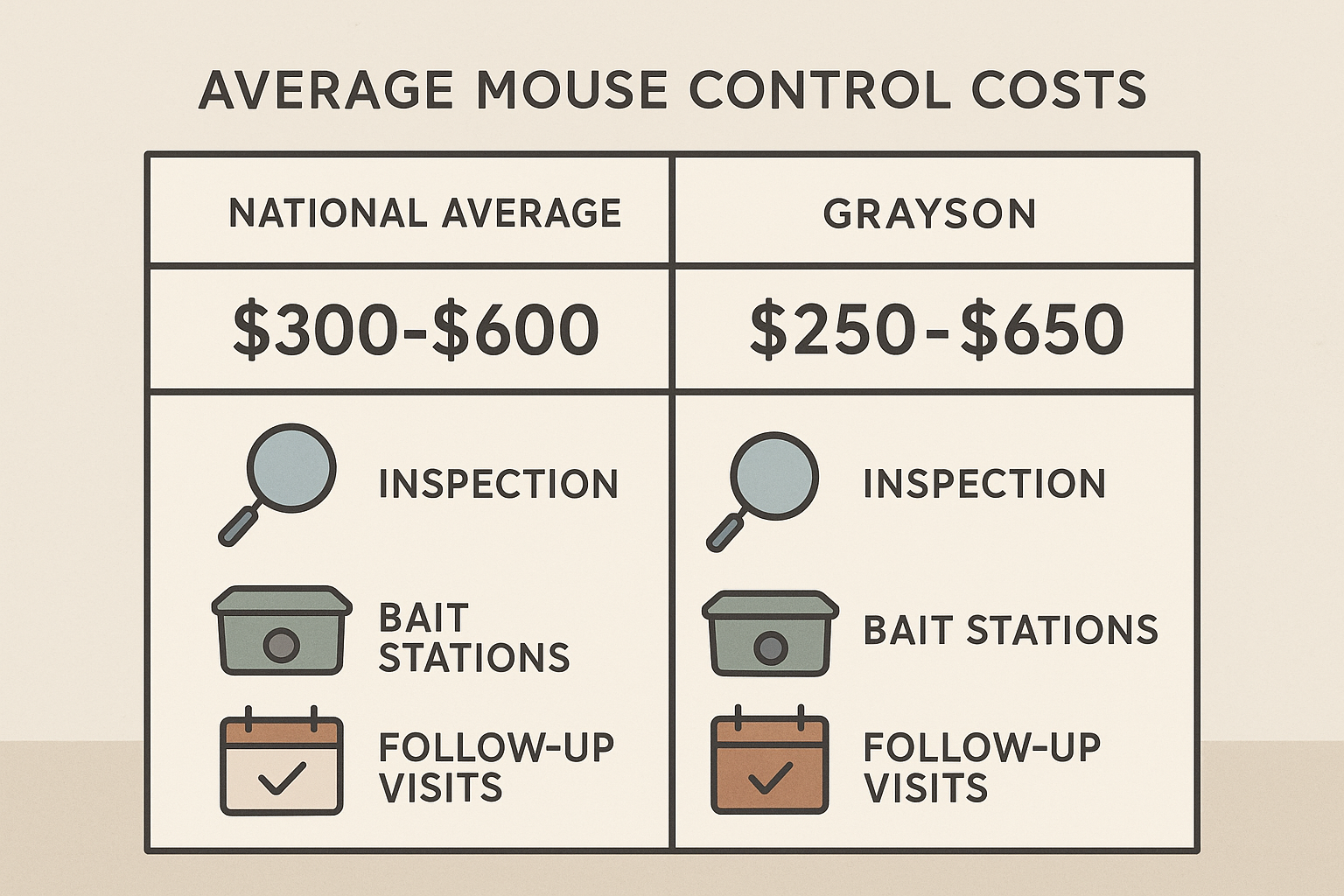
The cost‑comparison infographic below visualizes these differences at a glance. The blue bar represents Grayson’s average price, sitting just under the national median (gray line). The orange bar shows the Atlanta‑suburb average, clearly above the gray line, while the green bar marks the lowest‑cost rural markets. The key takeaway: Grayson offers a competitive price point—roughly 8% cheaper than the U.S. average—while still delivering the same professional treatment standards you’d expect from a national provider.
Choosing the Right Treatment for Your Home
Exterior Bait Stations
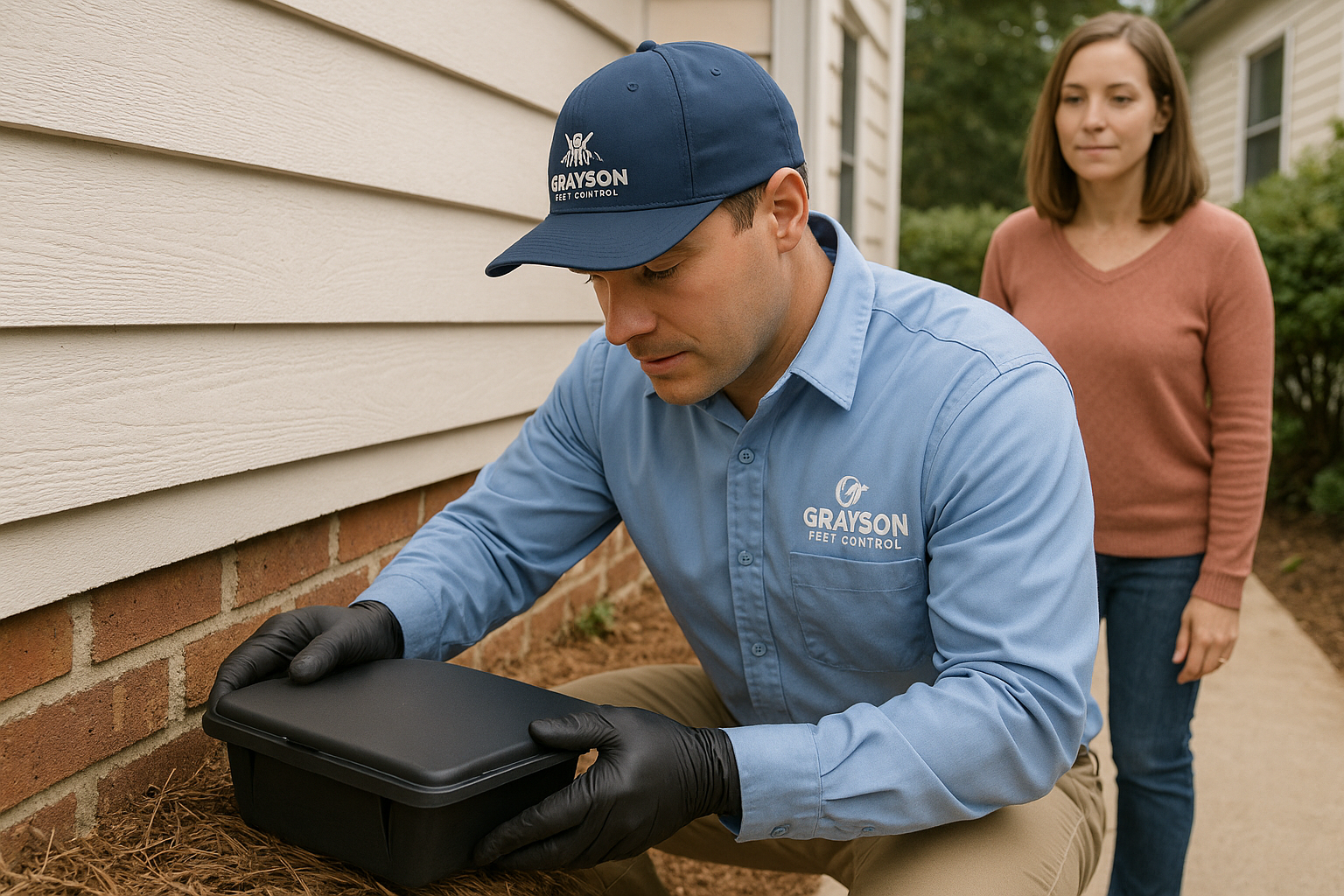
Exterior bait stations are placed around the perimeter of your property, targeting mice before they even step inside. Modern stations feature tamper‑resistant lids, so curious pets and children can’t access the poison. Each unit typically costs between $5 and $10, plus a modest service fee for placement and monitoring. Because the bait is protected and the stations are spaced strategically, you get continuous control with minimal risk to the household.
Interior Traps & Bait
When you’ve confirmed mouse activity inside the house, interior traps become the go‑to solution. Snap traps are inexpensive (often under $2 each) and kill instantly, making them a humane choice for many homeowners. Glue boards are discreet and can be placed in corners or under appliances, but they’re less humane and may require more frequent replacement. Both options can be paired with bait pellets to increase capture rates, and a professional can position them in high‑traffic zones for maximum effectiveness.
Exclusion Services
Exclusion is the “seal‑the‑crack” approach: technicians locate gaps, vent openings, utility entry points, and other access routes, then install steel wool, caulk, or custom metal flashing to block mice permanently. While the upfront cost is higher—usually ranging from $200 to $400 for a typical single‑family home—the long‑term savings are significant because you eliminate the need for repeated baiting or trapping. Proper exclusion also reduces the risk of future infestations from other pests.
Integrated Pest Management (IPM)
IPM blends inspection, treatment, and homeowner education into a single, cohesive plan. A certified technician conducts a thorough walk‑through, identifies vulnerable entry points, recommends the most appropriate control method, and provides a customized action schedule. By combining bait stations, interior traps, and exclusion where needed, IPM delivers a balanced, low‑impact solution that keeps mice at bay while minimizing chemical use.
Real‑World Example
Take the case of a Grayson homeowner who initially requested interior trapping after spotting droppings in the kitchen. During the first visit, the technician discovered several unsealed gaps behind baseboards and around a utility conduit. By opting for exclusion instead of ongoing trapping, the homeowner avoided multiple service calls and saved $150 in the long run—plus they eliminated the source of the problem entirely.
Quick Tip: Evaluate Your Home Layout Before Selecting a Service
Walk around the exterior of your house and note any openings larger than a quarter‑inch—cracks in the foundation, gaps around doors, and vent openings are common entry points. Inside, focus on areas where food is stored or waste accumulates, such as kitchens, pantries, and garages. Mapping these hotspots helps you and your pest‑control professional decide whether bait stations, traps, exclusion, or a full IPM program will give you the best return on investment.
Winter vs. Summer: When to Book for the Best Value
In the Greater Grayson area, mouse activity doesn’t pause for the holidays, but the business of mouse control does. As colder months settle in, especially in January, homeowners notice more sightings inside their homes, and pest‑service companies experience a surge in emergency calls. This spike translates into higher demand and, consequently, premium rates for the same service that might be offered at a modest price in milder months.
The most cost‑friendly window arrives before the winter rush, typically during early autumn—mid‑September to early October. Scheduling a thorough inspection and, if needed, a preventative treatment during this window lets you lock in the seasonal “off‑peak” price while still addressing the early signs of indoor activity that appear as temperatures begin to drop. Early fall is also when property‑owner‑friendly access is easier, so technicians can seal entry points more efficiently.
Benefits of early‑fall booking
- Lock in lower seasonal rates.
- Address early activity before winter forces rodents indoors.
- Gain priority scheduling before the January rush.
Tip: Ask providers about off‑season discounts. Many companies offer reduced rates for scheduled fall inspections, so it’s worth asking before you book.
Tip: Ask providers about off‑season discounts. Many companies offer reduced rates for scheduled fall inspections, so it’s worth asking before you book.
Mouse behavior follows the temperature tide. As cold drives rodents indoors, they become more active in basements, attics and kitchen cabinets during winter. Conversely, summer’s warm, dry conditions push them to the exterior, where they may be seen foraging in yard mulch or near outdoor garbage. Understanding this seasonal rhythm helps you anticipate the periods when a proactive treatment will have the greatest impact and the lowest price.
Who’s Who in Grayson Mouse Control
When a mouse makes a home in Grayson, you want a local expert who knows the neighborhood, the typical entry points, and the most cost‑effective treatment plan. Below is a quick rundown of the four most frequently called‑upon providers, what they bring to the table, and where they focus their service.
PestZone
Founded in 1997, PestZone has built a reputation for dependable rodent control across the greater Grayson area.
- Service highlights: Comprehensive inspection, bait‑station placement, and a re‑treatment guarantee if mice return within the service window.
- Approximate price: $250 – $650 per treatment, depending on property size and infestation severity.
- Neighborhoods served: East Grayson, Grayson‑Lake, Downtown Grayson, and surrounding subdivisions such as Riverbend and Oakwood.
Active Pest Control
Active Pest Control markets itself as a rapid‑response specialist, ideal for homeowners who need a solution fast.
- Service highlights: Tailored quotes based on a free on‑site estimate, same‑day or next‑day service for urgent mouse sightings, and ongoing monitoring for up to three months.
- Approximate price: Prices are customized; typical residential mouse packages start around $300 after the free estimate.
- Neighborhoods served: Primarily East Grayson and Grayson‑Lake, but they also cover North Grayson, the historic downtown district, and nearby commercial zones.
Massey Services
Massey Services is a national brand with a strong local presence, known for its “no‑surprises” guarantee.
- Service highlights: Free initial inspection, a written guarantee that covers re‑treatment if activity is detected within 90 days, and eco‑friendly bait options.
- Approximate price: The company does not publish fixed rates; homeowners receive a personalized quote after the inspection.
- Neighborhoods served: Downtown Grayson, Grayson‑Lake, East Grayson, and the newer West Grayson developments.
Anthem Pest
Anthem Pest leverages its national resources while delivering a locally focused experience for Grayson residents.
- Service highlights: Integrated mouse control that pairs trapping, baiting, and exclusion techniques; a free, no‑obligation quote; and a 100‑day satisfaction guarantee that includes follow‑up visits.
- Approximate price: Anthem does not list a specific Grayson price online, but the average residential mouse treatment ranges from $280 to $540 after the free quote.
- Neighborhoods served: All Grayson neighborhoods, including East Grayson, Grayson‑Lake, Downtown Grayson, West Grayson, and the surrounding rural parcels.
Call 877‑371‑8196 for a free, no‑obligation quote from Anthem Pest.
Step‑by‑Step Walkthrough of a Typical Service
Technician Arrival and Safety Briefing
When the Anthem Pest Control technician pulls up, you’ll see a uniformed professional with a clearly labeled ID badge. Before stepping inside, they introduce themselves, confirm the address, and give a quick safety briefing. This includes a rundown of the products they’ll use, any required ventilation, and how they protect pets and children during the visit.
Comprehensive Interior and Exterior Inspection
The first task is a systematic walk‑through of your home. Inside, the technician checks kitchens, pantries, basements, and attics for signs of mouse activity—droppings, gnaw marks, and nesting material. Outside, they examine the foundation, crawl spaces, and any gaps around utility lines. Every potential entry point is noted, and the level of infestation is assessed to determine the most effective treatment plan.
Placement of Bait Stations, Traps, and Sealing Entry Points
Based on the inspection, the technician strategically positions tamper‑proof bait stations and snap traps where mouse traffic is highest. All stations are placed out of reach of children and pets, often on countertops, behind appliances, or in low‑traffic corners. Simultaneously, they seal cracks, gaps, and openings with steel‑wool, caulk, or metal flashing—permanent barriers that prevent future invasions.
Paperwork: Service Report, Warranty Details, and Homeowner Signature
After the treatment, the technician provides a concise service report. The document lists the locations of bait stations, the type of products used, and a map of sealed entry points. It also outlines the warranty coverage—typically a 30‑day guarantee that any new mouse activity will be addressed at no extra cost. You sign to confirm the work was completed to your satisfaction.
Pet and Child Safety Measures Throughout the Process
Every step is designed with your family’s safety in mind. Bait stations are child‑proof, and any chemicals applied meet EPA standards for low toxicity. The technician explains how long to keep children and pets away from treated areas and provides tips for maintaining a mouse‑free home without compromising safety.
Protecting Your Investment
When you spend money on a mouse‑control program, you want assurance that the job will stick. That’s why most reputable companies back their work with guarantees, warranties, or follow‑up visits. Understanding the fine print helps you compare options and avoid surprise costs later.
PestZone’s “re‑treat at no extra charge” policy
PestZone promises a free re‑treatment if mice are still active within 30 days of the initial service. The policy covers the same treatment method used originally and applies only when the homeowner has followed the recommended sanitation steps. No additional labor fees are charged, but the cost of any extra bait stations required after the re‑treat is billed separately.
Anthem Pest’s 30‑day satisfaction guarantee
Anthem Pest offers a 30‑day satisfaction guarantee on all rodent‑control plans. If you notice mouse activity within the guarantee window, a licensed technician will return, reassess the situation, and perform any necessary additional treatment at no extra cost. The guarantee is unconditional, provided the homeowner has not altered the treatment area or ignored the post‑service instructions.
Industry‑standard warranties and follow‑up visits
Most pest‑control firms in Georgia include at least one complimentary follow‑up visit within the first month and a limited warranty ranging from 30 to 90 days. These warranties typically require the homeowner to maintain a clean environment and report any new activity promptly.
How to file a claim
- Contact the provider’s customer service line (e.g., Anthem Pest: 877‑371‑8196) within the guarantee period.
- Provide the service date, invoice number, and a brief description of the ongoing mouse activity.
- Submit any required documentation, such as photos of mouse droppings or traps set after treatment.
- Schedule the follow‑up visit; the technician will verify compliance with post‑treatment recommendations before proceeding with the free re‑treat.
When a DIY Approach Makes Sense—and When It Doesn’t
Before you reach for a credit‑card and call a pest‑control crew, it’s worth asking whether a do‑it‑yourself (DIY) plan can actually save you money and hassle. For a handful of mouse sightings in a single room, a well‑placed trap may be enough. But as the infestation spreads, the hidden costs of a DIY strategy often outweigh the low upfront price.
Common DIY tools
- Store‑bought snap traps – classic wooden or plastic models that kill on contact.
- Ultrasonic repellents – devices that emit high‑frequency sound intended to deter rodents.
- DIY bait stations – simple containers you fill with peanut butter, chocolate, or commercial poison.
Typical price range
A pack of snap traps runs about $20‑$50 for 10‑20 units, while a basic ultrasonic unit costs $30‑$70. DIY bait stations themselves are inexpensive (often under $10), but a ready‑made bait station kit with pre‑loaded poison can be $30‑$50.
Hidden costs to consider
- Time investment: Setting, checking, and resetting traps can take several minutes each day, quickly adding up to hours over weeks.
- Lower effectiveness: Studies show that snap traps capture only 30‑40 % of active mice, and ultrasonic devices often fail to reach all corners of a home.
- Potential property damage: Improperly placed traps may snap shut on furniture, curtains, or even pets.
The National Pest Management Association (NPMA) reports that professional rodent‑control programs achieve roughly 85 % success in eliminating infestations within the first treatment cycle (NPMA, 2023). That figure reflects trained technicians, calibrated bait placement, and follow‑up monitoring that DIY methods typically lack.
When to DIY and when to call a pro
- Isolated sighting: One or two mice in a single area – try snap traps or a bait station for a week.
- Multiple sightings across rooms: Consider a hybrid approach – start with DIY traps while scheduling a professional inspection.
- Visible damage, droppings in food areas, or children/pets at risk: Skip the DIY trial and contact a licensed service like Anthem Pest Control immediately.
Quick Answers for Grayson Homeowners
When a mouse problem shows up, you need fast, reliable information. Below are the most common questions Grayson residents ask about professional mouse control, answered in plain language. Our team follows best practices for quick, safe results in Grayson.
How long does it take to see results?
Most homeowners notice a reduction in activity within 3‑7 days after bait stations are placed. The timeline depends on the size of the infestation, the placement of the stations, and whether food sources have been sealed. If activity continues after a week, call us to adjust bait placement.
Are the chemicals safe for pets?
Yes. Reputable providers use tamper‑resistant bait stations that contain low‑toxicity anticoagulant rodenticides approved by the EPA. These products are formulated to pose minimal risk to cats, dogs, and wildlife when stations are installed correctly and kept out of reach. Stations release bait only when a rodent enters, limiting exposure. Always follow the technician’s safety instructions and keep pets away from the stations until they are sealed.
Can I combine mouse control with other pest services?
Absolutely. Many Grayson pest‑control companies, including Anthem Pest Control, offer bundled packages that cover rodents, insects, and even seasonal pests like mosquitoes. Bundling can lower overall costs and streamline scheduling, so you only need one technician to handle multiple issues during a single visit. Bundling includes a full inspection to seal gaps and prevent future problems.
How often should I schedule follow‑up visits?
Frequency depends on risk level. For a typical home with moderate risk (sealed entry points, limited food sources), a quarterly inspection keeps the mouse population in check. High‑risk properties—such as older homes, rentals, or locations near grain storage—benefit from monthly visits to maintain a proactive barrier. We’ll also replace depleted bait and update your exclusion plan each visit.
Note: Verify the most current EPA rodent bait safety guidelines before any treatment. EPA Rodenticide Guidelines. Staying informed protects your family and pets.
Investing in a Mouse‑Free Home: The Bottom Line
Keeping your home mouse‑free isn’t just about comfort—it protects your structure, food supply, and peace of mind. In Grayson, Georgia, the realistic cost for a full mouse‑control service typically falls between $250 and $650. Prices shift based on the severity of the infestation, the size of the property, and whether you need one‑time removal, ongoing monitoring, or a comprehensive exclusion program.
A professional inspection is the linchpin of any successful plan. Trained technicians can pinpoint entry points, assess damage, and design a treatment that targets the specific species and habits you’re dealing with. That tailored approach saves you time, reduces chemical use, and lowers the risk of a repeat invasion.
When selecting a local provider, look for guarantees that cover both removal and future prevention, clear service scope (inspection, baiting, sealing, follow‑up), and transparent pricing. Reviews and licensing are good secondary checks, but a solid warranty often separates the best from the rest.
If you’re ready to protect your home without guesswork, Anthem Pest offers a free, no‑obligation quote. Call 877‑371‑8196 or Visit Anthem Pest Control to schedule your inspection today. Our team works quickly, respects your schedule, and ensures lasting results.