Why Moth Control Matters in Dunwoody

Pantry moths and their suburban cousins
In most Dunwoody homes, the most common moth intruders are the Indian meal moth (Plodia interpunctella) and the ubiquitous carpet or clothes moth (Tineola bisselliella). The pantry moth thrives in dry goods—flour, cereal, nuts, and pet food—while its cloth‑eating counterpart chews through wool, cashmere, and stored blankets. Both species are small, but their larvae can multiply quickly, turning a tidy pantry or closet into a hidden infestation.
Health concerns that go beyond a nuisance
Beyond the visual annoyance, moths pose real health risks. The tiny scales that cover adult moth wings become airborne and can trigger allergic reactions in sensitive individuals. The Centers for Disease Control and Prevention (CDC) notes that moth allergens may cause respiratory irritation, sneezing, and even asthma flare‑ups, especially in homes with children or seniors.
While moths are not disease vectors, the contamination of food products by larvae, frass, and silk webbing can lead to gastrointestinal upset if ingested. Regular cleaning and prompt control are essential to keep these hidden hazards from affecting your family’s well‑being.
The economic bite of moth‑related loss
According to the U.S. Environmental Protection Agency, moth‑related food loss costs American households roughly $1.2 billion each year. That figure includes discarded grain, cereal, and pet foods that become unusable once larvae have infested them. For a typical Dunwoody family, even a single pantry moth outbreak can waste dozens of dollars worth of groceries.
Carpet and clothes moths add another layer of expense. The cost of repairing or replacing damaged textiles, upholstery, and holiday decorations can quickly climb, especially when infestations go unnoticed for months.
Why Dunwoody homeowners see moths more often
Dunwoody’s humid subtropical climate creates an ideal environment for moth development. Warm, moist summers accelerate egg hatching, while the mild winters allow larvae to survive in insulated walls and storage areas. Additionally, suburban storage habits—bulk buying, open pantry shelves, and infrequent rotation of stored foods—give moths the perfect breeding grounds.
Many homes in the area also feature spacious closets and carpeted flooring, providing ample hiding spots for carpet and clothes moth larvae. Without vigilant monitoring, these pests can remain hidden for weeks, silently damaging fabrics and building up populations.
Setting the stage for a data‑driven, professional guide
Understanding the health, financial, and property‑value implications of moth infestations is the first step toward effective control. In the sections that follow, Anthem Pest Control will walk you through proven inspection techniques, treatment options, and preventive habits tailored to Dunwoody’s unique climate. Armed with this knowledge, you’ll be able to protect your home, your family’s health, and your wallet from the silent threat of moths.
Common Moth Species Around the Neighborhood
When a Dunwoody homeowner discovers tiny, fluttering insects or mysterious damage to food and fabrics, it’s usually one of three moth species that have taken up residence. Knowing which culprit you’re dealing with makes it far easier to choose the right treatment and keep your home moth‑free.
Indian Meal Moth (Plodia interpunctella)
This pantry invader follows the classic four‑stage life cycle: egg → larva → pupa → adult. A female can lay up to 400 eggs on the surface of stored grains, cereals, nuts, or dried fruit. Within a week—especially when humidity hovers around 70 %—the eggs hatch into creamy‑white larvae that tunnel through food, leaving behind silken tubes and frass (tiny black droppings). As they mature, they spin a cocoon in the corners of pantries, then emerge as the familiar reddish‑brown moth with a coppery‑gold band across the wings.
Signs of infestation include:
- Fine webbing or silken threads in the corners of cabinets.
- Clumped, powdery residues on grains or flour.
- Adult moths fluttering near kitchen lights at night.
Because the larvae feed directly on food, the damage is both a health risk and a waste of money. Early detection—regularly inspecting sealed containers and rotating pantry stock—can stop an outbreak before it spreads.
Webbing Clothes Moth (Tineola bisselliella)
Unlike its pantry‑loving cousin, the webbing clothes moth prefers natural fibers such as wool, silk, cashmere, and even fur. The adult moth is a tiny, beige‑gray flyer that rarely feeds; its primary mission is to find a suitable place to lay eggs. Once the eggs hatch, the larvae spin a protective web and begin chewing tiny, irregular holes in garments, especially in dark, undisturbed closets.
Seasonal activity peaks in late summer and early fall when indoor humidity rises. Homeowners often notice the damage after a long winter when they pull out stored sweaters or blankets. The larvae’s silk tunnels can also attract dust and mold, further degrading fabrics.
Preventive steps include:
- Storing off‑season clothing in airtight vacuum bags.
- Using cedar blocks or lavender sachets—natural repellents that moths dislike.
- Regularly vacuuming closets to remove stray eggs and larvae.
Brown House Moth (Hymenia vespertina)
The brown house moth is a bridge between outdoor and indoor environments. Adults are attracted to outdoor lights and often enter homes during the warm months. Once inside, they gravitate toward stored grains, dried herbs, and even fabric remnants. Their larvae are less picky than the webbing clothes moth, feeding on a mix of plant‑based materials and animal fibers.
Because they can migrate from an outdoor pantry or shed directly into the kitchen, controlling them requires both interior and exterior measures. Sealing cracks around windows, doors, and utility entries reduces the number of moths that can slip inside.
Why Dunwoody’s Climate Feeds Moths
Dunwoody’s average relative humidity sits between 65 % and 75 % for most of the year, according to the National Weather Service. Those moisture levels create an ideal incubator for moth eggs, which can hatch up to 48 % faster than in drier conditions. Warm temperatures (mid‑70s °F to low‑80s °F) also accelerate larval development, shortening the life cycle from weeks to a matter of days.
In addition, the region’s humid subtropical climate means that indoor humidity rarely drops below the threshold moths need to thrive. Without proper dehumidification, pantry shelves, closets, and even attics become perfect breeding grounds.
According to the 2024 NPMA survey, 30 % of Georgia homes report moth sightings each year. That statistic underscores how common these pests are and why proactive monitoring is essential for any Dunwoody homeowner.

Spotting Moth Activity Before It Spreads
Moths can establish a hidden colony before you ever notice a single adult fluttering by. A quick, systematic walk‑through of the places they love—pantry shelves, closets, and even outdoor storage—lets you catch the problem while it’s still manageable. Below is a step‑by‑step routine that fits into a weekly housekeeping schedule.
Pantry Inspection Checklist
The kitchen pantry is the moth’s favorite buffet. Grab a flashlight and a clean cloth, then work through each product row by row.
- Examine flour, cereal, rice, and dried fruit for tiny larvae (often ½‑inch long, cream‑colored) and fine silk webbing.
- Pull the front of each bag or box to look for holes or webbing at the seams.
- Check the bottom of jars and cans for clumped powder or web strands.
- Rotate stock weekly: move older items to the front and use them first, which deprives moths of a fresh food source.
Closet and Wardrobe Sweep
Clothes‑moths prefer natural fibers such as wool, cashmere, and silk, but they’ll also chew synthetic blends if food residues are present.
- Pull garments away from the walls and inspect seams for silky tunnels or small, cigar‑shaped cocoons.
- Run a lint roller along the inside of drawers; moth larvae leave behind fine droppings that appear as tiny dark specks.
- Shake out blankets, scarves, and sweaters outdoors; any movement of webbing indicates an active infestation.
- Vacuum the floor, baseboards, and carpet edges, then immediately dispose of the vacuum bag or empty canister into a sealed trash bag.
Using Pheromone Traps Effectively
Pheromone traps act like a neon sign for male moths, drawing them in and giving you a clear picture of what species you’re dealing with.
- Place one trap per 200 square feet, preferably in dark corners of the pantry, laundry room, or near clothing storage.
- Hang traps at shoulder height; moths fly low and will encounter the lure more readily.
- Check traps weekly: a single catch usually means a low
Proven Methods to Eliminate Moths
Professional Chemical Treatment
When a homeowner discovers a moth infestation, the fastest way to regain control is a professional chemical spray approved by the U.S. Environmental Protection Agency. Anthem Pest’s technicians use an EPA‑registered aerosol that targets both adult moths and larvae hidden in closets, pantry shelves, and carpeted areas. The product is applied as a fine mist that penetrates cracks, seams, and fabric folds, creating a residual barrier that stays active for up to four weeks. Before spraying, the technician conducts a brief walkthrough to identify vulnerable zones and to protect food preparation surfaces.
EPA testing in 2024 showed a 95 % reduction in moth populations within 48 hours of a single application (EPA product efficacy 2024). The study measured results across several common household moth species and confirmed consistent performance in typical U.S. homes. To protect occupants, the technician follows a strict safety protocol: all occupants and pets leave the treated room for at least 30 minutes, windows are ventilated, and the spray is confined to interior surfaces only. After the mist settles, a brief walkthrough confirms that no overspray has contacted food preparation zones.
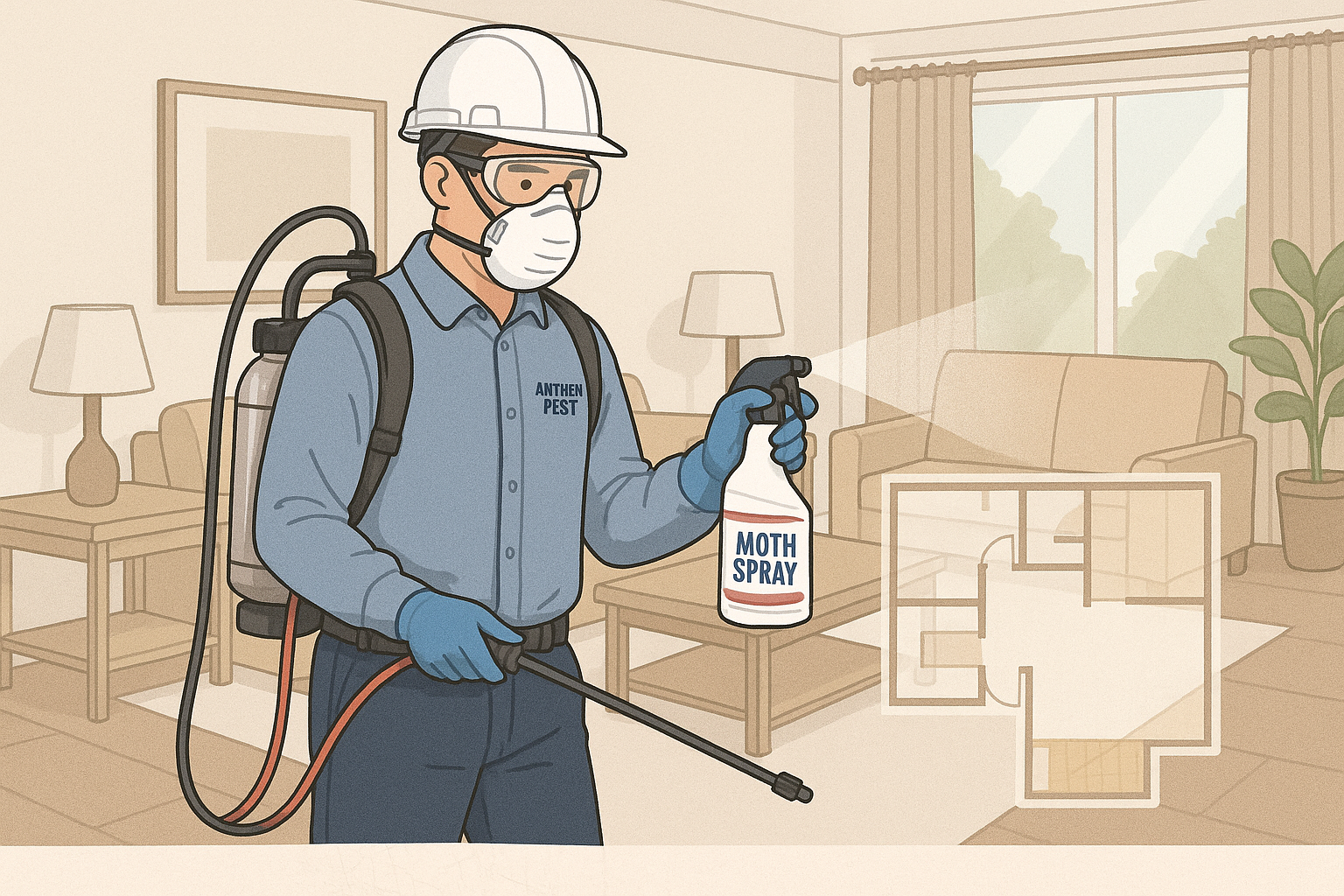
Visualizing the process, imagine a certified Anthem technician standing in a living‑room, nozzle in hand, carefully sweeping the spray across baseboards, behind couch cushions, and along the edges of window frames. The technician wears a disposable respirator, gloves, and eye protection, ensuring both personal safety and minimal residue on household items. The illustration below captures that exact moment, showing the fine cloud of mist and the protective gear worn by the professional.
AI-generated image Integrated Pest Management (IPM)
IPM blends chemical and non‑chemical tactics to keep moths at bay over the long term. Rather than relying on a single spray, Anthem’s IPM plan starts with a thorough inspection, then deploys pheromone traps in high‑traffic zones—especially near windows, pantry doors, and laundry rooms—to monitor adult activity. Traps double as early‑warning devices, allowing the technician to adjust treatment frequency before an outbreak spreads.
Sanitation is the second pillar of IPM. Homeowners are coached to vacuum regularly, store seasonal clothing in sealed containers, and wipe down pantry shelves with a mild detergent. By removing food residues and egg‑laying sites, the environment becomes inhospitable to moths, reducing the need for repeat chemical applications. Regular cleaning also helps keep trap catches low, which is a clear sign that the population is under control.
When chemicals are necessary, IPM favors low‑toxicity, targeted sprays that are applied only where trap data indicates activity. This approach not only cuts down on overall pesticide use but also supports a healthier indoor air quality for families and pets. The reduced frequency of applications translates into lower long‑term costs while maintaining effective control.
DIY Non‑Chemical Options
For homeowners who prefer a hands‑off approach, several low‑cost, non‑chemical methods can curb a mild moth problem. Cedar blocks and lavender sachets emit natural repellents that deter adult moths from nesting in closets and drawers. While these scents won’t eradicate an established infestation, they are useful for preventive maintenance and add a pleasant aroma to storage areas.
Pheromone traps purchased at garden centers work by luring male moths into a sticky reservoir, interrupting the breeding cycle. Place traps in dark, undisturbed corners—such as under beds, behind wardrobes, or in pantry corners—and replace them every 30 days for optimal results. The visual count on each trap provides a quick gauge of activity levels.
One of the most effective DIY tricks is freezer treatment. Items that can tolerate low temperatures—such as wool sweaters, blankets, or stored fabrics—should be sealed in an airtight plastic bag and frozen for at least 72 hours. The extreme cold kills eggs, larvae, and adult moths without any chemicals, and the sealed bag prevents any surviving insects from re‑infesting other belongings once they are removed from the freezer.
Pricing Snapshot
Understanding the cost difference between methods helps homeowners choose the right balance of speed, safety, and budget. Below is a quick reference that outlines typical price ranges for each approach in the Dunwoody area.
Average cost ranges for common moth‑control strategies Method Typical Price Range Key Benefits Professional Chemical Treatment $150 – $250 per treatment Fast 95 % reduction, residual protection Integrated Pest Management (IPM) $200 – $350 for initial inspection & follow‑up Long‑term monitoring, reduced pesticide use DIY Non‑Chemical Options $20 – $80 for traps, cedar, freezer method Low upfront cost, chemical‑free Choosing the right strategy depends on the severity of the infestation, your comfort with chemicals, and how quickly you need results. A professional chemical spray delivers immediate relief, IPM offers sustainable control, and DIY methods provide an affordable entry point for light problems. Whatever you decide, Anthem Pest stands ready to conduct a free inspection, evaluate which method fits your home best, and create a customized plan that protects your family and belongings.
How Much Does Moth Control Cost in Dunwoody?
When you’re faced with a moth infestation, the first question on most homeowners’ minds is the price tag. Understanding what drives the cost helps you compare options and choose a solution that protects your home without breaking the bank.
Key Factors That Influence Pricing
- Home size: Larger square footage requires more product and longer application times.
- Infestation severity: A light, early‑stage problem can be treated with fewer applications, while a heavy outbreak often needs multiple visits and stronger products.
- Treatment type: Traditional chemical sprays, Integrated Pest Management (IPM) packages, and DIY kits each have distinct price structures.
- Number of follow‑up visits: One‑time treatments are cheaper upfront, but recurring visits can keep moths at bay long‑term and may lower overall damage costs.
Typical Price Ranges in Dunwoody
Based on current market data and local service providers, you can expect the following ranges:
- Chemical treatment: $120 – $250 per application.
- Integrated Pest Management (IPM) package: $180 – $300, which usually includes a combination of low‑toxicity products, monitoring, and a preventive plan.
- DIY kits: $30 – $80, suitable for very small spaces or early detection but lacking professional follow‑up.
Benchmark Offer from Anthem Pest
Anthem Pest’s flagship “Moth Master” package is priced at $199 for homes up to 2,000 sq ft. The deal includes two professional visits, a comprehensive pheromone trap kit, and a post‑treatment inspection to ensure the moths are gone for good. This transparent, all‑inclusive price is designed to give Dunwoody homeowners a clear expectation before any work begins.
Cost‑Effectiveness of Early Intervention
Addressing a moth problem early can save you hundreds of dollars in the long run. Moths can damage clothing, upholstery, and even wooden structures when larvae feed on fibers. An early, targeted treatment typically costs less than a full‑scale remediation after extensive damage has occurred. In many cases, the $199 “Moth Master” package pays for itself by preventing costly repairs and replacement of infested items.
Pricing Overview by Home Size and Service Plan
Typical Moth Control Pricing in Dunwoody by Home Size and Service Plan Home Size (sq ft) One‑Time Treatment Annual Maintenance Plan Up to 1,000 $120 – $180 $150 – $210 1,001 – 2,000 $180 – $250 $210 – $300 2,001 – 3,000 $250 – $320 $300 – $380 These figures illustrate how price scales with both the size of your home and the level of ongoing protection you choose. While a one‑time treatment may seem cheaper, an annual maintenance plan often delivers better value by preventing re‑infestations and reducing the need for emergency visits.
In summary, knowing the variables that affect cost, reviewing the price ranges, and comparing them to a trusted local benchmark like Anthem Pest’s $199 “Moth Master” package equips you to make a confident, cost‑effective decision for your Dunwoody home.
When to Treat and How to Keep Moths Out Year‑Round
Peak Activity Window
In the Atlanta metro area, including Dunwoody, pantry moths are most active from late spring through early fall. The first generation typically emerges as temperatures climb above 68 °F (20 °C) in May. By June, humidity spikes—often driven by summer thunderstorms—create the perfect breeding environment for Plodia interpunctella (Indian meal moth) and Ephestia kuehniella (Mediterranean flour moth). Expect a noticeable rise in sightings through July and August, then a gradual decline as nights grow cooler in September.
Year‑Round Prevention Checklist
Keeping moths at bay isn’t a one‑time task; it’s a habit. Below is a printable, homeowner‑friendly checklist you can post on your fridge or in the pantry:
- Store dry goods in airtight containers: Glass or heavy‑wall plastic containers with a rubber seal prevent adult moths from laying eggs and larvae from escaping.
- Use natural repellents: Cedar blocks, lavender sachets, or dried rosemary placed on shelves deter moths without chemicals.
- Vacuum regularly: A thorough vacuum of pantry shelves, cracks, and baseboards removes eggs, larvae, and adult moths. Dispose of the bag or empty the canister outside immediately.
- Seal cracks and gaps: Apply caulk around baseboards, window frames, and pantry door seals. Even a 1‑mm opening can become a highway for a moth.
- Rotate stock: Practice “first‑in, first‑out” for flour, cereals, and pet food. Use older items before opening new packages.
- Inspect new purchases: Before storing bulk items, give them a quick visual check for webbing or tiny larvae.
Seasonal Inspection Schedule
Timing your inspections around the moth life cycle maximizes your chances of catching an infestation early.
- Early Spring (late March‑early April): Schedule a professional pre‑season inspection. Technicians will look for residual moth activity from the previous year and seal any entry points.
- Mid‑Spring (mid April‑May): Perform a DIY pantry sweep. Empty all containers, wipe shelves with a solution of 1 % vinegar, and replace items in new airtight containers.
- Post‑Holiday Review (early January): After the holiday baking season, pull out all flour, sugar, and spice jars. Discard any that show signs of webbing or tiny specks, and give the pantry a deep clean.
- Late Summer (August‑September): Conduct a second check before humidity drops. Look for adult moths near windows and light fixtures, as they are attracted to bright areas.
Neighborhood Insight: Brook Run Residents
Our technicians hear a consistent story from homeowners in the Brook Run community: a noticeable surge in pantry moths right after the holiday baking rush. The combination of open flour bags, warm ovens, and lingering crumbs creates a buffet for moths. Residents who proactively sealed their pantry doors and swapped out old flour for airtight containers reported up to a 70 % reduction in moth sightings the following year.
Printable Checklist (Download)
For quick reference, download our Moth Prevention Checklist. Print it, hang it on your pantry door, and tick off each step as you complete it. Consistency is the key to keeping those pesky moths out of your kitchen all year long.
Moth Issues in Specific Dunwoody Areas
Even within a single city, moth problems can look very different from one neighborhood to the next. The key is understanding how the local housing stock influences where moths hide, what they eat, and how quickly an infestation can spread. In Dunwoody, three micro‑markets illustrate this perfectly: the newer townhomes of Dunwoody Village, the classic ranches of Peachtree Creek, and the mixed‑age homes of Brook Run. By matching each area’s architectural quirks with the most common moth species, you can spot warning signs early and choose the right treatment before the problem gets out of hand.
Dunwoody Village
Dunwoody Village is a relatively new development built mostly in the last decade, featuring townhomes with attached two‑car garages and compact storage sheds. Because the structures are tight‑fitted, homeowners often use the garage and shed for bulk grocery storage, especially dry goods like grains, cereals, and spices. These pantry‑friendly environments create an ideal breeding ground for Indian meal moths (Plodia interpunctella). The moths lay their eggs directly on food packages, and the larvae can chew through cardboard, leaving webby residue and tiny holes. A quick visual inspection of pantry shelves, garage shelves, and shed bins—looking for silken tunnels and clumped debris—can catch an infestation before it spreads to the kitchen.
Peachtree Creek
The Peachtree Creek section is characterized by older, single‑story ranch homes built in the 1970s and 1980s. Many of these houses have unfinished attic spaces, often accessed through small crawl‑spaces or pull‑down stairs that are rarely inspected. These hidden cavities retain a steady temperature and low light—perfect conditions for carpet and clothes moths (Trichophaga spp. and Tineola bisselliella). The adult moths are attracted to natural fibers in carpets, wool blankets, and stored clothing, where they deposit eggs. Over time, the larvae feed on the keratin in the fibers, leaving irregular holes and a fine, powdery frass. Because the infestation stays concealed in the attic, homeowners may notice damage only after months of quiet feeding.
Brook Run
Brook Run offers a blend of older bungalows and newer townhomes, creating a mixed‑age housing landscape. This diversity means the area sees a seasonal spike in pantry moth activity, especially after the holiday baking season. Families tend to stock up on flour, nuts, dried fruit, and holiday treats, often storing them in decorative containers that are not airtight. The abundance of food, combined with the occasional lapse in cleaning after celebrations, gives pantry moths a short but intense feeding window. The result is a rapid increase in larvae and webbing throughout kitchen cabinets, pantry shelves, and even the occasional decorative pantry box.
“We never realized the garage could become a moth hotspot until we started finding tiny webbing in our flour bins. A quick treatment from Anthem Pest cleared it up, and now we keep everything sealed.”
— Homeowner, Dunwoody VillageTrust Local Expertise for Reliable Results
When it comes to moth control in Dunwoody, you deserve a partner who blends scientific rigor with neighborhood know‑how. At Anthem Pest, our local teams combine nationally recognized certifications with an intimate understanding of the area’s unique climate and housing styles. That combination means you get a treatment plan that’s both proven and perfectly tuned to your home.
Certified Solutions You Can Rely On
Our technicians are fully state‑licensed and work exclusively with EPA‑registered products that meet the highest safety standards for families, pets, and the environment. Every year, we invest in ongoing training—from the latest integrated pest management (IPM) techniques to emerging moth‑specific technologies—so the methods we use are always current and effective. This certification pipeline ensures that the chemicals applied are not only powerful against moths but also applied in a way that minimizes any risk to your home’s occupants.
Our 100% Satisfaction Guarantee
We stand behind every service with a 100 % satisfaction guarantee. If you’re not completely happy with the results after the initial treatment, we’ll return promptly at no extra charge to re‑treat the affected area. This guarantee isn’t just a marketing line; it’s a promise that our confidence in our work translates into peace of mind for you. Should any moth activity reappear within the warranty period, our team will assess the situation, adjust the approach if needed, and ensure the problem is fully resolved.
Proven Success Backed by Data
Numbers speak louder than words. According to the NPMA 2024 study, professionally treated homes achieve a 98 % long‑term success rate against moth infestations. That figure reflects homes where certified technicians applied industry‑standard protocols, exactly the approach we follow at Anthem Pest. In other words, when you choose us, you’re aligning with the best‑performing segment of the pest‑control industry.
Local Knowledge That Makes a Difference
Dunwoody’s humid subtropical climate creates a perfect breeding ground for pantry and carpet moths, especially during the warm summer months. Our technicians have spent years navigating the region’s older brick bungalows, modern townhomes, and sprawling single‑family residences. This experience translates into a keen eye for the hidden entry points—like attic vents, crawl‑space gaps, and poorly sealed pantry doors—that often escape a generic, out‑of‑area service. By tailoring inspections and treatments to these local quirks, we close the gaps before moths can establish a foothold.
Ready to Experience the Anthem Pest Difference?
Take the first step toward a moth‑free home today. Call our Dunwoody specialists at 877‑371‑8196 or visit anthempest.com to schedule a free, no‑obligation inspection. Let our certified, locally‑trained team give you the reliable results you deserve.
Quick Answers for Homeowners
How long does a treatment last?
Most EPA‑approved chemical treatments remain effective for six to twelve months when applied correctly. The active ingredients continue to suppress adult moths and disrupt the life cycle long enough to keep the population below damaging levels. If you combine the chemical approach with an Integrated Pest Management (IPM) plan—regular cleaning, vacuuming, and proper food storage—the protective window can stretch even further. Maintaining those preventive habits is the key to extending the life of any treatment.
Are the chemicals safe for children and pets?
Yes, when we use EPA‑registered products and follow label safety guidelines, the risk to people and pets is minimal. Our technicians apply the chemicals in a controlled manner, then vacate the treated area for a short period (usually 30 minutes to an hour) to allow the product to settle. Afterward, we recommend a brief ventilation step—open windows or run an exhaust fan—before re‑entry. For detailed safety information, see the EPA pesticide safety page. Following these steps ensures that the treatment is both effective and safe for your household.
What’s the difference between pantry and carpet moths?
Pantry moths (e.g., Indian meal moth, Plodia interpunctella) are attracted to stored food products. Their larvae feed on grains, nuts, dried fruit, and pet food, leaving webbing and small holes in packaging. Damage is primarily economic—contaminated food must be discarded.
Carpet moths (e.g., webbing carpet moth, Tineola bisselliella) prefer natural fibers such as wool, silk, and fur. Their larvae chew on the fibers, creating irregular holes and a fine, silvery web. The damage is structural and can be costly to repair if left unchecked.
Both species share a similar life cycle—egg, larva, pupa, adult—but the preferred food source and the type of damage they cause are what set them apart. Knowing which moth you’re dealing with helps us select the right treatment and prevention strategy.
Can I prevent re‑infestation without a professional?
Absolutely, homeowners can keep moths at bay with diligent housekeeping:
- Store dry goods in airtight containers made of glass, metal, or heavy‑wall plastic.
- Vacuum pantry shelves, closets, and carpeted areas weekly to remove eggs and larvae.
- Replace pheromone traps every 30‑45 days to monitor activity.
- Inspect and clean rarely used spaces—attics, basements, and storage closets—where moths love to hide.
Even with a solid DIY routine, a professional follow‑up visit can uncover hidden infestations that are difficult to see, such as larvae deep within wall voids or under floorboards. Our technicians use specialized tools and targeted treatments to eliminate those hidden pockets, giving you peace of mind that the problem is truly gone.
For more information on how moth allergens can affect indoor air quality, refer to the CDC moth allergens page. By staying informed and proactive, you protect both your home and your family’s health.
Take Control of Moths Today
Keeping moths at bay isn’t a one‑time event—it’s a habit you build into your home routine. By staying vigilant and acting early, you protect food supplies, preserve fabrics, and avoid costly repairs.
Quick Recap of Proven Steps
- Inspect regularly: Check pantry shelves, closets, and attics monthly for larvae, webbing, or adult moths.
- Choose the right treatment: Use targeted baits, traps, or professional‑grade sprays based on the species you encounter.
- Implement year‑round prevention: Store dry goods in airtight containers, keep clothing in sealed bags, and maintain proper ventilation to discourage moisture‑loving moths.
- Schedule a professional follow‑up: A quarterly inspection from a certified technician catches hidden infestations before they spread.
Why Early Action Saves Money
Every moth that goes unnoticed can damage stored grains, spices, and even delicate fabrics. A single infestation may force you to discard dozens of pounds of food or replace damaged upholstery—expenses that quickly eclipse the modest cost of preventive treatment. Detecting a problem in its infancy lets you use low‑impact solutions, which are far cheaper than emergency extermination or extensive repairs.
Anthem Pest: Your Local Moth‑Control Partner
Anthem Pest brings Dun‑woody expertise straight to your doorstep. Our transparent $199 “Moth Master” package includes a thorough inspection, customized treatment plan, and a guarantee that you’ll see results. We pride ourselves on clear pricing, safe products, and a satisfaction promise that lets you sleep soundly knowing the job is done right.
Ready to Take the Next Step?
Give us a call at 877‑371‑8196 for a free, no‑obligation quote. Our friendly, knowledgeable team will walk you through the process, answer any questions, and schedule a convenient visit. When you choose Anthem Pest, you’re choosing a partner who treats every home as if it were our own.
Visit Anthem Pest Control today and start protecting your home before moths become a problem.