Why Termite Protection Matters for Homeowners

Common Termite Species in U.S. Homes
Most residential infestations involve three culprits: subterranean termites, which build mud tubes from the soil into the structure; drywood termites, which live entirely within the wood and require no moisture; and dampwood termites, which prefer damp, decaying timber. Each species attacks wood differently, but all can undermine a house’s framing, flooring, and even its foundation if left unchecked.
The Financial Impact of an Untreated Infestation
According to the National Pest Management Association, the average U.S. homeowner spends between $2,000 and $5,000 on termite repairs after damage is discovered. In severe cases—particularly with subterranean colonies—the cost can soar above $10,000. Nationwide, termites cause an estimated $5 billion in property damage each year, making them one of the most costly hidden pests.
Silent Invaders: How Termites Go Unnoticed
Termites are master stealth operators. They work 24/7, chewing through wood from the inside out, leaving only a thin veneer of surface material. Homeowners often see no visible signs until structural components begin to sag, paint cracks, or a faint “tunnel” pattern appears in walls. By the time a homeowner spots a tell‑tale swarm of winged alates, the colony may have been feeding for months.
Proactive Treatment vs. Reactive Extermination
A proactive approach means installing a barrier or bait system before a colony establishes itself. This strategy interrupts the termite’s life cycle, reduces the risk of future infestations, and typically costs less than emergency remediation. Reactive extermination, on the other hand, focuses on eradicating an existing colony after damage is evident—often requiring extensive repairs in addition to the chemical treatment.
Anthem Pest Control’s Commitment to Homeowners
At Anthem Pest Control, we believe every homeowner deserves affordable, transparent protection. Our termite programs combine industry‑proven products with a clear pricing structure, so you know exactly what you’re paying for—no hidden fees, no surprise invoices. Whether you opt for a pre‑emptive barrier, a baiting system, or a combination of both, our licensed technicians tailor the solution to your home’s unique risk profile.
Spotting Termite Activity Early
Visual Signs You Can’t Ignore
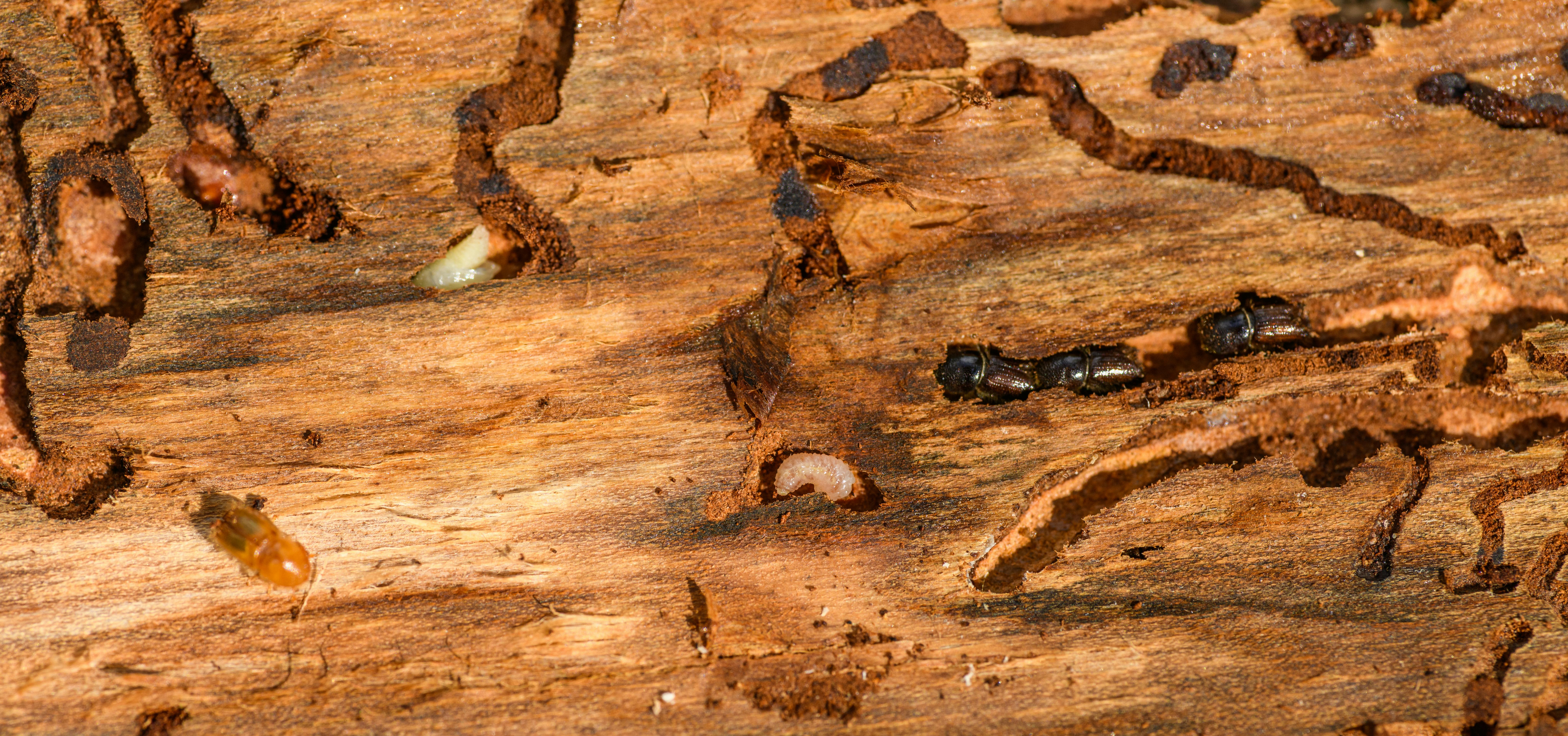
Termites are masters of disguise, but they leave a trail of clues. The most common giveaway is mud tubes—silky, tunnel‑like pathways the insects build to travel between soil and wood. Look for these on foundation walls, porch steps, or any exterior wood exposed to moisture.
Another red flag is discarded wings. Swarmers shed their wings after a nuptial flight; a pile of delicate, translucent wings near a window or light source often means a colony is nearby.
Tap a wooden beam or joist; if it sounds hollow or echoes like a drum, the interior may be riddled with tunnels. Finally, keep an eye out for frass—dry, pellet‑like droppings that look like sawdust. Frass is the termite’s waste and a clear sign they’re feeding on the wood.
DIY Inspection: A Quick Walk‑Through
Grab a flashlight and a screwdriver and follow these simple steps:
- Foundation and crawl space: Crawl under the house and inspect the sill plate, joists, and any wooden supports. Mud tubes or damp, softened wood are immediate warnings.
- Exterior wood: Examine decks, fences, and siding for mud tubes, cracks, or water damage. Termites love moisture, so any wood that’s constantly wet is a hotspot.
- Attic and roof space: Look for frass in insulation, along beams, or in hidden corners. Also check for any small holes that could serve as entry points.
- Interior rooms: Tap doors, windows, and baseboards. A hollow sound often means termites have tunneled behind the finish.
Take notes and photos of anything suspicious. Even a single piece of evidence can justify a professional evaluation before damage escalates.
Why Macro‑Level Evidence Is a Red Flag
Seeing isolated signs—like a few discarded wings—might be unsettling, but discovering macro‑level evidence such as large patches of wood that sound hollow or visible galleries inside structural members signals an established colony. At this stage, termites have likely been feeding for months, and the damage can be extensive and costly to repair.
Active Colonies vs. Isolated Sightings
An active colony will produce multiple signs simultaneously: mud tubes, frass, and ongoing wood damage. These colonies are self‑sustaining and will expand unless interrupted.
In contrast, an isolated sighting—for example, a lone swarm of winged termites—might indicate a new colony trying to establish itself. While the immediate damage may be minimal, it’s still a warning sign that you need to act quickly to prevent a full‑blown infestation.
Want to Dive Deeper?
Understanding the cost implications of treatment can help you budget for a proactive approach. For a detailed breakdown of pricing factors, check out How Much Does Termite Treatment Cost?.
Core Termite Treatment Options
When termites start gnawing at the wooden frame of your Suwanee home, the choice of treatment can feel overwhelming. The three most common approaches—liquid barriers, bait stations, and whole‑structure fumigation—each rely on a different mechanism and suit distinct infestation scenarios.
Liquid Barrier Treatments
Liquid barrier treatments create a chemical “moat” around your home’s foundation and throughout the soil that termites must cross to reach the structure. A licensed technician drills a series of small holes in the slab, crawl spaces, and perimeter walls, then pumps a termiticide that penetrates the soil to a depth of 12–18 inches. The product bonds to soil particles, forming a long‑lasting, invisible shield that kills or repels foraging termites on contact.
Homeowners typically choose this method when:
- Early‑stage, subterranean infestations are detected.
- The property has a solid foundation or crawl space that can be accessed easily.
- Long‑term protection is a priority, especially in neighborhoods with high termite pressure.
Pros: Immediate protection, minimal disruption to daily life, and effectiveness that can last 3–5 years with proper maintenance. Cons: Requires excavation or drilling, may need retreatment in highly active soils, and effectiveness depends on proper installation and regular monitoring.
Bait Station Systems (e.g., Sentricon)
Bait stations work on a “colony interception” principle. Small, discreet stations are placed around the perimeter and in strategic interior locations. Each station contains a cellulose substrate laced with a slow‑acting growth regulator. Foraging termites collect the bait and share it with the colony through trophallaxis, gradually weakening the queen and eventually collapsing the entire population.
This approach shines when:
- There is evidence of an established colony but limited structural damage.
- The homeowner prefers a less invasive solution that blends into the landscape.
- Ongoing monitoring is desired to catch re‑infestations early.
Pros: Low visual impact, continuous monitoring, and the ability to target the colony at its source rather than just the foragers. Cons: Requires regular inspections (usually every 3–6 months), effectiveness can be slower to manifest, and severe dry‑wood infestations may demand a supplemental treatment.
Fumigation / Whole‑Structure Treatments
Whole‑structure fumigation, often called “tenting,” is reserved for the most severe cases—particularly dry‑wood termites that have already consumed significant structural timber. The entire building is sealed with a gas‑tight tarp, and a vapor‑phase fumigant (commonly sulfuryl fluoride) is released. The gas permeates every void, wood cavity, and hidden tunnel, eradicating termites throughout the home in a single, decisive exposure.
Typical scenarios for fumigation include:
- Extensive dry‑wood damage that cannot be addressed by localized treatments.
- Multiple species co‑habiting the property, making targeted methods impractical.
- When a homeowner is planning major renovations and wants a clean slate before construction.
Pros: Guarantees 100 % kill of all life stages, eliminates hidden colonies, and clears the way for structural repairs. Cons: Requires the home to be vacated for 24–48 hours, higher upfront cost, and the process can be disruptive to daily routines.
Comparative Overview
| Method | Effectiveness | Invasiveness | Maintenance Needs |
|---|---|---|---|
| Liquid Barrier | High for subterranean termites; protects for 3–5 years | Moderate – requires drilling/excavation | Periodic re‑inspection; retreat every few years |
| Bait Stations | High when colony is reachable; gradual kill | Low – stations are discreet | Regular monitoring & bait replacement (3–6 mo) |
| Whole‑Structure Fumigation | Very high – eliminates all life stages | High – home must be vacated and tented | None post‑treatment; may need follow‑up for future infestations |
Why a Professional Assessment Matters
Every termite situation is unique. The soil type in Suwanee, the construction style of your home, and the specific termite species all influence which method will deliver the best results. A certified technician from Anthem Pest Control will conduct a thorough inspection, identify the colony’s location, and recommend the most cost‑effective, least disruptive solution. Skipping this step can lead to unnecessary expenses or, worse, a treatment that fails to protect your home in the long run.
Sentricon Bait Stations Explained
What the system looks like
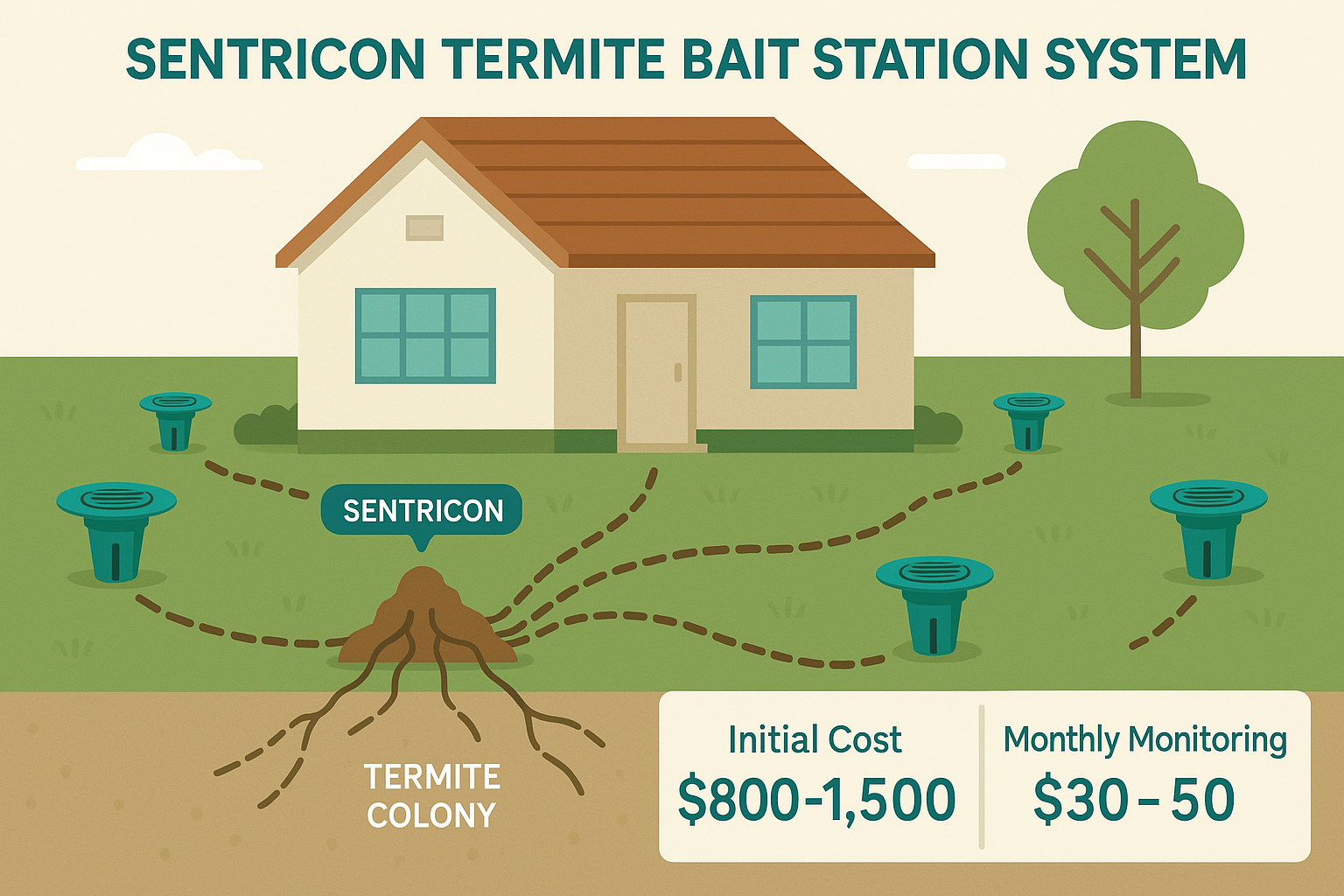
The Sentricon system is built around a series of discreet bait stations that sit flush with your landscaping. Each station houses a hollow PVC pipe, a removable lid, and a cellulose‑based bait matrix infused with a low‑dose, slow‑acting insect growth regulator (IGR). Termites are attracted to the cellulose as a food source, and the IGR interferes with their molting process, preventing the colony from producing viable workers. The design is deliberately simple: no visible chemicals, no noisy equipment, just a small, weather‑proof box that blends into a garden bed or along a foundation wall.
How we position the stations around your home
When Anthem Pest installs Sentricon, we start with a comprehensive inspection to locate active foraging paths and known entry points. Typically, a suburban home receives four to eight stations placed in a strategic perimeter—one every 15‑20 feet along the foundation, near crawl‑space vents, and close to any visible mud tubes or wood‑to‑soil contacts. Stations are also positioned near utility penetrations, such as water lines and electrical conduits, because termites often use these routes to travel unnoticed. This grid‑like layout creates a “kill zone” that forces foraging termites to encounter the bait as they search for food.
Monitoring and the road to colony collapse
After installation, our technicians visit the property monthly to inspect each station. During these checks we record the amount of bait consumed, look for fresh termite activity, and replace any depleted stations. A typical indicator of a healthy colony is steady bait consumption; a sudden drop suggests that the IGR has begun disrupting the colony’s reproductive cycle. Within three to six months of consistent monitoring, the queen’s ability to lay viable eggs is compromised, leading to a gradual decline in worker numbers and, ultimately, colony collapse. Homeowners receive a concise report after each visit, so they can see the progress in real time.
Cost breakdown
| Item | Cost Range | Frequency |
|---|---|---|
| Initial bait station setup (4‑8 stations) | $800 – $1,500 | One‑time |
| Monthly monitoring & bait replenishment | $30 – $50 per visit | Monthly |
Long‑term benefits for homeowners
Beyond the upfront expense, Sentricon delivers several lasting advantages. Because the system relies on a low‑dose IGR rather than broad‑spectrum sprays, chemical exposure to your family, pets, and beneficial insects is dramatically reduced. Once the colony is eradicated, the stations continue to act as a preventive barrier, catching any new foragers before they can establish a foothold. This ongoing protection translates to lower retreatment rates—studies show homes with Sentricon experience up to 70 % fewer repeat termite services compared to conventional liquid termiticides. In short, the system offers a safer, more sustainable, and cost‑effective path to a termite‑free home.
Comparing Costs, Coverage, and Seasonal Factors
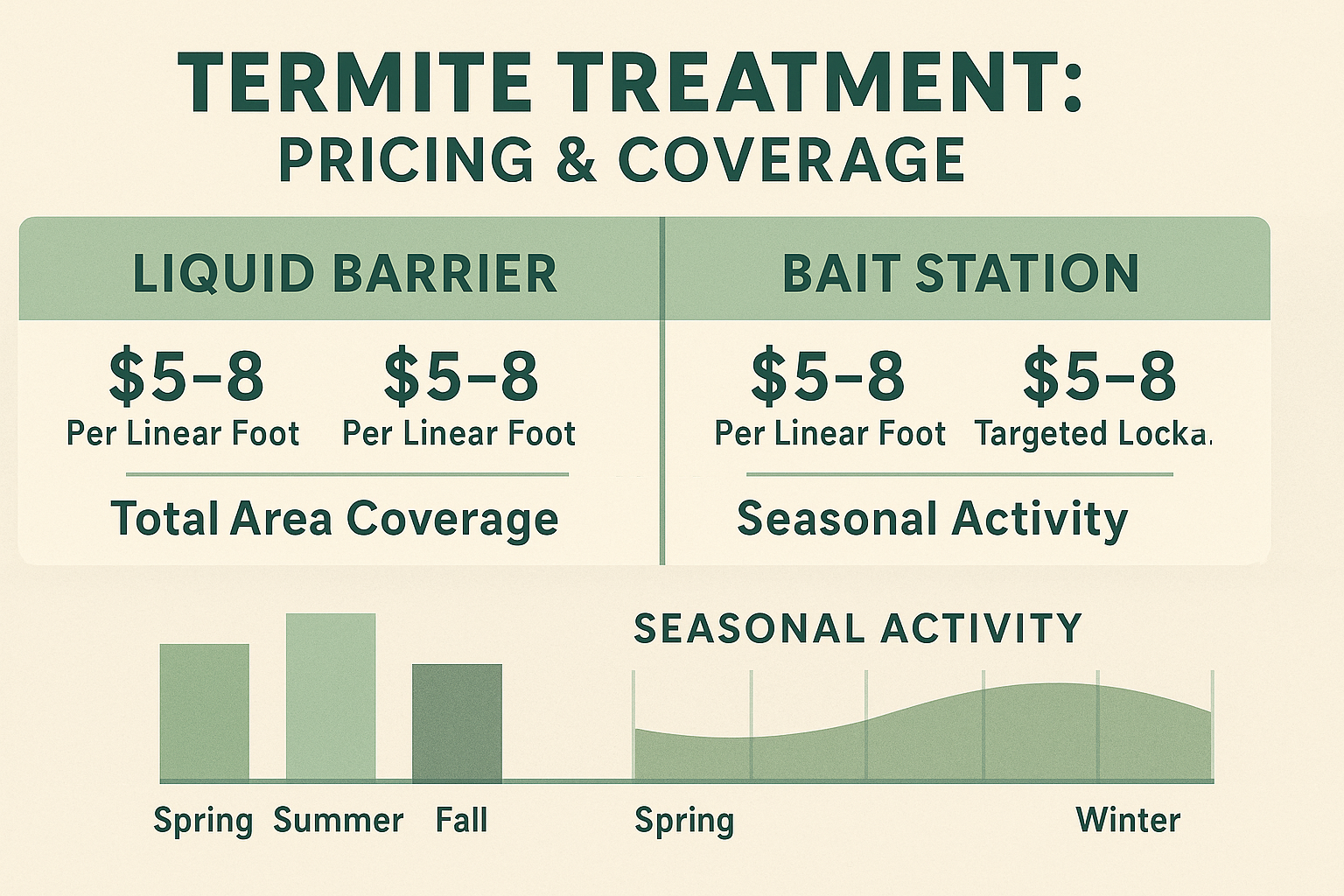
Pricing & Coverage Overview
| Method | Pricing Model | Typical Coverage |
|---|---|---|
| Liquid Barrier (Termiticides) | $5 – $8 per linear foot | Applied around foundation walls; coverage depends on perimeter length (≈ 120 ft for a 2,000 sq ft home) |
| Bait Station System | Flat fee per station (usually $120 – $180 per station) | Each station protects roughly 300–400 sq ft; a typical 2,000 sq ft home needs 5–7 stations |
Estimated Project Cost for a 2,000‑sq‑ft Home
When you combine material costs with professional labor, the total out‑of‑pocket expense for a standard 2,000‑sq‑ft residence looks like this:
- Liquid Barrier: 120 ft × $6.50 (average) = $780 for product + $350 – $500 labor = $1,130 – $1,280.
- Bait Station System: 6 stations × $150 (average) = $900 for stations + $300 – $450 labor = $1,200 – $1,350.
Both approaches fall within a comparable price band, but the choice often hinges on homeowner preference for ongoing monitoring (bait) versus a one‑time barrier (liquid).
Seasonal Activity & Timing
| Season | Foraging Activity | Why Timing Matters |
|---|---|---|
| Spring (Mar – May) | High – colonies expand and search for food | Ideal for bait placement; termites readily discover stations. |
| Summer (Jun – Aug) | Peak – warm, moist conditions accelerate feeding | Best window for liquid barriers; soil moisture improves penetration. |
| Fall (Sep – Nov) | Moderate – activity tapers as colonies prepare for winter | Maintenance checks for bait stations; barrier re‑application if soil dries. |
| Winter (Dec – Feb) | Low – termites remain deep in the wood, foraging slows | Limited effectiveness for new bait stations; barrier work may be delayed until soil thaws. |
Optimal Treatment Windows by Climate
In Suwanee’s humid subtropical climate, spring and early summer provide the most reliable foraging activity, making it the prime period for both bait deployment and liquid barrier installation. Homeowners in cooler northern zones should aim for late spring, when soil temperatures consistently exceed 65 °F, to ensure the termiticide penetrates fully. Conversely, in hot‑dry regions, early fall offers a sweet spot—soil is still warm enough for barrier absorption, but moisture levels have risen enough to prevent rapid drying.
Regardless of the method you choose, Anthem Pest Control prides itself on transparent pricing and flexible scheduling. Our technicians will assess your home’s specific layout, recommend the most cost‑effective solution, and time the treatment to match the seasonal activity of subterranean termites in your area.
Protect Your Home Today with Anthem Pest Control
Early detection and the right treatment are the two pillars that keep termites from turning a solid foundation into a costly nightmare. Spotting subtle signs—like mud tubes, hollow‑sounding wood, or tiny wings near windows—allows you to act before a colony spreads. Choosing a proven treatment, whether it’s a liquid barrier, bait system, or a targeted foam, ensures the infestation is eliminated and future invasions are blocked.
That’s where Anthem Pest Control steps in. Our technicians are certified, undergo continuous training, and know the local termite species that thrive in Suwanee’s climate. We prioritize safety, using EPA‑approved products that protect your family, pets, and the environment while delivering aggressive results. Transparency is built into every job: you’ll receive a detailed inspection report, a clear explanation of the recommended method, and an upfront price list so there are no surprise fees.
We invite you to take the next simple step—a free, no‑obligation inspection. During the visit, our expert will walk you through any findings, discuss the most effective treatment for your property, and answer every question you have. Because we understand that a home is more than a structure, we treat each inspection as a partnership aimed at preserving the comfort and value you’ve worked hard to build.
Ready to safeguard your home from costly termite damage? Call Anthem Pest Control today at 877‑371‑8196 for a free, no‑obligation quote. Our certified technicians will assess your property, recommend the best treatment option, and explain all costs up front.
For additional details, visit Anthem Pest Control. Whether you need a quick check‑up or a comprehensive eradication plan, we’re here to help you protect what matters most.
Our commitment doesn’t end after the first treatment. We offer annual monitoring, seasonal termite barrier refreshes, and a satisfaction guarantee that gives you peace of mind year after year. When you choose Anthem, you gain a trusted partner who stays ahead of termite activity so you never have to worry about hidden damage again.