What Are Carpet Beetles and Why They Matter
Family and Common Species
Carpet beetles belong to the Dermestidae family, a group of small, oval‑shaped insects that thrive in human‑occupied spaces. In U.S. homes you’ll most often encounter three species: the Varied Carpet Beetle (Anthrenus verbasci), the Black Carpet Beetle (Attagenus unicolor), and the Furniture Carpet Beetle (Anthrenus flavipes). Though adults are harmless to people, their presence signals a potential hidden problem for your belongings.
Life Cycle Overview
Understanding the beetle’s four‑stage life cycle helps you spot trouble early. An adult female lays dozens of tiny, white eggs in cracks, crevices, or directly on natural‑fiber items. Within a week the eggs hatch into larvae—often called “woolly bears”—which can remain active for several months, depending on temperature and food availability. The larva then pupates, forming a protective cocoon before emerging as an adult beetle ready to reproduce. Each stage interacts with household items differently: eggs are inert, larvae are the feeding stage, pupae are hidden and non‑destructive, and adults mainly wander in search of mates and new oviposition sites.
Why the Larvae Cause the Most Damage
The real threat lies in the larval phase. These voracious eaters chew on any protein‑rich, keratin‑based material—think wool, silk, cotton, hair, feathers, and even certain synthetic blends. As they gnaw, they leave behind irregular holes, a fine powdery frass, and a distinct, musty odor. Because the larvae work silently inside carpets, upholstery, and stored clothing, damage can accumulate unnoticed for months, turning a small infestation into a costly repair job.
Where They Hide Indoors
Carpet beetles favor dark, undisturbed locations where their larvae can feed safely. Typical indoor habitats include:
- Wall‑to‑wall carpets and area rugs
- Upholstered furniture and cushions
- Closets holding stored clothing, blankets, or drapes
- Insulation and attic spaces where dust and lint collect
- Pet bedding and even dryer lint traps
These environments provide both shelter and a steady food source, allowing the larvae to grow and multiply.
The Economic Impact
While a single beetle may seem insignificant, the collective damage adds up quickly. According to Anthem Pest Control, homeowners across the United States incur **over $200 million** in annual losses from carpet beetle damage alone. This figure underscores why early detection and professional treatment are essential to protect your investment and keep your home looking its best.
Spotting a Carpet Beetle Infestation Early
Carpet beetles are tiny, but they can cause big damage if they’re allowed to multiply unchecked. The good news is that the first signs appear long before you notice shredded wool sweaters or chewed upholstery. By learning to recognize these early clues, you can intervene quickly and keep your home’s fabrics safe—without waiting for a professional call‑out.
Visual signs
When carpet beetles are in the larval stage, they shed their skins as they grow. Look for tiny, pepper‑like specks along carpet edges, under baseboards, or in the folds of rugs. You may also find small, dark fecal pellets that resemble grains of sand. These particles often collect in a line, creating a “peppery” dust pattern that is a hallmark of an active infestation.
Damage clues
Larvae feed on natural fibers, so the damage is subtle at first. Check wool blankets, silk curtains, and upholstered chairs for irregular holes or areas where the fabric looks thinner than the surrounding material. The edges may appear chewed, with frayed fibers that look as if a tiny insect has been nibbling away. If you spot a patch that feels rough or has a fuzzy residue, you’re likely looking at a feeding site.
Behavioral clues
Adult carpet beetles are attracted to light. After dusk, they often gather near windows, lamps, or any illuminated doorway. Turn off the lights in a room and use a flashlight to sweep the ceiling and walls; you may see a few beetles fluttering toward the beam. Spotting these flying insects at night is a reliable indicator that a breeding population exists nearby.

DIY inspection checklist
Grab a notebook and work through your home room by room. Use the following checklist to stay systematic and avoid missing hidden hotspots.
- Living areas: Examine carpet seams, under sofa cushions, and behind baseboards for shed skins or dust.
- Bedrooms: Pull back mattress covers, inspect closet rods, and check wool blankets or sweaters stored in drawers.
- Hallways and closets: Look inside stored luggage, seasonal clothing boxes, and the backs of coat racks.
- Attic & crawl spaces: Scan insulation, stored quilts, and any fabric‑covered boxes for larvae.
- Kitchen & pantry: Though less common, beetles can wander into stored food packaging; give cardboard boxes a quick glance.
For each area, run your fingers along seams and folds; a slight gritty texture often means larvae have been tunneling. If you find any of the visual or damage clues, note the exact location—this information will help a professional target treatment later.
Using your vacuum to confirm presence
A high‑suction vacuum is both a detection tool and a first‑line control method. Slowly vacuum the suspect spots, then immediately inspect the bag or canister. You’re looking for:
- Live or dead larvae—usually white to cream‑colored, slightly curved bodies.
- Shedded skins that appear as translucent, parchment‑like shells.
- Clusters of dark fecal pellets mixed with carpet fibers.
If you spot any of these, seal the vacuum bag in a plastic bag before disposing of it. This prevents the insects from escaping back into the home. Remember to repeat the vacuum sweep after a few days; a second pass often captures larvae that were hidden during the first inspection.
By staying vigilant and following this simple, room‑by‑room routine, you can catch a carpet beetle problem before it escalates into costly fabric damage. Early detection gives you the upper hand, whether you choose a DIY approach or call Anthem Pest Control for a professional, fast‑acting treatment.
Treatment Options and How Cost Is Calculated
Professional Services: What’s Included?
When you call Anthem Pest Control, our technicians start with a thorough inspection to gauge the beetle population and pinpoint hotspots. From there, we offer three core professional solutions:
- Targeted Spray – A precise application of EPA‑approved insecticide directly onto infested areas such as baseboards, closets, and under furniture. The spray creates a residual barrier that kills beetles on contact and keeps newcomers at bay for weeks.
- Heat Treatment – We raise the temperature of the entire home (or specific rooms) to 130‑140°F for several hours. Beetle larvae, eggs, and adults cannot survive the heat, and the process reaches places that sprays miss, like fabric seams and wall voids.
- Whole‑Home Fogging – A fine mist of fast‑acting pesticide is released into the HVAC system, allowing the chemical to circulate through ducts, vents, and hidden crevices. Fogging is especially useful for large homes or when the infestation has spread to multiple floors.
DIY Alternatives: When You Might Go It Alone
For homeowners on a tighter budget or those who prefer a hands‑on approach, there are effective do‑it‑yourself options:
- Enzyme Cleaners – These break down organic debris (wool, feathers, dead insects) that beetles feed on. Regularly cleaning carpets, upholstery, and stored fabrics with an enzyme solution reduces food sources and discourages new activity.
- Heat‑Treating Items – Small infested objects such as blankets, sweaters, or stuffed toys can be placed in a dryer on high heat for 30‑45 minutes. The heat kills all life stages without the need for chemicals.
- Over‑the‑Counter Sprays – Consumer‑grade aerosol sprays containing pyrethrins or permethrin can be applied to cracks, baseboards, and storage areas. While convenient, they often lack the residual power of professional formulations and may require repeated applications.
Factors That Influence the Price Tag
Understanding why a quote varies helps you make an informed decision. The main cost drivers are:
- Severity of Infestation – A light, localized problem may need a single targeted spray, while a heavy, multi‑room outbreak could require heat treatment plus fogging.
- Square Footage – Larger homes demand more product, longer labor hours, and possibly multiple treatment passes.
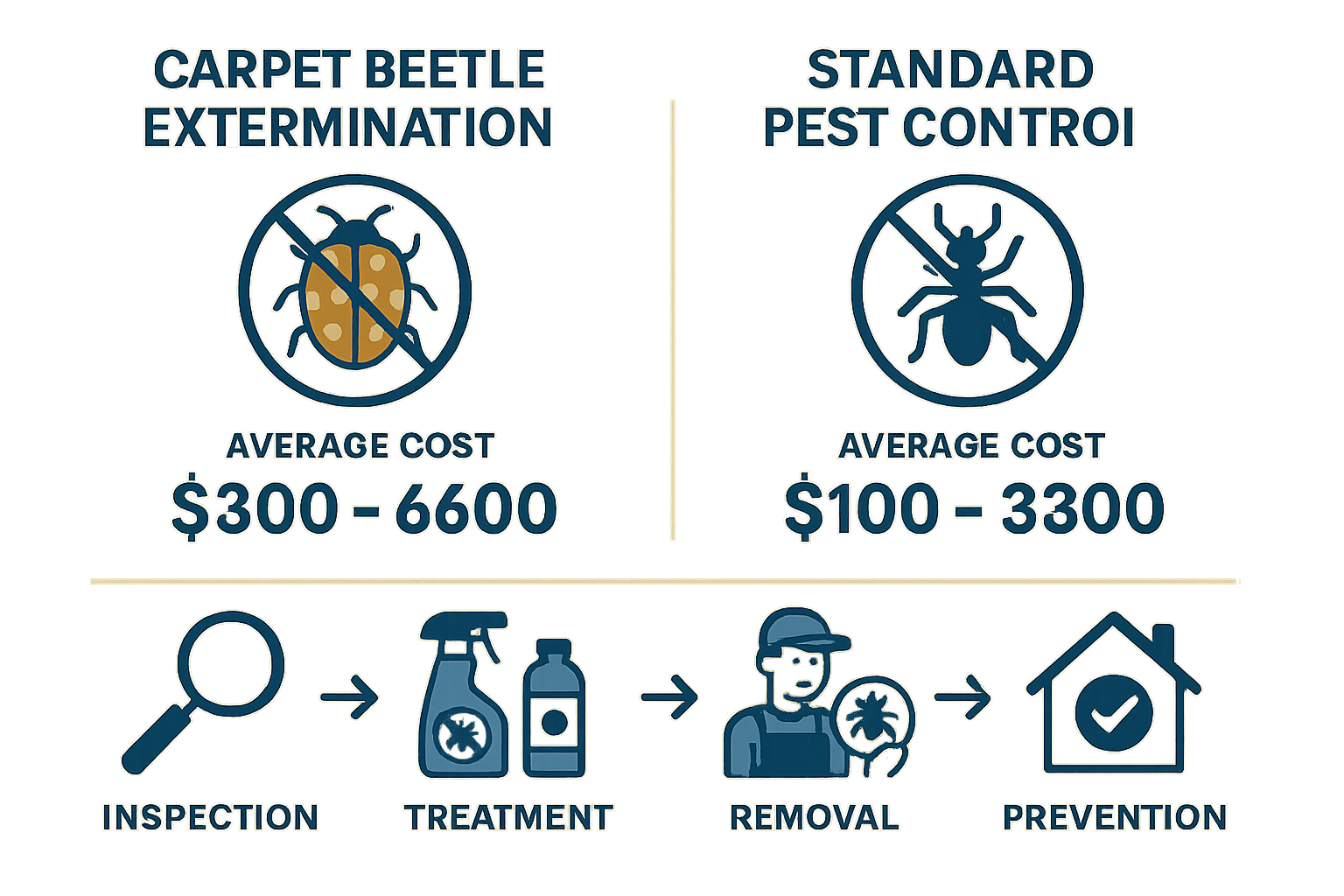
- Type of Treatment – Heat and fogging are equipment‑intensive and thus priced higher than a simple spray.
- Follow‑Up Visits – Some cases need a second inspection or retreat to ensure complete eradication, especially if the beetles have nested in hard‑to‑reach spaces.
Typical Price Ranges for a Single‑Family Home
| Service Level | Low Estimate | Mid Estimate | High Estimate |
|---|---|---|---|
| Targeted Spray (single visit) | $180 | $250 | $320 |
| Heat Treatment (whole‑home) | $550 | $720 | $950 |
| Whole‑Home Fogging + Follow‑Up | $400 | $580 | $760 |
Fast‑Track Extermination vs. Standard Packages
Our “Fast‑Track Beetle Treatment” is designed for homeowners who need rapid relief. It combines a high‑intensity heat cycle with a targeted spray, completing the job in a single day. Compared with a standard quarterly pest‑control plan, fast‑track offers:
- Immediate knock‑down of adult beetles and larvae.
- Fewer total visits, saving time and travel costs.
- Reduced risk of secondary damage to fabrics and stored goods.
- Transparent, upfront pricing—no hidden fees for extra follow‑ups.
Standard packages spread treatment over several months and often rely on lower‑intensity sprays. While they work for ongoing prevention, they may not eradicate a heavy infestation quickly enough to protect prized clothing or heirloom items.
When Are Carpet Beetles Most Active?
Carpet beetles aren’t year‑round trouble‑makers; they follow a predictable seasonal rhythm that aligns with temperature, humidity, and daylight. Understanding that rhythm lets you schedule inspections before the insects become a visible nuisance, and it gives you a clear window for the most effective treatment.
Peak Activity Months – Late Spring Through Early Fall
In most of Georgia, adult carpet beetles emerge in late April and stay busy until early October. The sweet spot is typically May through September, when daily highs hover between 70°F and 85°F (21°C – 29°C). Those temperatures accelerate the beetles’ metabolism, prompting adults to mate, lay eggs, and the larvae to feed voraciously on natural fibers.
Regional Variations – Warm vs. Cool Zones
- Warmer micro‑climates (e.g., low‑lying neighborhoods or homes with strong sun exposure) can see the first adult flights as early as late March. In those spots, the activity curve shifts forward by three to four weeks.
- Cooler areas—higher elevations or homes with heavy shading—often delay the peak until mid‑June. The beetles wait for consistent warmth before committing to reproduction.
These regional quirks matter because a treatment that’s perfectly timed for a downtown Peachtree City home might be too early for a suburban property tucked in the foothills.
Using the Seasonal Activity Chart to Plan Inspections
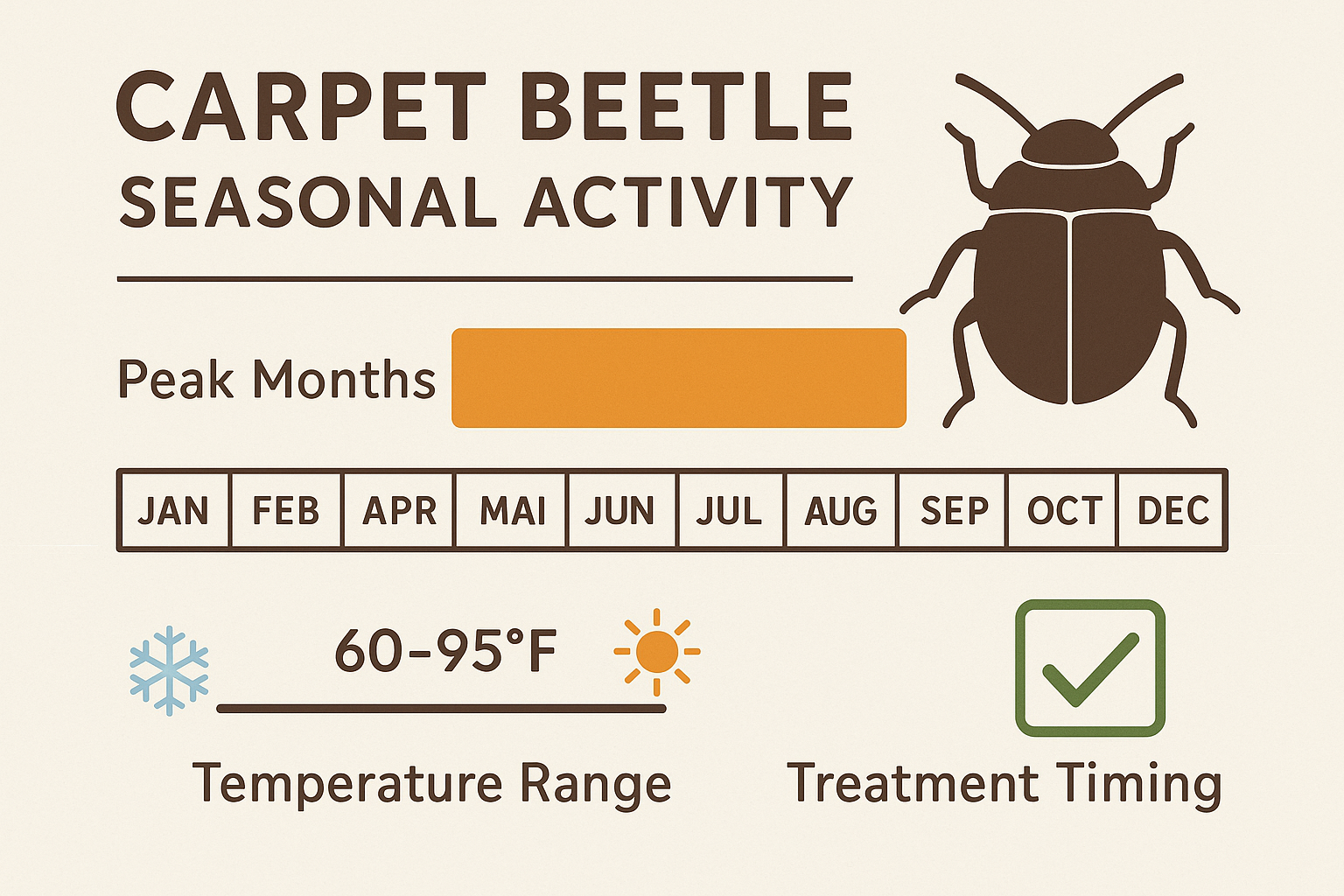
The chart above maps adult flight periods, egg‑laying windows, and larval growth phases across the calendar year. Here’s how to translate it into action:
- Early‑season check (late March–early April): Look for adult beetles near windows, light fixtures, and outdoor vents.
- Mid‑season sweep (May–June): Focus on hidden larval hotspots—underneath carpets, in attic insulation, and inside stored clothing.
- Late‑season review (August–September): Confirm that any residual larvae are eliminated before cooler weather slows their development.
Recommended Treatment Windows – Pre‑emptive vs. Reactive
Pre‑emptive approach: Schedule a professional inspection and, if needed, a preventive spray in early May. This timing hits the first wave of adults before they can lay a full complement of eggs, dramatically reducing the subsequent larval population.
Reactive approach: If you spot beetles or notice damage in July or August, act quickly. A targeted treatment during the mid‑season window can still knock down the current generation, but you’ll likely need a follow‑up in September to catch any late‑emerging larvae.
Homeowner Tips – Monitoring Humidity and Light
- Humidity matters: Carpet beetle larvae thrive in relative humidity above 55 %. Use a hygrometer in basements and closets; dehumidifiers can keep moisture levels below the beetles’ comfort zone.
- Light exposure: Adults are attracted to bright indoor lights, especially near windows and skylights. Swap incandescent bulbs for yellow‑tinted LED fixtures, or install motion‑sensor lights that stay off when rooms are empty.
- Regular housekeeping: Vacuum carpets, rugs, and upholstery weekly, paying extra attention to seams and edges where larvae hide. Empty the vacuum canister outside to prevent re‑infestation.
- Storage smartly: Keep seasonal clothing in sealed plastic containers rather than cardboard boxes. The airtight barrier blocks both adult entry and larval feeding.
By aligning your inspections with the beetles’ seasonal peaks, adjusting for local climate quirks, and maintaining low humidity and reduced indoor lighting, you create an environment that’s hostile to carpet beetles. The result? Fewer insects, less damage, and a home that stays comfortable year after year.
Prevention Strategies to Keep Carpet Beetles at Bay
1. Adopt a Consistent Cleaning Routine
Carpet beetle larvae thrive in dust, lint, and shed fibers, so a slow‑moving vacuum is your first line of defense. Run the vacuum over carpets, area rugs, and upholstery at least twice a week, pausing on high‑traffic spots to allow the brush roll to lift hidden particles. Empty the canister or bag outdoors after each session to prevent re‑infestation.
2. Store Seasonal Items in Airtight Containers
Wool blankets, sweaters, and stored linens are prime beetle targets. Transfer them into plastic bins with snap‑tight lids or heavy‑duty vacuum‑seal bags. Adding natural repellents—cedar blocks or lavender sachets—inside the containers creates an unfriendly environment for adult beetles seeking a place to lay eggs.
3. Declutter and Remove Unnecessary Fabrics
Every extra cushion, decorative pillow, or forgotten fabric pile is a potential beetle hideout. Conduct a quarterly sweep of closets, attics, and basements, discarding or donating items you no longer use. The fewer fabric reservoirs you have, the fewer places larvae can hide and develop.
4. Seal Your Home Against Adult Entry
Adult carpet beetles can slip through the tiniest cracks around windows, doors, and utility openings. Inspect the exterior for gaps, repair cracked siding, and install door sweeps on all exterior doors. Fit tight‑weave window screens and use weather‑stripping around frames to block ingress, especially during the warmer months when beetles are most active.
5. Schedule Professional Preventative Service
Even the most diligent homeowner can miss a hidden infestation. Anthem Pest Control offers an annual inspection that pinpoints vulnerable zones and applies a low‑toxicity barrier treatment around baseboards, entry points, and storage areas. This proactive approach not only reduces current beetle populations but also deters future invasions, giving you peace of mind year‑round.
Quick‑Check Checklist
- Vacuum carpets and upholstery weekly with a slow‑speed setting.
- Place all seasonal clothing in sealed containers; add cedar or lavender.
- Remove or donate unused fabric items every three months.
- Repair exterior cracks, install door sweeps, and fit window screens.
- Book an annual inspection with Anthem Pest Control for barrier treatment.
Take the Next Step with Anthem Pest Control
When carpet beetles slip past the first warning signs, they can quickly turn a tidy home into a storage nightmare. That’s why catching an infestation early, treating it promptly, and maintaining a regular prevention plan are non‑negotiable steps for protecting your carpets, upholstery, and cherished belongings.
Anthem Pest Control brings more than a toolbox to the job. Our technicians are trained specifically in carpet beetle biology, so they know exactly where larvae hide and which treatment products work fastest without harming your family or pets. Because we price everything up front, you’ll never face surprise fees, and our nationwide network means the same reliable service is available whether you live in Peachtree City or any other U.S. community. Our service contracts also include annual follow‑ups, so you never have to wonder if the beetles have returned.
Ready to put those safeguards in place? We’ll send a certified specialist to your door for a free, no‑obligation inspection, walk you through the findings, and provide a clear, written quote before any work begins. That way you can decide with confidence and schedule treatment at the moment the beetles are most vulnerable.
Give us a call today at 877‑371‑8196 or visit Anthem Pest Control to request your free quote. Our friendly team is standing by to answer questions, set up the inspection, and get your home back to a beetle‑free zone.
We look forward to helping you protect what matters most—so feel free to reach out, learn more about our approach, and take the first step toward a cleaner, safer home.