Why Rats Are a Growing Concern in Suwanee, GA

Suwanee’s blend of humid subtropical climate and rapidly expanding neighborhoods creates a perfect buffet for two of the most common rodent invaders in Georgia: Norway (brown) rats and roof rats—one of the main reasons homeowners often search for a rat exterminator Suwanee GA residents can rely on. Warm summers, mild winters, and abundant vegetation give these pests year-round access to food, water, and shelter. At the same time, new subdivisions, cul-de-sacs, and well-maintained lawns provide countless entry points—cracks in foundations, gaps around utility lines, and overgrown landscaping—that let rats slip into homes as easily as a neighbor’s dog wanders onto a front porch.
Spotting the Signs of an Infestation
Homeowners often discover a rat problem only after the damage is done. Knowing the early warning signs can save you time, money, and stress:
- Droppings: Small, dark, rice‑shaped pellets appear along walls, in cabinets, or under appliances.
- Gnaw marks: Fresh, clean cuts on wood, plastic, or metal—especially near entry points.
- Gnaw‑scent: A strong, oily odor that intensifies at night when rats are most active.
- Burrows: Fresh soil mounds in gardens, under decks, or along fence lines indicate outdoor nesting.
- Noisy activity: Scratching, scurrying, or squeaking sounds in walls, attics, or crawl spaces, typically after dusk.
Health Hazards Backed by EPA and CDC
Rats are more than a nuisance; they are vectors for serious diseases. The EPA and the CDC list several pathogens that can be transmitted through droppings, urine, or bites:
- Hantavirus: Inhalation of aerosolized droppings can cause severe respiratory illness.
- Leptospirosis: Contact with contaminated water or soil may lead to kidney failure if untreated.
- Salmonella: Food contamination from rat feces can trigger food‑borne outbreaks.
- Allergic reactions: Proteins in rat urine and dander often trigger asthma attacks and skin irritation.
Property Damage You Can’t Afford to Ignore
Rats chew indiscriminately, and the damage quickly escalates from unsightly to hazardous:
- Wiring chews: Severed electrical cables increase the risk of short circuits and house fires.
- Insulation loss: Gnawed insulation reduces energy efficiency and can expose ducts to moisture.
- Structural weakening: Repeated gnawing on wooden studs, joists, or drywall compromises the integrity of walls and roofs.
Economic Impact on Homeowners
Beyond the direct repair costs—often ranging from a few hundred to several thousand dollars—rat infestations can inflate homeowners’ insurance premiums. Many policies either exclude rodent damage or require a deductible that can strain a family’s budget. In extreme cases, unchecked infestations may lower property resale value, as prospective buyers factor in the cost of remediation.
Seasonal Activity Patterns: When to Inspect
Understanding rat behavior helps you time inspections for maximum effectiveness. Norway rats tend to be most active in late summer and early fall when food stores are abundant, while roof rats peak in spring as they seek nesting sites in trees and roof voids. Conduct a thorough visual inspection at the start of each season—especially after heavy rains, which push rats indoors seeking shelter.
By recognizing Suwanee’s environmental draw, the unmistakable signs of an infestation, and the serious health and financial stakes, homeowners can act early. The next step is to pair this awareness with a proactive inspection schedule, setting the stage for targeted treatment and long‑term prevention.
Seasonal Rat Activity in Suwanee – When to Watch Closely
Rats are opportunistic survivors, and their behavior in Suwanee follows a predictable rhythm driven by three main forces: temperature, food availability, and breeding cycles—patterns that often signal when to call a rat exterminator Suwanee GA homeowners trust. When the mercury climbs above 50°F (10°C), rats emerge from their nests to forage, mate, and expand colonies. Warm months accelerate breeding—female rats can produce a new litter every three weeks, swelling populations rapidly. Conversely, colder periods force them deeper into insulated walls, attics, and crawl spaces, where activity drops but the risk of hidden infestations remains.
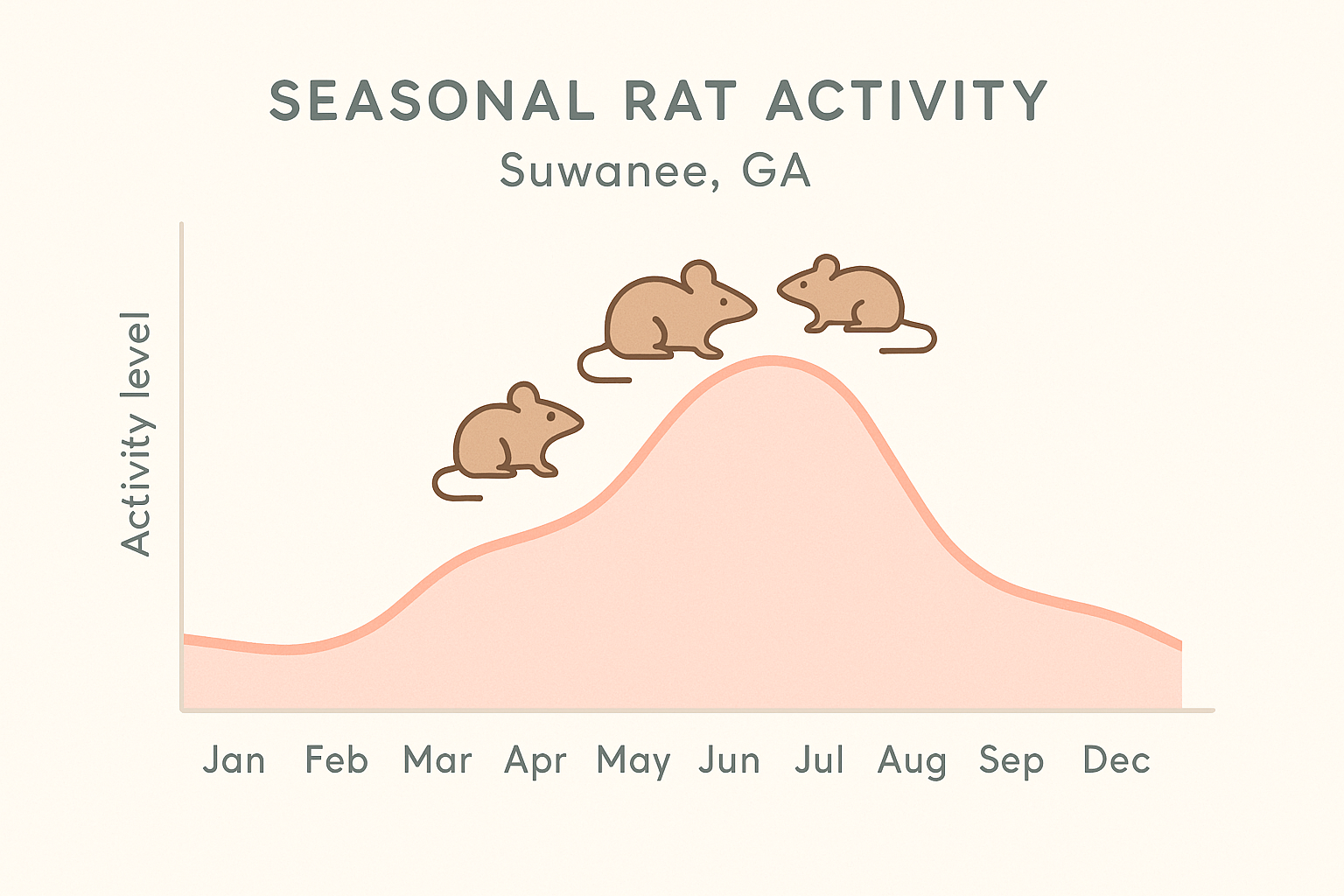
Reading the Seasonal Activity Chart
The chart above breaks Suwanee’s rat activity into four zones:
| Month | Activity Level | Key Drivers |
|---|---|---|
| January – February | Low | Cold weather, limited outdoor food sources |
| March – May | Rising | Warmer temps, early breeding, spring clean‑ups create food scraps |
| June – August | High | Peak breeding, abundant outdoor waste, garden produce |
| September – October | Elevated | Harvest festivals, school‑year end, rats stockpile before winter |
| November – December | Moderate‑Low | Cooling temperatures, reduced outdoor activity |
Notice the two distinct spikes: early spring (March‑May) and late summer into early fall (June‑October). These are the windows when new generations are emerging and food waste from community events is at its highest.
Local Events That Amplify the Risk
- Harvest festivals (late September to early October): Food stalls, open‑air grills, and overflowing trash cans leave a buffet for foraging rats.
- School breaks (spring break, summer vacation): Families often host backyard barbecues, increasing outdoor crumbs and compost activity.
- Community yard sales (May‑June): Unattended cardboard boxes and discarded food attract nesting rodents.
When these events coincide with the natural breeding surge, rat populations can double in just a few weeks. Homeowners who notice increased sightings after a festival should assume the infestation has already taken root and act quickly.
Practical Timing for Professional Inspections
Based on the seasonal pattern, the most effective strategy is to schedule a professional inspection with a rat exterminator Suwanee GA homeowners trust during the two high-risk windows:
- Early spring (mid‑March to early April): A pre‑emptive check catches rats before they breed in large numbers, allowing treatment before they spread.
- Late fall (late October to early November): A post‑harvest inspection removes any survivors that have hoarded food for winter, preventing a hidden resurgence in the new year.
During these visits, Anthem Pest Control will assess entry points, set up monitoring stations, and recommend targeted baiting or exclusion methods. Early detection not only saves money but also reduces the chance of structural damage and disease exposure.
For a deeper dive into seasonal monitoring best practices, consult the National Pest Management Association’s guidance on rodent control: NPMA – Rodent Control. Following their recommendations alongside local expertise ensures you stay one step ahead of Suwanee’s most persistent house guests.
How to Inspect Your Home for Hidden Rats

Identify Common Entry Points
Rats are opportunistic climbers and squeezers; even a gap the size of a pencil can become a doorway. Walk the perimeter of your home, paying special attention to:
- Foundation cracks and gaps around basement walls.
- Utility openings for water, gas, and electrical lines.
- Vent covers, especially in the attic and crawl spaces.
- Door sweeps that are worn, torn, or missing.
Seal each opening with steel wool, caulk, or metal flashing before the next inspection, because a single unsealed crack can undo weeks of preventive work.
Kitchen Deep‑Dive Inspection
The kitchen is a rat’s favorite buffet, so a thorough sweep is non‑negotiable. Follow this checklist room‑by‑room:
- Under appliances: Pull the refrigerator, stove, and dishwasher away from the wall. Look for dark droppings, gnaw marks on wiring, or shredded packaging.
- Pantry shelves: Remove boxes and examine the back of each shelf. Rats leave behind greasy smears and tiny urine stains that glow under a flashlight.
- Behind cabinets: Open cabinet doors and shine a light into the void. Check the inner backs and the floor for fresh droppings or shredded paper.
- Sink and garbage area: Inspect the underside of the sink cabinet and the base of the trash compactor for chew marks on plastic or metal.
If you spot any of these signs, note the exact location; it will help a professional target treatment zones more efficiently.
Tools to Reveal Hidden Spots
Most rat activity occurs in shadowed corners where the naked eye fails. Equip yourself with:
- Flashlight: A high‑lumens LED beam penetrates tight spaces and makes droppings appear white.
- Inspection mirror: A small, angled mirror lets you see behind appliances without moving heavy equipment.
- Motion‑activated camera: Place a battery‑powered camera in suspected pathways for a 24‑hour watch. Review footage at dawn when rats are most active.
These low‑cost tools dramatically increase detection accuracy and give you concrete evidence to share with a pest‑control technician.
Spot the Difference: Rat vs. Other Pests
Not every droplet is a rat’s doing. Here’s how to tell them apart:
| Characteristic | Rats | Other Pests (e.g., mice, insects) |
|---|---|---|
| Dropping size | 1‑½ to 2 inches, dark, rice‑shaped | Smaller (mouse) or irregular (insect frass) |
| Gnaw marks | U‑shaped, clean cuts on wood, plastic, or wiring | Irregular nibble marks, often on softer materials |
| Tail marks | Fresh, reddish‑brown smears where a tail brushed a surface | Absent or very faint |
| Noises | Scratching or scurrying in walls, especially at night | Higher‑pitched squeaks (mice) or buzzing (insects) |
DIY Prevention Measures
Once you’ve identified entry points and hot spots, lock the door on future invasions with these simple steps:
- Seal gaps: Use stainless‑steel mesh or hardware cloth for larger openings; caulk for cracks under ¼ inch.
- Store food properly: Keep pantry items in airtight containers; never leave pet food out overnight.
- Manage trash: Use bins with tight‑fitting lids and empty them daily; clean residue from the interior.
- Trim landscaping: Keep shrubs, tree branches, and vines at least 2 feet away from the home’s exterior to eliminate climbing pathways.
Consistent housekeeping combined with these barriers creates an environment that’s far less inviting to rats.
When It’s Time to Call a Professional
Even the most diligent DIY effort can miss hidden burrows or structural damage. Contact a licensed exterminator if you encounter any of the following:
- Extensive gnaw networks within walls or insulation.
- Multiple sightings across different rooms in a short period.
- Visible damage to structural elements such as beams, joists, or electrical wiring.
- Persistent odor or droppings despite thorough cleaning.
Anthem Pest Control offers a rapid response inspection, safe bait placement, and a guaranteed follow‑up plan to protect your Suwanee home for the long term. When in doubt, a professional assessment is the fastest route to peace of mind.
Rat Extermination Options and Pricing Tiers in Suwanee
Common Treatment Modalities
Homeowners in Suwanee have four primary ways to tackle a rat problem. Each method targets the pest differently, and the right choice depends on your home’s layout, your comfort level, and how quickly you need results.
- Snap Traps: Classic mechanical devices that kill rats instantly with a spring‑loaded bar.
- Electronic Traps: Battery‑powered units that deliver a lethal shock and often record each catch.
- Bait Stations: Secure containers holding anticoagulant or non‑anticoagulant poison, designed for safe placement where children and pets can’t reach.
- Integrated Pest Management (IPM) Programs: A holistic approach that combines inspection, exclusion, sanitation, and targeted treatments to keep rodents out long‑term.
Benefits and Drawbacks of Each Method
- Snap Traps
- Pros: Immediate kill, no chemicals, low cost.
- Cons: Requires frequent checking, can be unsettling to set, limited to high‑traffic areas.
- Electronic Traps
- Pros: Quick kill, reusable, often includes a catch log for verification.
- Cons: Higher upfront price, needs battery changes, may not be ideal for large infestations.
- Bait Stations
- Pros: Effective for hidden populations, can treat multiple entry points from one location.
- Cons: Involves chemicals, requires careful placement, may take several days to see results.
- IPM Programs
- Pros: Addresses root causes, reduces future risk, environmentally friendly.
- Cons: Higher service cost, needs homeowner cooperation on sanitation and structural repairs.
Anthem Pest Control’s Three Service Tiers
Anthem Pest Control tailors its rat‑removal services into three clear tiers, so you know exactly what you’re paying for.
- Basic Tier – One‑time inspection, placement of snap or electronic traps, and a single follow‑up visit. Ideal for isolated sightings.
- Standard Tier – Includes everything in Basic plus bait‑station deployment, two additional monitoring visits, and a 30‑day guarantee against re‑infestation.
- Premium Tier – Full IPM package: comprehensive inspection, exclusion sealing, trap and bait placement, quarterly monitoring, and a 90‑day guarantee with priority re‑service.
Pricing Comparison Infographic
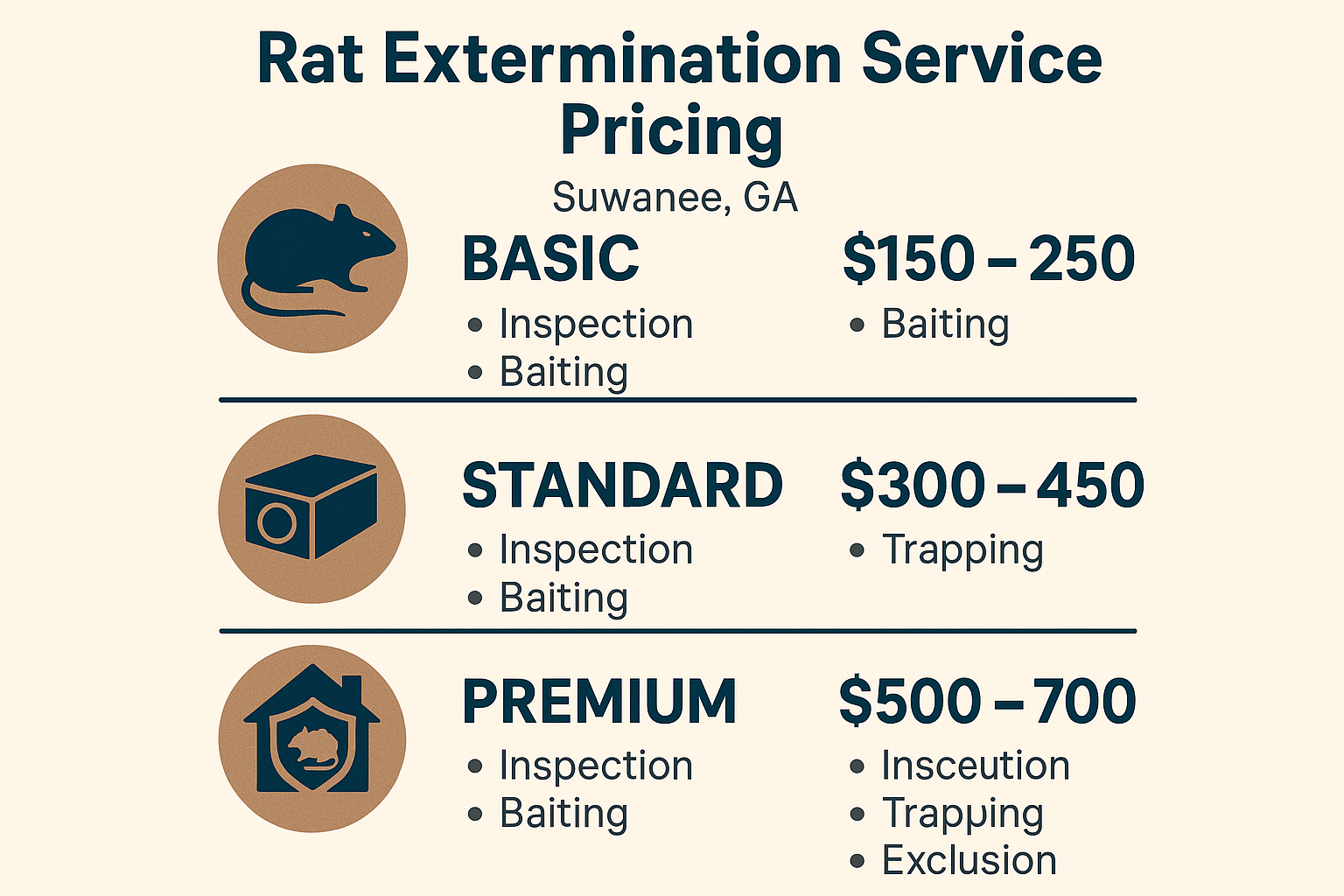
The chart above breaks down each tier’s price range, number of technician visits, ongoing monitoring, and guarantee periods. In Suwanee, the Basic tier typically runs between $99‑$149, Standard falls in the $179‑$239 bracket, and Premium is priced from $299‑$399. The visual also highlights that higher tiers deliver more visits and longer guarantees, which can translate into fewer surprise costs down the road.
Frequently Asked Questions
- Do the service tiers include warranties? Yes. Basic offers a 14‑day guarantee, Standard provides 30 days, and Premium extends protection to 90 days, covering any repeat activity detected during the guarantee period.
- How many follow‑up visits are typical? Basic includes one follow‑up, Standard adds two, and Premium schedules quarterly checks for the first year.
- What factors influence the final cost? Infestation size, total square footage, accessibility of entry points, and any required structural repairs all affect pricing.
- Can I combine methods? Absolutely. Anthem’s technicians often pair traps with bait stations and IPM tactics to maximize effectiveness, especially in larger homes.
Early Intervention Saves Money
Addressing a rat problem at the first sign—droppings, gnaw marks, or noisy attic activity—prevents the costly cascade of damage that follows. A single unchecked rat can chew through wiring, insulation, and even structural beams, leading to fire hazards and expensive repairs. By choosing the appropriate tier early, you lock in a predictable price and avoid the hidden expenses of water‑damage restoration, contaminated food replacement, and potential health‑code violations.
Protect Your Home Today with Anthem Pest Control
In Suwanee, a single rat sighting can quickly turn into a full‑blown infestation if you wait. These rodents reproduce fast, chew through insulation, wiring, and even structural wood, creating fire hazards and costly repairs. Moreover, rats carry diseases that threaten the health of your family and pets. Acting promptly not only stops damage in its tracks but also prevents the stress and expense of a large‑scale eradication later this year.
Seasonal windows, inspection steps, and treatment choices at a glance
- Spring & early summer: Rats seek shelter as temperatures rise—ideal time for a thorough exterior inspection.
- Fall: As food sources dwindle, rodents look for warm indoor havens; schedule a preventive check before the chill sets in.
- Inspection checklist: Seal gaps larger than ¼ in., trim vegetation away from the foundation, and set up snap traps or monitoring stations.
- Treatment options: Mechanical trapping, bait stations with EPA‑approved rodenticides, and exclusion techniques that block entry points.
Why Anthem Pest Control is the trusted partner for Suwanee homeowners
Anthem’s team brings more than just tools—they bring expertise. Every technician is fully licensed and trained in the latest rodent‑control protocols, ensuring you receive safe, effective solutions that meet EPA standards. Our products are vetted for indoor use, protecting children and pets while delivering rapid results. Transparent pricing means you’ll know exactly what you’re paying for, with no hidden fees, and our deep local knowledge lets us pinpoint the most common entry points in Suwanee homes. From the first inspection to the final follow‑up, Anthem stands by a guarantee of satisfaction and long‑term prevention.
Take the next step—protect your home now
Ready to put an end to rat worries? Contact a rat exterminator Suwanee GA homeowners trust at Anthem Pest Control for a free, no-obligation quote. Call us today at 877-371-8196 and let our experienced team safeguard your home with a customized, science-backed plan.