Understanding Field Crickets as Household Pests
Common Species in Druid Hills
In the Atlanta metro area, including Druid Hills, the most frequently encountered field crickets belong to the Gryllus and Acheta genera, making cricket control Druid Hills an important consideration for local homeowners. The Southern House Cricket (Gryllus texensis) and the Common Field Cricket (Gryllus assimilis) thrive in grassy lawns, garden beds, and the edges of wooded lots. Their dark brown to black exoskeletons blend easily with leaf litter, making them hard to spot until they start chirping.
Life Cycle at a Glance
Field crickets follow a simple three‑stage life cycle: egg, nymph, and adult. Females deposit 200‑400 eggs in moist soil or under leaf debris in late summer. Eggs hatch in 10‑14 days, releasing nymphs that look like miniature adults but lack fully developed wings. Nymphs molt five to seven times over 2‑3 months before reaching maturity. Once adult, crickets live 2‑4 months, with the peak of activity occurring from late spring through early fall.
Why They Slip Inside
Crickets are opportunistic explorers. As outdoor temperatures rise, they seek out cool, humid shelters—often finding both in basements, crawl spaces, and attics. Food sources such as plant material, crumbs, or pet kibble lure them further indoors. Outdoor lighting, especially sodium‑vapor or LED fixtures, creates a beacon that draws adult males searching for mates, guiding them straight to open windows and doorways.
How to Spot an Early Infestation
- Audible chirping—the characteristic trilling is most noticeable at night when the house is quiet.
- Droppings—small, black specks resembling pepper grains often appear near baseboards or pantry shelves.
- Plant damage—chewed edges on ornamental foliage or wilted seedlings in indoor containers.
- Occasional bites—while rare, a cricket may bite if handled, leaving a tiny, painless puncture.
Health Considerations
For most homeowners, field crickets are a nuisance rather than a health threat. However, their shed skins and droppings can trigger allergic reactions in sensitive individuals, especially those with asthma. The CDC notes that indoor insects may exacerbate respiratory conditions. Although crickets are not known vectors of serious disease, it’s prudent to keep infestations low to reduce allergen buildup.
Staying Within the Law
When it comes to control, choosing products that comply with federal regulations protects both your family and the environment. The U.S. Environmental Protection Agency maintains a searchable database of approved pesticide ingredients and usage guidelines. Visit the EPA pesticide regulations page for the latest information on safe, effective treatments that Anthem Pest Control can apply in your home.
Identifying Field Crickets in and Around Your Home
Field crickets are the most common chirping intruders in Druid Hills yards, and spotting them early can save you a lot of nighttime serenades. Below is a quick‑look guide that helps you tell a cricket apart from the insects that are harmless or less likely to cause a nuisance.
Physical Characteristics
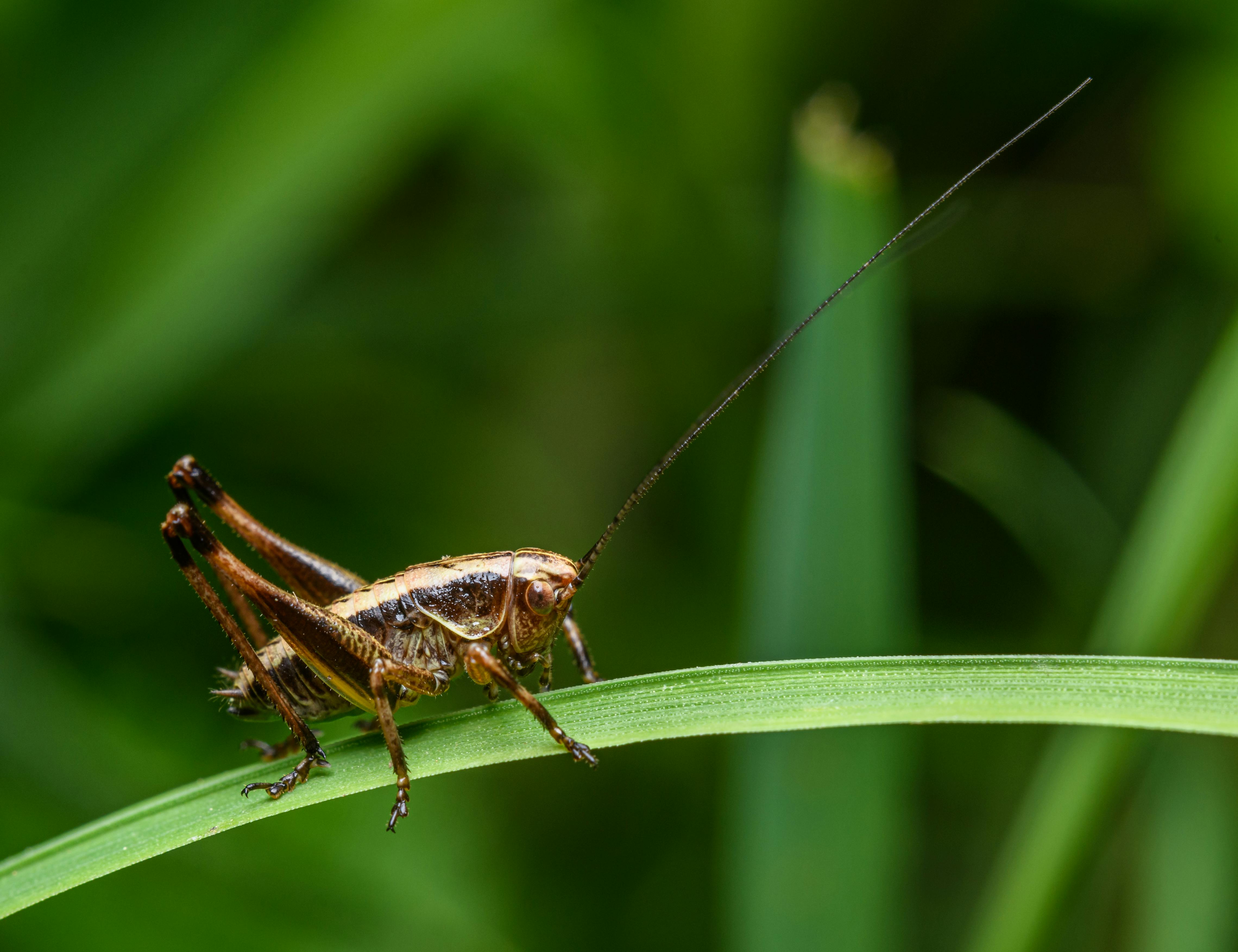
- Size: Adults measure roughly ½ – 1 inch (12‑25 mm) long.
- Coloration: Light brown to dark gray, often with subtle mottling that blends with grass and mulch.
- Antennae: Long, filamentous, and typically longer than the body.
- Hind legs: Stout, muscular, and built for powerful jumps; the femur is noticeably thicker than that of grasshoppers.
Typical Habitats
Field crickets love moist, sheltered spots. You’ll most often find them:
- In well‑kept lawns and garden beds where grass is short.
- Amid mulch, leaf litter, or under garden stones.
- Inside foundation cracks, especially after a rainy spell.
- Near outdoor lighting fixtures – the light attracts insects they feed on, and the crickets follow.
Day vs. Night Spotting
During daylight, crickets hide under debris or in soil, making them hard to see. Look for movement in the grass or a faint silhouette near a porch light after dusk. At night, their characteristic chirp (produced by rubbing wing edges) is the easiest clue; follow the sound to the source.
Cricket vs. Similar Insects
| Feature | Field Cricket | Grasshopper | Katydid |
|---|---|---|---|
| Size | ½–1 in | 1–2 in | 1–2 in |
| Color | Brown/gray mottled | Green or brown | Leaf‑like green |
| Antennae length | Longer than body | Short, less than half body | Very long, often twice body length |
| Hind leg shape | Robust, thick femur | Sleeker, built for jumping long distances | Slender, adapted for climbing |
| Sound | Continuous chirp (male) | Generally silent | Soft rustling, rarely audible |
| Activity time | Nocturnal | Diurnal | Crepuscular to nocturnal |
Tips for Confirming an Infestation
- Listen after sunset; a steady chorus indicates multiple males.
- Inspect outdoor lighting fixtures and the surrounding area for dead or hiding crickets.
- Check mulch, leaf piles, and the base of garden beds for clusters of exoskeletons.
- Run a flashlight along foundation cracks; a quick hop or movement is a tell‑tale sign.
- If you find more than a handful in a single area, it’s time to call a professional for a targeted treatment plan.
Seasonal Activity Patterns of Crickets in the Atlanta Region
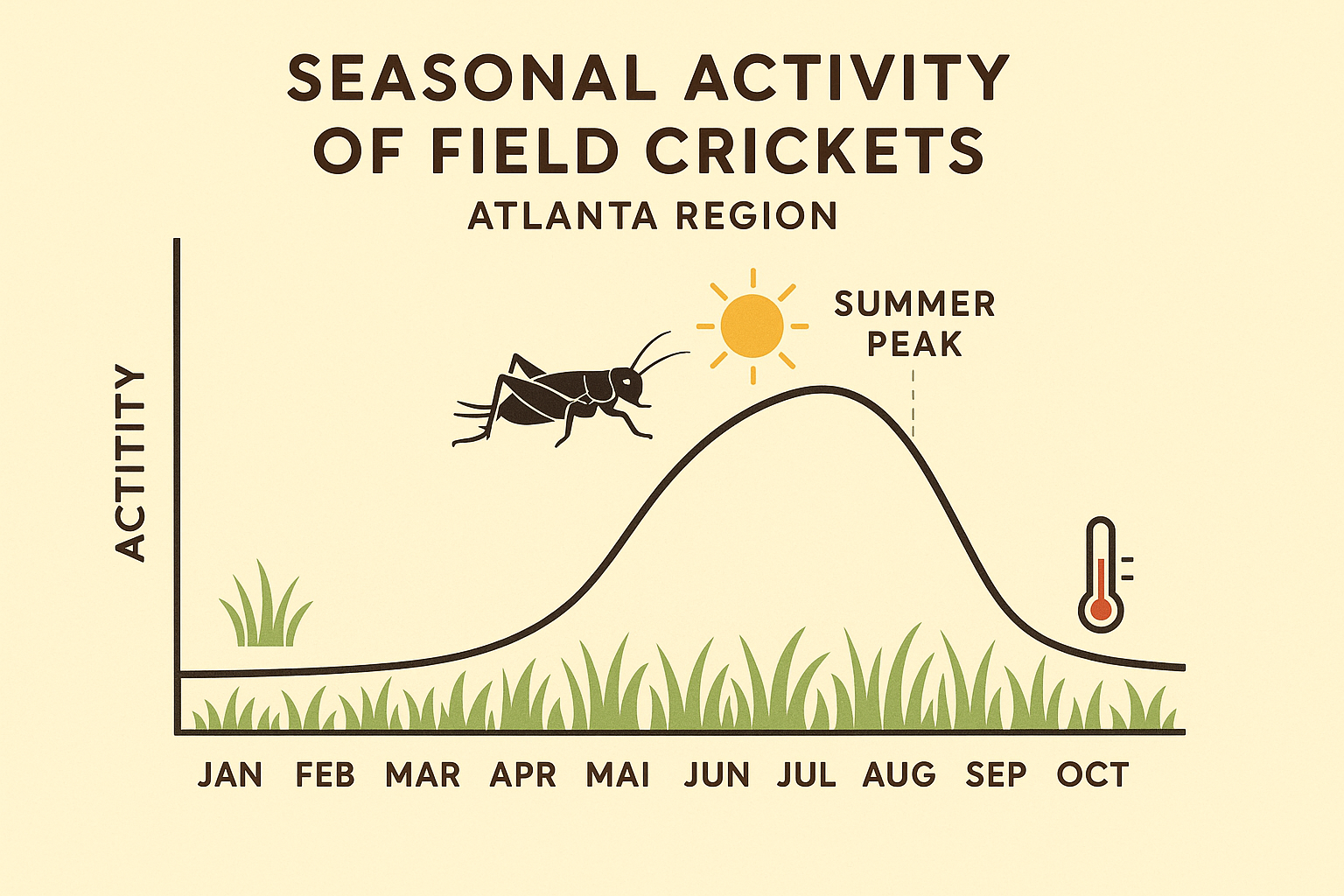
Crickets in the Atlanta metro, including neighborhoods like Druid Hills, follow a predictable annual rhythm that mirrors the region’s subtropical climate—one reason cricket control Druid Hills is most effective when timed seasonally. Eggs hatch in late March to early April when soil temperatures consistently reach 55 °F (13 °C). Nymphs molt five to six times, reaching adulthood by mid-May. Adults mate, lay a second batch of eggs in late summer, and most die off as temperatures dip below 50 °F in November, leaving overwintering eggs to restart the cycle.
The seasonal activity chart above highlights two clear peaks. The first, a sharp rise from mid‑May through early July, corresponds with the emergence of mature males that sing to attract mates. A secondary, smaller surge appears in September when a late‑season generation seeks mates before winter. Low‑activity periods stretch from late August to early October and again from November through February, when only eggs persist in the soil.
Temperature is the primary driver of cricket vigor. Warm days accelerate nymph development, while cool nights trigger the characteristic chirping of males. When daily highs consistently stay above 75 °F (24 °C), populations can double within two weeks, explaining the rapid escalation seen in late spring.
High humidity and recent rainfall create the moist ground crickets need for egg laying and nymph survival. A rain event of an inch or more within a week can boost egg hatch rates by up to 30 %, especially in the May‑June window when soils remain warm.
Long daylight hours in summer extend the period of nocturnal activity. As days shorten after the summer solstice, males reduce their song frequency, which naturally dampens population visibility.
Artificial outdoor lighting also influences nighttime cricket numbers. The CDC’s lighting guidance recommends using motion‑activated, low‑intensity fixtures and shielding bulbs to limit skyglow. Reducing constant illumination can cut local cricket attraction by roughly 40 %, giving homeowners a quieter yard.
For early detection, focus inspections in late spring (late April to early May) and again in early summer (mid‑June). During these windows, nymphs are abundant and adult males begin singing, making it easy to spot activity before populations explode.
Quick Seasonal Inspection Checklist
- Walk the perimeter after sunset; listen for chirping within 20 feet.
- Check mulch, leaf litter, and garden beds for egg sacs or small nymphs.
- Inspect exterior lighting; replace bulbs with motion‑sensor, low‑watt options.
- Record soil moisture; aim for well‑drained but not bone‑dry conditions.
- Schedule a professional pre‑emptive treatment in early May if activity exceeds normal levels.
Professional Treatment Methods for Cricket Control
When crickets invade your yard or crawl inside your home, a targeted, EPA‑approved approach is the most reliable way to eliminate them and keep them from returning. Professional pest technicians use three main categories of treatment—perimeter sprays, spot‑on applications, and structural barriers—to create a multi‑layer defense that works faster and lasts longer than over‑the‑counter sprays.
Perimeter Sprays, Spot Treatments, and Structural Barriers
Perimeter sprays form a protective ring around the foundation, walkways, and outdoor gathering spaces where crickets typically enter. Spot treatments focus on hot spots such as mulch beds, cracks, and door thresholds where insects congregate. Finally, structural barriers involve applying residual insecticide to interior surfaces like baseboards and wall voids, sealing off any pathways that crickets might use to move indoors.
What a Certified Technician Does

During a perimeter spray, a licensed Anthem Pest Control technician first inspects the property to identify entry points and high‑traffic cricket zones. Using a calibrated handheld sprayer, they apply a fine mist that evenly coats the soil, foundation walls, and any vegetation within a 3‑foot radius of the home. The technician follows a strict safety protocol, wearing protective gear and ensuring that the spray does not drift onto neighbor’s lawns or into water sources.
EPA‑Approved Active Ingredients
- Bifenthrin – a synthetic pyrethroid with long‑lasting residual action; EPA‑registered for outdoor use against crickets.
- Lambda‑Cyhalothrin – another pyrethroid known for rapid knock‑down and low toxicity to mammals when used as directed.
- Imidacloprid – a systemic neonicotinoid that can be applied to soil, allowing plants to absorb it and protect against chewing insects.
- Permethrin – widely used for spot treatments; EPA‑approved for indoor and outdoor applications.
All of these ingredients are listed on the EPA’s “Approved Pesticide Products” database, meaning they have been evaluated for efficacy and safety when applied by trained professionals.
Safety First: Protecting Residents and Pets
Before spraying, technicians advise homeowners to keep children and pets indoors for at least two hours. After application, the treated area should remain undisturbed until the spray dries—usually 30 minutes. Anthem’s formulations are low‑odor and designed to break down quickly, but we still recommend ventilating indoor spaces and washing any pet bedding that may have come into direct contact with the residual barrier.
Why Choose Professional Application Over DIY
DIY sprays often lack the coverage needed to seal a property’s perimeter, and many over‑the‑counter products are not EPA‑registered for cricket control, reducing their effectiveness. A professional service guarantees:
- Complete coverage of every potential entry point.
- A warranty that backs the treatment for 30 days, with free re‑treatment if crickets reappear.
- Follow‑up inspections to adjust the plan as needed.
Anthem Pest Control’s Customized Plans
Anthem doesn’t use a one‑size‑fits‑all formula. After the initial assessment, we calculate the exact square footage, landscape features, and infestation severity. For a small cottage with light activity, a single perimeter spray may suffice. Larger homes with dense foliage or multiple structures receive a combination of perimeter misting, targeted spot treatments, and interior barrier applications. This tailored approach maximizes efficacy while keeping costs transparent—so you know exactly what you’re paying for.
Pricing Comparison for Cricket Treatment in Druid Hills and Neighboring Areas
How Companies Structure Their Prices
Most pest-control firms in the Metro Atlanta region charge in one of three ways when offering cricket control Druid Hills services: a flat fee per visit, a rate based on square footage, or a bundled package that covers multiple visits and preventive measures. A per-visit charge is simple but can add up quickly for larger homes. Square-foot pricing scales with the size of the property, while package deals often include a free follow-up and a seasonal warranty, making them the most cost-effective for chronic cricket activity.
Pricing Infographic: Druid Hills vs. Nearby Neighborhoods
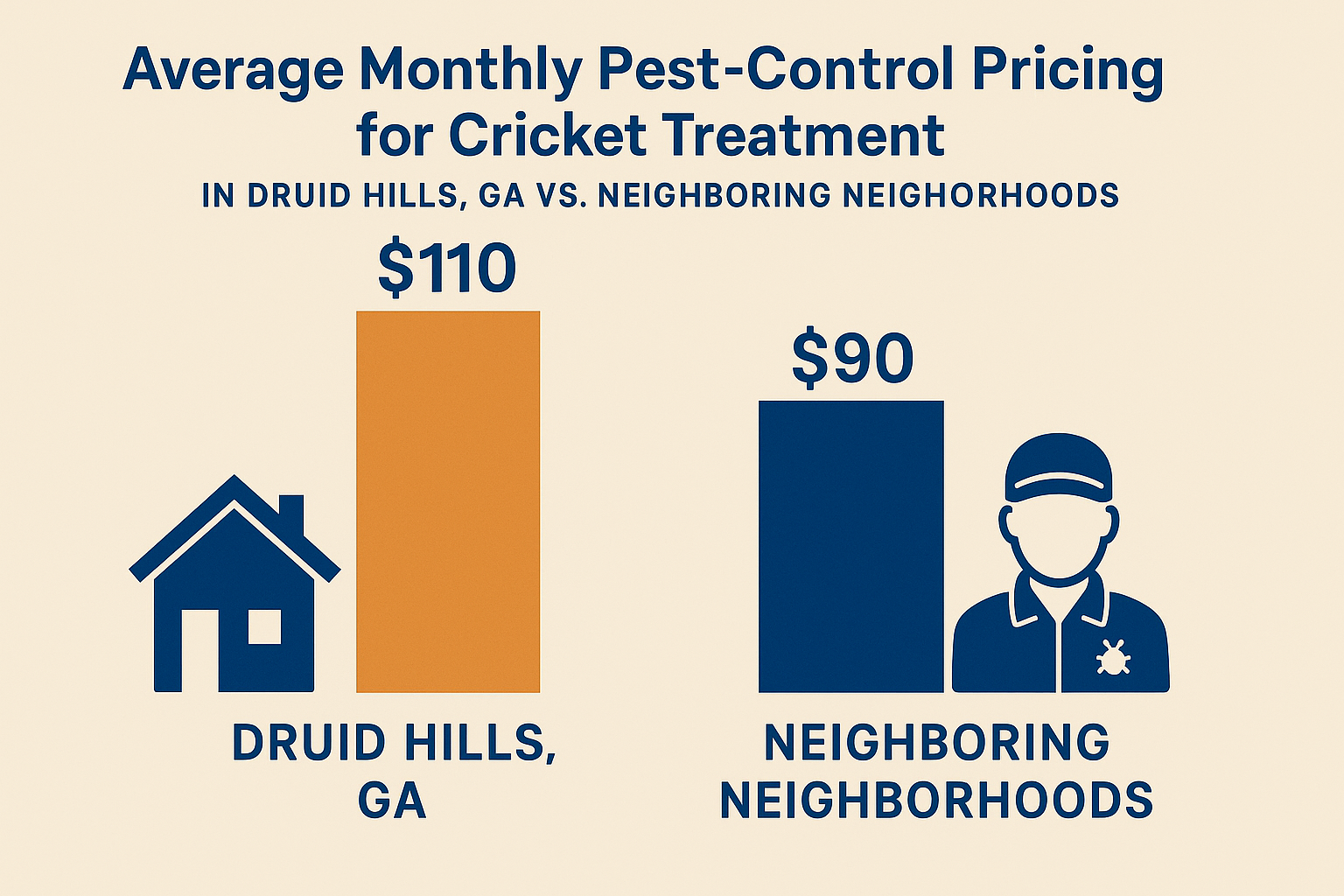
The graphic above shows that Druid Hills homeowners typically pay $120–$150 per visit, while neighboring areas such as Decatur and Brookhaven hover around $130–$165. Package deals in Druid Hills average $350 for a three‑visit seasonal plan, slightly lower than the $380‑$420 range seen in the surrounding suburbs.
What Drives the Final Bill?
- Property size: Larger square footage means more treatment zones and higher material costs.
- Infestation severity: Heavy cricket populations require extra labor and stronger insecticides.
- Treatment frequency: One‑time spot treatments cost less than a full‑season preventive schedule.
- Seasonal discounts: Many companies lower rates in early spring to lock in annual contracts.
Industry Benchmarks from NPMAPestWorld
According to the National Pest Management Association’s Pest World pricing database, the national average for a single cricket treatment is $138, with a typical range of $110–$165. The Druid Hills figures in our infographic sit comfortably within this national band, confirming that local rates are competitive and not inflated.
Anthem Pest Control’s Transparent Pricing Model
Anthem Pest Control offers a clear, upfront quote based on square footage and infestation level. Our standard per‑visit price in Druid Hills is $125, and we provide a three‑visit seasonal package for $340—$30 less than the regional average. Every estimate includes a written guarantee: if crickets return within 30 days of treatment, we’ll re‑treat at no extra charge. Homeowners can also request a free, no‑obligation quote through our website or by calling 877‑371‑8196.
Tips for Homeowners to Evaluate Quotes
- Ask for a detailed breakdown—per‑visit fee, materials, and any travel costs.
- Verify that the quote includes a warranty or follow‑up visit.
- Compare the total cost of a seasonal package versus multiple single visits.
- Watch for hidden fees such as “service call” surcharges or “disposal” charges.
- Check that the provider references industry data (e.g., NPMAPestWorld) to back up their pricing.
By keeping these points in mind, Druid Hills homeowners can confidently choose a pest‑control partner that delivers value without surprise fees.
Protect Your Home from Crickets with Anthem Pest Control
By now you should be able to spot a cricket by its distinctive chirp, oval body and long hind legs, recognize that late summer and early fall bring the highest activity, and understand that treatment options range from DIY traps to professional perimeter sprays. Knowing these basics makes it easier to act before a small night‑time chorus turns into a full‑blown infestation.
Anthem Pest Control combines safety, effectiveness, and deep local knowledge to give Druid Hills homeowners a decisive advantage. Our technicians use EPA‑approved products that target crickets while protecting children, pets, and indoor air quality. Because we’ve serviced the Atlanta metro area for years, we know which micro‑climates in Druid Hills encourage cricket breeding and we tailor each plan to those conditions.
Crickets thrive when grass is moist and nighttime temperatures stay above 70°F. In Druid Hills, the first warm nights of June signal the start of breeding, and by late August the population peaks. Acting early—ideally before the first audible chorus—lets our technicians apply a pre‑emptive barrier that stops adults from laying eggs, reducing the need for multiple follow‑up visits.
Ready to take the next step? We offer a free, no‑obligation quote that outlines exactly what you need—no hidden fees, no surprise visits. Call us today at 877‑371‑8196 or visit our website to schedule your assessment. Our online form lets you pick a convenient time, and a licensed technician will arrive promptly, fully equipped to assess, treat, and advise.
Choosing Anthem means you get affordable pricing backed by a satisfaction guarantee. All of our staff are state‑licensed, continuously trained, and committed to leaving your yard and home cricket‑free. We stand behind every service with a 100 % guarantee: if crickets return within the treatment window, we’ll re‑treat at no extra cost. That peace of mind is why homeowners across Georgia trust us for every pest challenge.
Take control now. Visit Anthem Pest Control to claim your free quote for cricket control Druid Hills and protect your home before the next chorus begins.