Understanding Mosquito Threats in Decatur, GA
Why Decatur’s Climate Is a Mosquito Magnet
Decatur sits in a humid subtropical zone, which means hot, humid summers and mild winters—conditions that make mosquito control Decatur homeowners rely on especially important. Between June and September, average highs hover around 88°F (31°C) and nightly lows rarely dip below 70°F (21°C). Those temperatures, combined with frequent afternoon thunderstorms, create the perfect breeding cocktail for mosquitoes. Warm water accelerates larval development, while high humidity prolongs adult flight time, allowing populations to explode in just a few weeks.
Common Mosquito Species and Where They Hide
Three species dominate the Decatur landscape, each with its own preferred habitat:
- Aedes albopictus (Asian tiger mosquito) – thrives in small containers, birdbaths, and clogged gutters; often found near shaded lawns.
- Culex quinquefasciatus (southern house mosquito) – favors larger, stagnant bodies of water such as storm drains, rain barrels, and low‑lying garden beds.
- Anopheles quadrimaculatus – prefers clean, sun‑lit pools and marshy edges of parks; can be spotted near vegetated swales.
All three species lay eggs on the surface of standing water, so any puddle that sits longer than 48 hours becomes a potential nursery.
Health Risks From Mosquito Bites
The bite itself is irritating, but the real danger lies in disease transmission. According to the Centers for Disease Control and Prevention (CDC), Georgia reports an average of 150 confirmed cases of West Nile virus each year, most of which are linked to Culex mosquitoes. Although rare, Aedes species can also carry Zika, dengue, and chikungunya if introduced by travelers. Even a single bite can trigger allergic reactions, severe itching, and, in vulnerable individuals, secondary skin infections.
Impact on Outdoor Living and Property Value
Mosquitoes turn a backyard barbecue into a swatting session. Persistent buzzing discourages families from using patios, pools, and fire pits—key amenities that drive a home’s livability rating. Moreover, neighborhoods plagued by frequent mosquito swarms often see slower resale activity and modest price depreciation, as prospective buyers factor in ongoing pest‑control costs and reduced outdoor enjoyment.
Quick Homeowner Checklist: Spotting a Mosquito Problem Early
- Inspect gutters, birdbaths, and planters for standing water after rain.
- Check lawn depressions and low‑lying areas for soggy spots that don’t dry quickly.
- Listen for a high‑pitched whine during dusk—adult mosquitoes are most active then.
- Look for clusters of small, dark larvae on the water’s surface; they resemble tiny fish scales.
- Notice increased bite reports from family members, especially on exposed skin.
Spotting these signs early gives you a head start on treatment, keeping your yard comfortable and protecting your family’s health.
Mosquito Activity Seasons and Peak Times
In Decatur, the mosquito calendar follows a predictable rhythm that hinges on temperature, humidity, and rainfall, making timely mosquito control Decatur homeowners depend on especially important. Female mosquitoes lay eggs on the surface of standing water; those eggs hatch into larvae within 24-48 hours when water temperatures rise above 65 °F (18 °C). Larvae develop into pupae and then into biting adults in roughly 7-10 days, provided the climate stays warm and moist. When winter chills drop below 50 °F (10 °C), development stalls, and adults seek shelter in protected indoor sites, ending the active season until the next spring thaw.
Temperature is the primary accelerator. Each degree above 70 °F (21 °C) shortens the life‑cycle by a day or two, while heavy rains create fresh breeding pools that can spark a sudden surge in numbers. Conversely, dry spells and cooler nights suppress activity, pushing mosquitoes into a dormant state. This interplay explains why Decatur experiences a sharp peak in midsummer and a secondary lull in early fall.
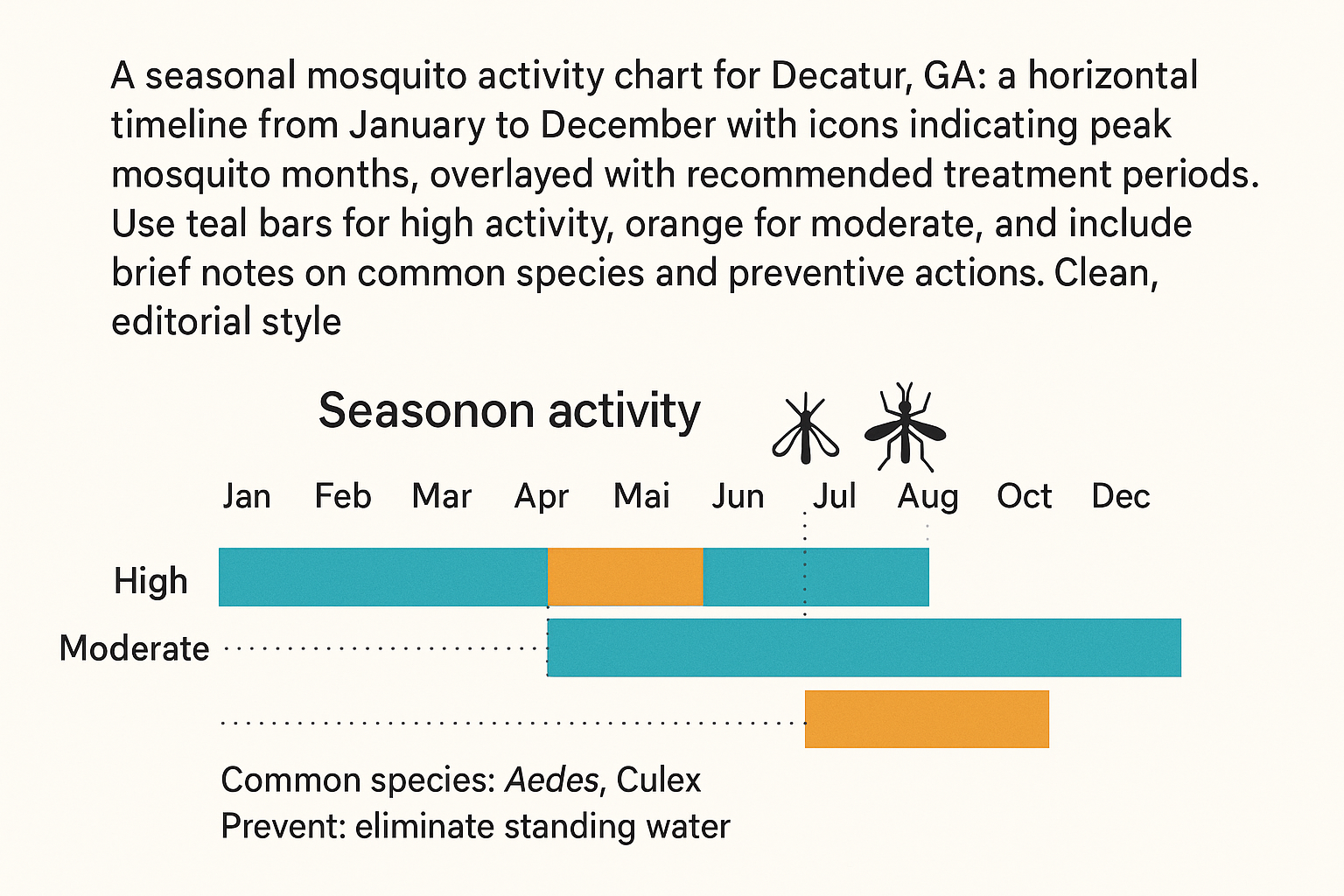
Seasonal Activity Chart
| Month | Activity Level | Dominant Species | Common Diseases |
|---|---|---|---|
| April – May | Moderate | Aedes albopictus (Asian tiger) | West Nile virus (low risk) |
| June – August | High (peak) | Culex quinquefasciatus, Aedes aegypti | West Nile, Zika, Dengue |
| September – October | Moderate | Culex pipiens | West Nile (declining) |
| November – March | Low/Inactive | Overwintering adults | Minimal transmission |
What Species Mean for You
During the early spring window (April‑May), the Asian tiger mosquito dominates. It thrives in shaded containers and is known for aggressive daytime bites, though it rarely carries serious diseases in Georgia. Summer’s heat brings the Culex and Aedes aegypti mosquitoes, the primary vectors for West Nile virus, Zika, and Dengue. Their peak activity coincides with the highest human exposure, making June through August the most critical period for protection. In September‑October, Culex pipiens re‑asserts itself, but cooler nights begin to curb virus replication, lowering disease risk.
Optimal Timing for Professional Treatments
To stay ahead of the swarm, schedule a barrier spray at the start of the moderate period—late April or early May—as part of a proactive mosquito control Decatur plan. This pre-emptive application creates a protective “wall” around your home just as the first eggs hatch. Follow up with a second barrier in early July, targeting the summer peak when larvae are most abundant. For larvicide treatments, aim for mid-June, right after the first heavy rains, to treat newly formed water collections before they become productive breeding sites. A final touch-up in early September helps suppress the fall resurgence.
Homeowner Tips for Reducing Breeding Sites
- Empty, clean, or store any containers that can hold water (birdbaths, plant saucers, gutters) at least once a week during June‑August.
- Trim overgrown vegetation and keep grass mowed to reduce humid micro‑habitats where adult mosquitoes rest.
- Repair leaky hoses, sprinklers, and air‑conditioning condensate lines promptly.
- Use fine‑mesh covers on rain barrels and ensure they have a tight‑fitting lid.
- Consider adding a small amount of biological larvicide (e.g., Bti) to ornamental ponds that cannot be drained.
By aligning your treatment schedule with the seasonal chart and eliminating standing water during the high‑activity months, you dramatically cut the chances of a mosquito invasion. Anthem Pest Control’s local expertise means we know exactly when Decatur’s mosquitoes are most vulnerable, allowing us to deliver effective, cost‑efficient protection when you need it most.
Effective Mosquito Control Methods for Homeowners

Barrier Sprays, Larvicides, and Fogging: How They Work
Barrier sprays create an invisible shield around your home by coating vegetation, fences, and other outdoor surfaces with residual insecticide. When adult mosquitoes land on these treated areas, the chemicals disrupt their nervous system, causing rapid knock‑down. Larvicides, on the other hand, target mosquito larvae before they emerge as biting adults. Applied to standing water—such as birdbaths, clogged gutters, or ornamental ponds—larvicides release a toxin that prevents larvae from maturing. Fogging is a short‑term, high‑volume aerosol that blankets a yard with fine droplets, providing immediate relief from swarms but offering little residual protection.
Professional Spray Application: Step‑by‑Step
- Pre‑treatment inspection: A certified technician walks the property, identifies breeding hotspots, and notes any sensitive areas (children’s play zones, pet feeding spots, etc.).
- Safety briefing: Homeowners are advised on temporary re‑entry times, especially if the product requires a 2‑hour dry‑down period.
- Equipment setup: Technicians use a calibrated backpack or truck‑mounted sprayer equipped with low‑drift nozzles to ensure even coverage while minimizing overspray.
- Targeted application: The spray is applied to all potential resting sites—shrubs, tree trunks, decks, and the undersides of eaves—at a rate that delivers the EPA‑registered label dosage.
- Post‑treatment verification: The crew checks for missed zones, records the product batch number, and provides the homeowner with a treatment summary and safety sheet.
This systematic approach maximizes efficacy, reduces the risk of resistance, and keeps families and pets safe.
DIY Alternatives: Sprays, Natural Repellents, and Traps
Many homeowners prefer a hands‑on approach. Below is a quick guide to the most common DIY options, along with their pros and cons.
- Home‑applied sprays: Over‑the‑counter pyrethroid or botanical products can be sprayed from a garden hose or pump sprayer. Pros: Immediate control, low upfront cost. Cons: Limited residual activity, higher risk of uneven coverage, and potential for misuse.
- Natural repellents: Essential‑oil blends (e.g., citronella, lemon eucalyptus) or garlic‑infused sprays deter mosquitoes without chemicals. Pros: Eco‑friendly, safe around children and pets. Cons: Short‑lived protection, requires frequent re‑application.
- Traps: CO₂ or UV‑light traps attract and capture adult mosquitoes. Pros: Reduces local populations, no chemicals needed. Cons: Effectiveness varies by species, traps can become breeding sites if not maintained.
Why EPA‑Registered Products Matter
Choosing EPA‑registered formulations ensures that the product has been evaluated for efficacy, human health safety, and environmental impact. These products come with clear label instructions, including required protective equipment and re‑entry intervals. Using non‑registered or homemade concoctions can lead to ineffective control, legal liability, and unintended harm to beneficial insects. For a full list of approved mosquito control products, visit the EPA’s mosquito‑control page.
When It’s Time to Call a Professional
DIY methods work well for small, isolated problems, but certain situations call for expert intervention:
- Large yards or multiple property zones: Uniform coverage becomes difficult without professional equipment.
- Persistent or seasonal infestations: Repeated bites despite DIY attempts often signal a hidden breeding source that requires larvicide treatment.
- Eco‑focused packages: Companies like Anthem Pest Control can blend low‑toxicity barrier sprays with targeted larvicides, delivering a balanced solution that protects both your family and the surrounding ecosystem.
- Health concerns: If anyone in the household has respiratory sensitivities or severe allergies, a trained technician can select the safest product and apply it with precision.
In these scenarios, a professional service not only eliminates the current mosquito population but also establishes a preventive barrier that keeps future swarms at bay.
How Much Does Mosquito Control Cost in Decatur?
When you call a professional service, the first question on most homeowners’ minds is price. In Decatur, Anthem Pest Control structures its rates around three common models: a single per‑visit fee, a seasonal contract that covers the entire mosquito season (typically March through October), and a one‑time treatment for urgent hotspots. The per‑visit option works well for smaller yards or occasional flare‑ups, while seasonal contracts spread the cost over multiple applications and often include a complimentary follow‑up. One‑time treatments are priced higher per application but give you flexibility if you’re only dealing with a temporary problem.
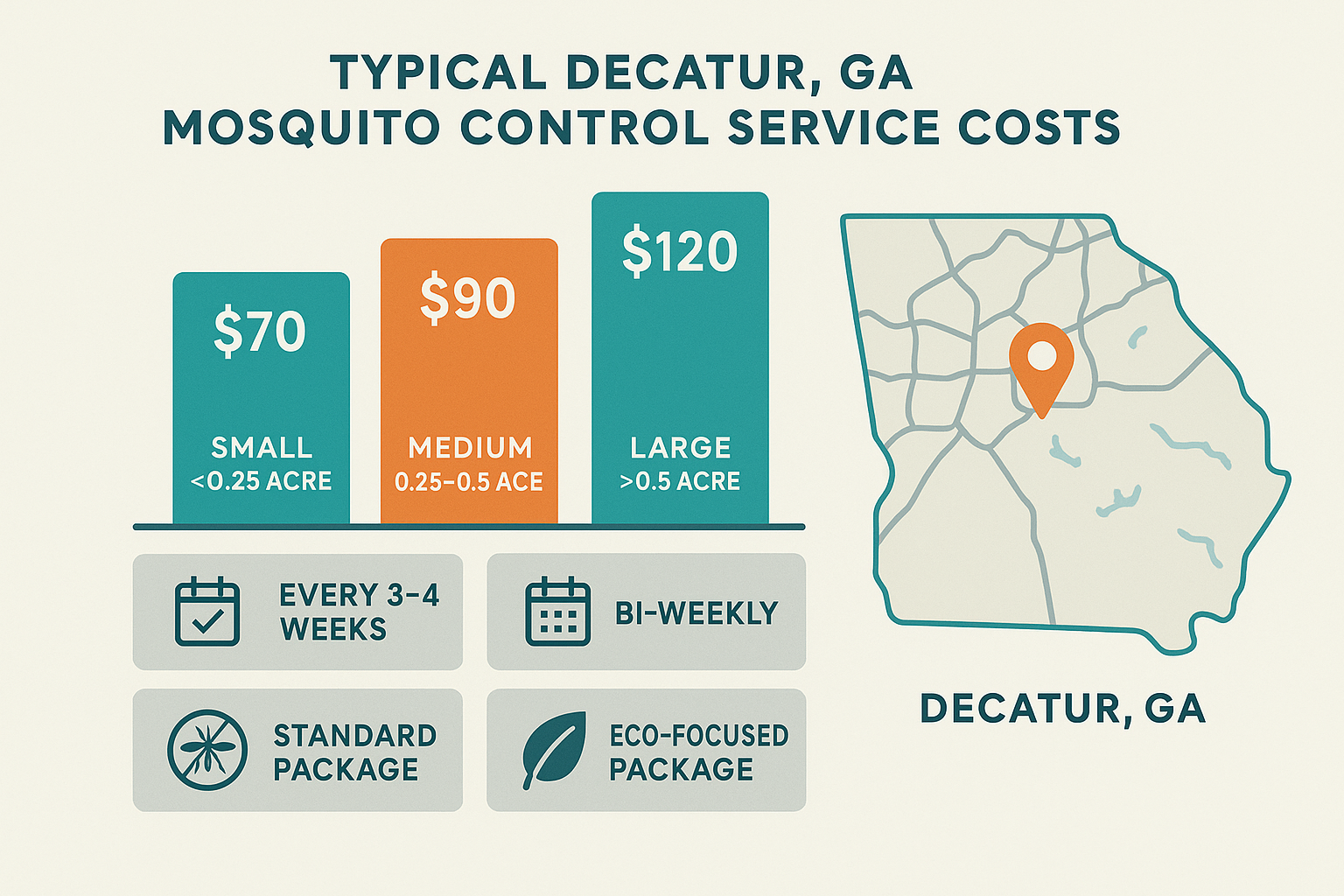
The graphic above breaks down three typical cost tiers—$70, $90, and $120 per service—matched to yard size categories (small up to 2,500 sq ft, medium 2,500–5,000 sq ft, and large over 5,000 sq ft) and the recommended frequency of application for professional mosquito control Decatur homeowners often choose. For a 3,000-sq-ft yard, a $90 tier usually means a bi-weekly spray throughout the season, while the $120 tier adds a supplemental larvicide treatment and a final “protect-and-prevent” application before winter sets in.
Standard vs. Eco‑Focused Packages
| Package | Included Services |
|---|---|
| Standard | Conventional adulticide spray, perimeter barrier, 4‑6 applications per season, basic follow‑up inspection. |
| Eco‑Focused | Organic larvicides, reduced‑chemical adulticide (pyrethrin‑based), habitat reduction advice, 6‑8 applications, detailed post‑treatment report. |
The Standard package leans on proven chemical controls that knock down adult mosquitoes quickly. The Eco‑Focused package, on the other hand, swaps out a portion of the synthetic adulticide for a pyrethrin blend and adds an organic larvicide that targets mosquito larvae in standing water. Homeowners who prioritize lower chemical exposure or have pets and small children often opt for the eco option, even though the upfront price sits about $20‑$30 higher per visit.
Factors That Can Shift the Bottom Line
- Property size: Larger lawns, extensive landscaping, or multiple structures (garage, pool house) require more product and labor.
- Application frequency: Bi‑weekly visits are standard, but a weekly schedule during peak summer months can increase the total cost by 15‑20%.
- Special requests: Treating water features, hanging baskets, or installing misting systems are considered add‑ons and are billed separately.
- Access challenges: Sloped terrain, narrow alleys, or gated communities may add a service surcharge for extra travel time.
By understanding these variables, you can ask Anthem Pest for a detailed estimate that reflects your unique situation rather than a one‑size‑fits‑all quote.
Quick Cost‑Benefit Analysis
While a $120 seasonal package may feel steep compared with a $70 basic plan, the long-term savings are compelling. Effective mosquito control Decatur homeowners invest in reduces the risk of mosquito-borne illnesses such as West Nile virus, cuts down on outdoor damage to furniture and landscaping caused by repeated swatting and chemical runoff, and preserves the enjoyment of your yard for family gatherings. In many cases, homeowners who invest in a higher-tier, eco-focused plan report fewer repeat visits and lower overall pesticide usage, translating into a healthier environment and a lower cumulative expense over several seasons.
Protect Your Yard with Anthem Pest Control – Get a Free Quote
Mosquitoes thrive when the weather in Decatur turns warm and humid, and a single missed week of treatment can turn a pleasant backyard into a buzzing nightmare. Timely, season‑aligned control not only keeps your family comfortable but also stops the spread of mosquito‑borne illnesses before they take hold. By acting early—ideally before the first summer storm—you give your yard the best chance to stay clear throughout the peak months.

Anthem Pest Control brings more than just a spray can to the job. Our certified technicians are trained in the latest EPA‑approved mosquito control methods, ensuring every application meets strict safety standards for children, pets, and the environment. We offer two customizable plan tracks:
- Standard Tier – Ideal for typical suburban yards, this plan uses proven adulticide formulas that create a protective barrier lasting up to four weeks.
- Eco‑Focused Tier – Perfect for eco‑conscious homeowners, this option relies on low‑toxicity, naturally derived ingredients that target larvae in standing water while preserving beneficial insects.
Both tracks can be tailored to your property’s size, landscape features, and any specific concerns you have—whether it’s a pool deck, garden beds, or a shaded patio. Our transparent pricing model lets you match the appropriate tier from the infographic you’ve seen, with no hidden fees or surprise add‑ons. You’ll receive a clear, itemized estimate before any work begins, so you know exactly what you’re paying for and why.
Ready to enjoy a mosquito‑free backyard this season? Give us a call at 877‑371‑8196 for a free, no‑obligation quote. One of our local experts will walk through your yard’s layout, discuss your budget, and recommend the plan that fits your environmental preferences. Whether you need a single seasonal treatment or a year‑round maintenance schedule, we’ll design a solution that protects your family while respecting your pocket.
Visit Anthem Pest Control for more information, or simply pick up the phone and let us know how we can help with professional mosquito control Decatur homeowners trust to reclaim their outdoor space. Your perfect, bite-free evenings are just a conversation away.