Understanding Ant Problems in Brookhaven Homes
Brookhaven’s Climate and Ant‑Friendly Conditions
Brookhaven sits in the heart of Georgia’s humid subtropical zone, where warm summers, mild winters, and abundant rainfall create a near‑perfect kitchen for many insects. The combination of outdoor vegetation, irrigation systems, and the occasional backyard compost pile gives ants a reliable source of moisture and food year‑round. For homeowners, that means an ant colony can establish itself just as easily under a porch deck as it can inside a kitchen cabinet. Recognizing how the local climate fuels ant activity is the first step toward staying ahead of an infestation.
Argentine Ants
The Argentine ant (Linepithema humile) is the most aggressive invader in the Atlanta metro area, and Brookhaven is no exception. These tiny, dark‑brown workers form massive supercolonies that can stretch for miles, allowing them to outcompete native ants for resources. They thrive in moist mulch, flower beds, and especially around outdoor lighting where they harvest honeydew from aphids. Inside the home, Argentine ants follow scent trails into kitchens, seeking sugary crumbs and pet food, and because they cooperate so closely, a single trail can quickly turn into a full‑blown indoor presence.
Pharaoh Ants
Pharaoh ants (Monomorium pharaonis) are the classic indoor pest that loves the climate‑controlled spaces of modern homes. They are small, light‑tan ants that nest in wall voids, under appliances, and even inside HVAC ducts where temperature and humidity stay stable. Because they reproduce rapidly—colonies can produce new queens in just a few weeks—an unnoticed nest can balloon to thousands of workers in a single season. Their preference for protein‑rich foods means they’ll raid pantry staples, grease traps, and even the occasional dead insect, contaminating everything they touch.
Odorous House Ants
Odorous House ants (Tapinoma sessile) are named for the faint, sweet odor they give off when crushed—a handy clue for homeowners. These medium‑sized, dark‑brown ants favor dry, sunny cracks in foundations, fire‑pits, and paver edges. In Brookhaven they often slip through these exterior gaps, then follow interior walls to food sources. Though less aggressive than Argentine ants, they establish multiple satellite colonies, making them a persistent nuisance in kitchens, bathrooms, and laundry rooms.
Potential Damage and Nuisance
Even tiny ants can cause costly problems. Food contamination is immediate—ant trails can transfer bacteria from garbage to countertops, turning a sandwich into a health risk. Some species, like Pharaoh ants, nest behind drywall or under flooring, compromising insulation and creating hidden moisture that encourages mold. For sensitive family members, repeated ant bites or allergens can trigger skin irritation or respiratory reactions. In short, an unchecked ant presence threatens both safety and comfort in your home.
Distinguishing True Infestations from Occasional Foraging
The line between a casual foraging party and a genuine infestation can be thin, but it matters. A single ant marching across a kitchen floor at night is often just a scout searching for food, and the colony may be located far outside your property. However, when you notice multiple trails, steady traffic, or ants nesting inside walls, you’re dealing with an established colony that will expand unless interrupted. Early identification lets you act before the problem spreads to other rooms, saves on treatment costs, and prevents the long‑term damage that a hidden nest can cause.
Looking Ahead
Now that you understand why Brookhaven’s climate, common ant species, and the subtle signs of activity matter, the next sections will guide you through precise identification techniques and the most effective treatment options. Armed with this knowledge, you’ll be better positioned to decide when a professional inspection is warranted and how to protect your home before ants become more than a minor inconvenience.
Spotting Ant Infestations Early
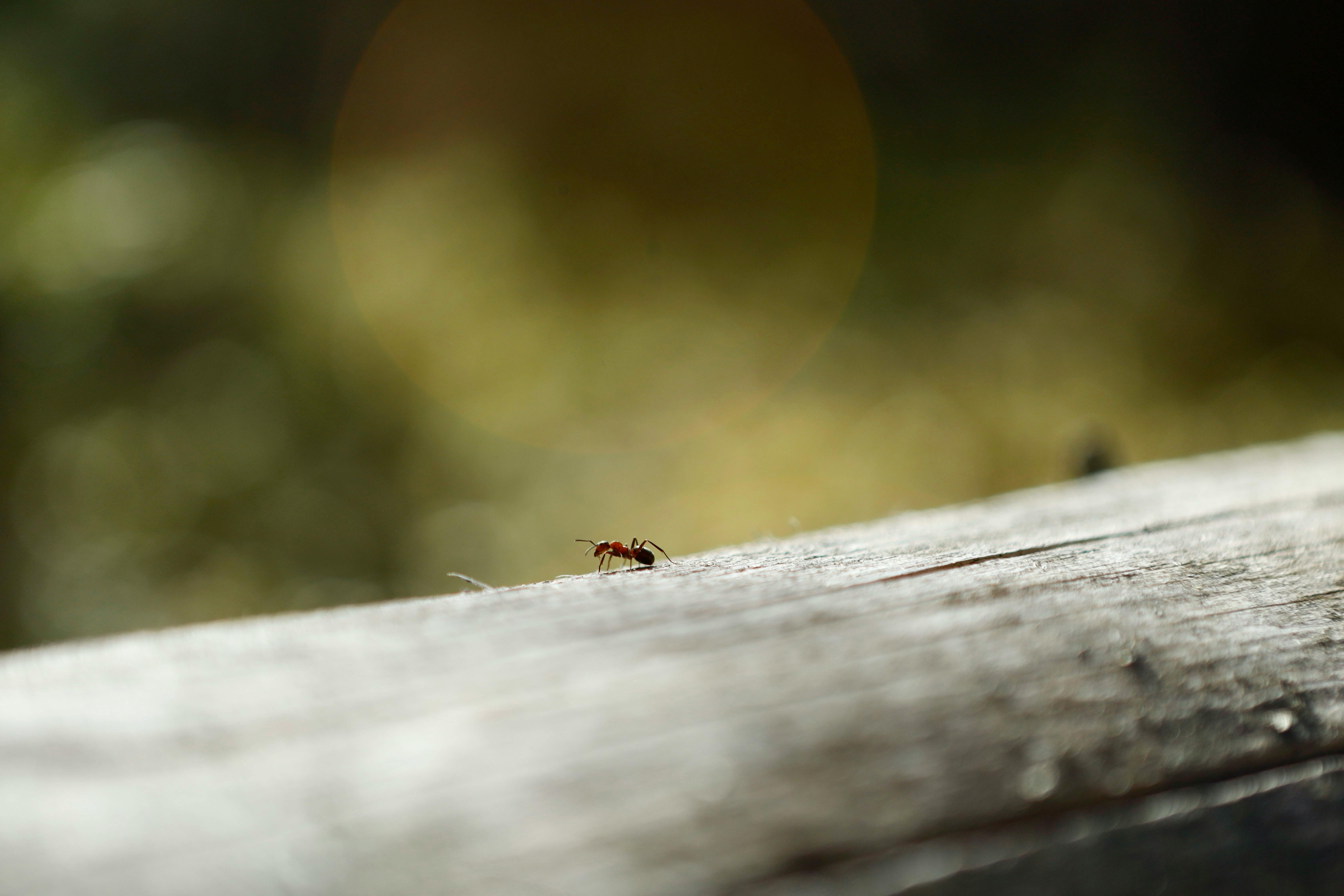
Ants are masters of stealth, slipping through the smallest cracks before you even notice a single worker. The good news is that most colonies give away subtle clues—trails, nests, and entry points—that a vigilant homeowner can catch early. Recognizing these visual cues and behavioral signs lets you act before a few foragers become a sprawling infestation.
Typical Trails, Nests, and Entry Points
In a Brookhaven home, ant activity most often concentrates in three zones:
- Kitchens: Look for thin, continuous lines of ants marching between food sources and water. Nests are frequently hidden under appliances, behind cabinets, or inside wall voids where crumbs accumulate.
- Bathrooms: Moisture is a magnet. Ants will exploit leaky pipes, grout gaps, and the undersides of sinks. Small, sand‑like piles near the baseboard often indicate a hidden nest.
- Foundations and Exterior Walls: Cracks in the foundation, gaps around utility lines, and poorly sealed windows serve as entry doors. Ants may establish satellite colonies in the soil just outside the home, sending foragers back along a well‑defined trail.
How to Differentiate Ant Trails from Other Insects
Not every line of tiny insects is an ant. Here’s how to tell them apart:
- Consistency of the line: Ant trails are usually straight or gently curved and maintain a uniform width. Spider or silverfish paths appear erratic and often intersect.
- Pheromone scent: Ants leave a chemical trail that other workers follow. Lightly tap a few ants onto a piece of paper; if you see a clear line of additional ants following the same route, you’re likely looking at an ant pheromone trail.
- Body shape and behavior: Ants have a distinct three‑segment body (head, thorax, abdomen) and elbowed antennae. They move purposefully, rarely stopping, whereas flies or beetles pause frequently.
Warning Signs That an Ant Problem Is Growing
Even if you haven’t spotted a full trail, these red flags suggest a colony is establishing itself nearby:
- Sticky or sugary food residues on countertops and pantry shelves.
- Dead ants found near entry points—colonies often sacrifice workers that wander into traps.
- Excess moisture or water stains near foundations, especially after rain.
- Sudden spikes in ant activity after a rainstorm or during warm evenings.
Weekly Home Inspection Checklist
Set aside 10‑15 minutes each week to run this quick audit. Consistency is key; the sooner you notice a trail, the easier it is to intervene.
- Kitchen sweep: Scan countertops, under appliances, and inside cabinets for crumbs or tiny ant lines. Wipe any residues with a mild detergent.
- Bathroom glance: Check under the sink, around the tub, and behind the toilet for damp spots or sand‑like debris.
- Foundation perimeter: Walk the exterior of your home, looking for cracks, gaps, or moist soil patches. Use a flashlight to peer into any openings.
- Entry point probe: Feel around windowsills, door thresholds, and utility penetrations. If you sense a narrow gap, seal it with caulk or weather‑stripping.
- Trap placement: Set up a few non‑toxic bait stations along suspected trails. Check them weekly for captured ants; an increase indicates active foraging.
- Record findings: Jot down locations, dates, and the number of ants observed. A simple log helps you spot patterns and decide when professional help is needed.
Why Early Detection Saves You Money and Headaches
Ant colonies expand exponentially. A queen can lay thousands of eggs in a single season, turning a few foragers into a network of satellite nests that infiltrate walls, cabinets, and even your yard. By catching the problem during the “trail” phase, you avoid:
- Extensive structural damage caused by certain species, such as carpenter ants.
- The need for multiple treatment rounds, which drive up costs.
- The disruption of daily life while technicians perform invasive inspections.
At Anthem Pest Control, we recommend a proactive approach: regular inspections, prompt sealing of entry points, and, when needed, targeted treatment that eliminates the colony at its source. Spotting ant activity early not only protects your home’s integrity but also keeps your budget in check.
Seasonal Patterns of Ant Activity in Brookhaven
Peak Months for Brookhaven’s Common Ants
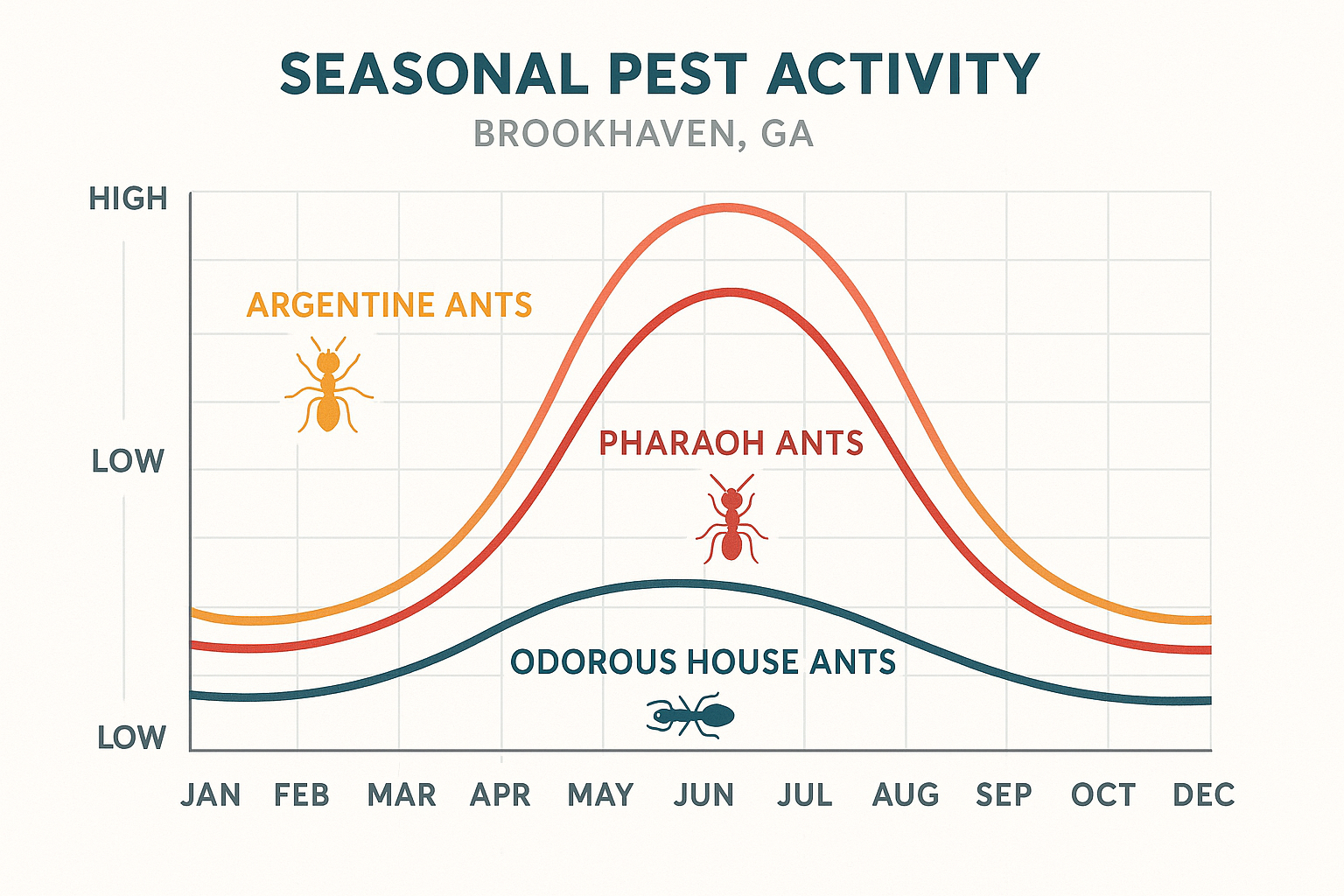
Brookhaven homeowners encounter three ant species most frequently: Argentine ants, Pharaoh ants, and Odorous House ants. Each has a distinct window of heightened activity that aligns with the local climate. Argentine ants typically surge in late spring, especially from mid‑May through early June, when soil temperatures climb above 70°F and outdoor foraging becomes energetically favorable. Pharaoh ants, preferring warmer indoor environments, reach their peak in midsummer—July and August—when indoor humidity spikes and food sources multiply. Finally, Odorous House ants dominate the early fall, from late September to early November, as they expand their colonies in response to cooling nights and the availability of fallen leaves and garden debris.
Weather Drivers: Temperature, Humidity, and Rain
Temperature is the primary catalyst for ant colony growth. As the ground warms, brood development accelerates, leading to larger worker populations and more aggressive foraging. In Brookhaven, daily highs above 75°F signal Argentine ants to intensify their search for sugary residues along foundations and garden beds.
Humidity works hand‑in‑hand with temperature. Pharaoh ants thrive in moist indoor spaces such as kitchens, bathrooms, and HVAC ducts. Summer rainstorms raise indoor humidity, creating ideal conditions for these tiny pests to establish satellite nests inside wall voids. When humidity drops in late summer, they retreat deeper into walls, only to re‑emerge when moisture levels rise again.
Rainfall also influences Odorous House ants. Early‑fall showers soften leaf litter and mulch, providing a moist substrate for new tunnels. The combination of cooler temperatures and abundant moisture prompts these ants to relocate food caches from the garden to the house, often appearing near windowsills and doorways as they seek shelter from the damp outdoors.
Seasonal Maintenance Checklist
- Spring (March‑May): Inspect foundation cracks and seal with caulk before Argentine ants emerge. Trim back vegetation that touches the house to eliminate bridge pathways.
- Summer (June‑August): Reduce indoor humidity by using dehumidifiers in kitchens and basements. Store pantry items in airtight containers and promptly clean up spills to deny Pharaoh ants easy food sources.
- Early Fall (September‑October): Rake leaf piles away from the foundation and compost only in sealed bins. Sweep outdoor patios regularly to remove crumbs that attract Odorous House ants.
- Late Fall & Winter (November‑February): Perform a final seal‑up of any newly discovered cracks. Keep indoor lighting low near entry points, as ants are drawn to warmth and light during colder months.
Seasonal Activity Chart
| Month | Argentine Ant | Pharaoh Ant | Odorous House Ant |
|---|---|---|---|
| January | Low | Low | Low |
| February | Low | Low | Low |
| March | Medium | Low | Low |
| April | Medium | Low | Low |
| May | High | Low | Low |
| June | High | Medium | Low |
| July | Medium | High | Low |
| August | Medium | High | Low |
| September | Low | Medium | High |
| October | Low | Medium | High |
| November | Low | Low | Medium |
| December | Low | Low | Low |
Professional Ant Control Methods That Work
Step 1: Thorough Inspection
Before any chemical or bait is applied, a certified technician conducts a systematic walk‑through of the property. The first task is to identify the ant species—carpenter, odorous house, or pavement ants each have distinct habits and nesting preferences. By examining for tell‑tale signs such as trail pheromones, shed wings, or mud tubes, the technician can pinpoint the exact colony locations. Next, they locate nests both inside walls, under foundations, and outdoors in mulch or soil. Finally, they map entry points—cracks, utility openings, and gaps around doors—to understand how the insects are gaining access.
Step 2: Targeted Treatment Modalities
Once the inspection is complete, the technician selects the most effective treatment mix for the identified species and nest locations.
- Baiting systems: Slow‑acting, sugar‑ or protein‑based baits are placed along foraging trails. Worker ants carry the poison back to the queen, eventually collapsing the entire colony.
- Perimeter sprays: EPA‑approved residual sprays are applied around the home’s foundation, creating a chemical barrier that repels foragers before they reach interior entry points.
- Dust applications: In tight voids—wall cavities, under baseboards, and in crawl spaces—dust formulations penetrate deep, staying active for months without visible residue.
- Structural treatments: For carpenter ant infestations, foam or gel concentrates are injected directly into wood damage, eradicating the hidden nest while preserving the integrity of the structure.
Safety First: EPA‑Approved Products
Anthem Pest Control only uses products that have passed rigorous EPA evaluation for human and pet safety. Technicians wear protective gear, isolate treated zones, and follow strict ventilation protocols to minimize exposure. Low‑odor, low‑toxicity formulations are chosen whenever possible, and all residues are clearly communicated to the homeowner. This safety‑first approach not only protects families and pets but also ensures compliance with local regulations and maintains the homeowner’s peace of mind.
DIY vs. Professional: What Really Works?
Many homeowners reach for over‑the‑counter sprays, assuming a quick fix will solve the problem. DIY sprays typically offer a short‑term knock‑down of visible workers, but they rarely affect the queen or deep‑nesting colonies. In contrast, professional bait stations are designed for longevity; they remain active for weeks, allowing ants to continuously transport the toxicant back to the nest. Studies show that professionally applied baits achieve up to 95% colony eradication within 30 days, while DIY sprays often require repeated applications and still leave the source intact. The result is a cycle of recurring infestations that costs more time and money in the long run.
The Technician’s Edge
A trained technician brings more than just a toolbox. They assess each home’s construction, landscaping, and micro‑climate to customize a treatment plan that fits the specific ant pressure. For example, a home with extensive mulch may need targeted dust in the soil, while a property with frequent outdoor gatherings might benefit from a stronger perimeter spray schedule. Technicians also educate homeowners on simple preventative steps—sealing cracks, managing moisture, and proper food storage—to keep ants from returning after the treatment is complete.

Ant Control Costs in Brookhaven – What to Expect
When it comes to ant problems in Brookhaven, the biggest question homeowners ask is, “How much will it cost?” At Anthem Pest Control we break pricing into three clear tiers so you can match the level of service to your budget and the severity of the infestation. All fees are quoted up‑front, with no hidden surcharges, and each tier includes a specific set of visits, warranties, and follow‑up support.
Service Tier Overview
- Basic Inspection – $79 one‑time fee. Includes a thorough visual inspection, a detailed report of ant species present, and a single spot‑treatment if the infestation is minimal. Warranty: 30 days.
- Standard Treatment – $149 per visit (typically two visits per year). Covers a full‑property perimeter spray, interior bait stations, and a 90‑day warranty that includes one complimentary follow‑up.
- Premium Package – $229 monthly subscription (or $2,199 annual flat fee). Provides quarterly comprehensive treatments, unlimited interior bait placement, a 12‑month warranty, and priority scheduling for any emergency re‑treatments.
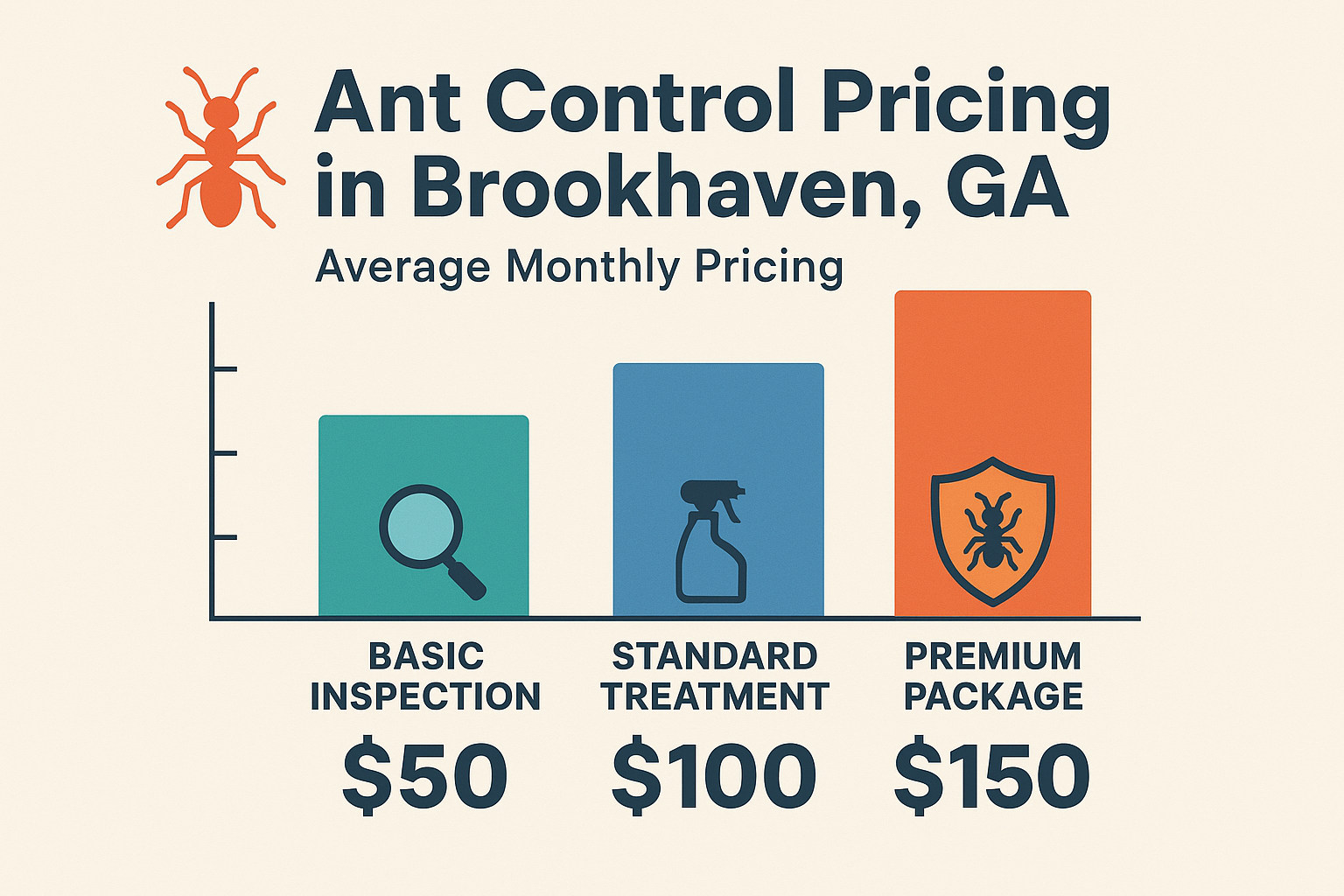
The infographic above visualizes the cost differences and highlights what each tier delivers—from the number of visits to the length of the warranty. Homeowners who need a quick fix often start with the Basic Inspection, while those looking for long‑term peace of mind gravitate toward the Premium Package.
Why Prices Vary
Even within Brookhaven, ant control costs can shift based on several key factors:
- Infestation severity: A light trail of pavement ants requires far less product and labor than a large colony of carpenter ants nesting in structural wood.
- Home size: Larger square footage means more treatment zones, which raises material costs.
- Ant species: Some species, like fire ants, need specialized baits that are pricier than standard sugar‑based lures.
- Seasonal promotions: We often run spring discounts or bundled offers that can shave 10‑15 % off the standard rates.
All of these variables are factored into the quote you receive after the initial inspection. For a transparent baseline, we reference the local pricing data compiled by Anthem Pest Control Ant Cost Guide, which aligns closely with the figures presented above.
Cost‑Benefit Calculator
To help you see the financial upside of professional treatment versus a DIY approach, use the table below. It compares the average annual spend on over‑the‑counter ant products with the cost of each service tier, then estimates the potential return on investment (ROI) based on reduced product purchases and avoided damage.
| Scenario | Annual Cost | Typical Savings | Estimated ROI |
|---|---|---|---|
| DIY – monthly ant baits & sprays | $180 | — | 0 % |
| Basic Inspection (one‑time) | $79 | $101 | 56 % |
| Standard Treatment (2 visits) | $149 | $131 | 88 % |
| Premium Package (monthly) | $2,748 | $1,452 | 53 % |
In the short term, the Standard Treatment delivers the highest percentage of savings because it eliminates the need for recurring DIY purchases while still covering a full‑property treatment. The Premium Package, though higher in absolute cost, protects larger homes and offers a 12‑month warranty that can prevent costly structural repairs caused by aggressive ant species.
Putting It All Together
Choosing the right tier starts with understanding your home’s risk profile. If you’ve just spotted a few trail lines, the Basic Inspection can confirm the species and give you a targeted spot‑treatment. For moderate to heavy activity, especially in multi‑level homes, the Standard Treatment strikes a balance between cost and comprehensive coverage. Finally, homeowners with large yards, historic properties, or a history of recurring ant issues will find the Premium Package’s ongoing protection and rapid response worth the investment.
Remember, ant control isn’t just about eradicating pests today—it’s about preventing future invasions that could damage your foundation, cabinets, or outdoor landscaping. By matching the service tier to your specific needs and using the cost‑benefit calculator as a guide, you can make an informed decision that safeguards both your home and your wallet.
Protect Your Home Today with Anthem Pest Control
Ants don’t take a vacation, and in Brookhaven they can appear any month when moisture, food crumbs, or a tiny entry point give them a foothold. Catching the problem early means you avoid structural damage, costly re‑treatments, and the stress of watching a colony spread through your kitchen, walls, or yard.
That’s where Anthem Pest Control steps in. Our technicians are state‑certified, locally trained, and equipped with the latest EPA‑approved products. We pride ourselves on transparent pricing—no hidden fees, just a clear estimate that matches the size of your home and the severity of the infestation. Every plan is customized for Brookhaven’s climate, soil type, and the specific ant species you’re dealing with.
- Certified expertise: All technicians complete rigorous training and continuing education.
- Tailored treatment tiers: From single‑visit spot treatments to comprehensive barrier programs.
- Transparent costs: Detailed quotes that break down labor, products, and follow‑up visits.
- Local knowledge: We know which ant species thrive in Fulton County and the best timing for each control method.
Early detection not only saves money, it reduces the need for aggressive chemicals. By partnering with Anthem, you gain access to a proactive monitoring schedule that catches colonies before they become visible, and you receive ongoing education on how simple habits—like sealing cracks and managing outdoor waste—can keep ants out for good.
We invite you to schedule a complimentary home inspection. During the visit, our specialist will walk through every vulnerable area, identify the ant species, and recommend the most effective tier of treatment—all at no charge and with no obligation to proceed.
Ready to take the next step? Call us today at 877‑371‑8196 for a free, no‑obligation quote. Our friendly team will answer your questions, set up a convenient appointment, and explain how our preventative measures keep ants at bay long after the first treatment.
For more details about our services, pricing options, and customer testimonials, visit Anthem Pest Control. Let us partner with you to protect your home, your family, and your peace of mind.