How a Proper Inspection Stops Termites Before They Invade
Termite damage isn’t just an eyesore—it’s a wallet-drainer, which is why termite control Decatur homeowners prioritize early detection. In the United States, a single colony can chew through thousands of dollars of structural wood before you even notice a problem. That’s why catching the infestation early, during a thorough home inspection, is the most cost-effective line of defense.

What a Typical Termite Inspection Looks Like
A qualified inspector follows a systematic checklist to leave no stone—or piece of timber—unturned. Below is the step‑by‑step breakdown you can expect:
- Visible signs: Look for discarded wings, fecal pellets (often called “kickout holes”), or a faint, sweet odor.
- Wood damage: Tap wood surfaces; hollow sounds indicate internal galleries.
- Mud tubes: These ear‑shaped tunnels on foundations, walls, or crawl spaces are the highways termites use to stay moist.
- Winged insects: Swarmers appear in late spring; spotting them near lights or windows is a red flag.
- Moisture sources: Leaky pipes, poor drainage, or excessive humidity create the perfect environment for termites.
Tools & Techniques Professionals Use
Modern inspectors combine experience with technology. Common gear includes:
- Moisture meters: Detect hidden damp spots that attract termites.
- Infrared cameras: Reveal temperature differences that signal decay or active colonies behind walls.
- Probing rods: Gently penetrate wood to confirm the presence of tunnels without causing damage.
Quick DIY Visual Check Before You Call a Pro
While a professional inspection is irreplaceable for effective termite control Decatur homeowners depend on, you can perform a fast visual sweep to catch obvious warning signs:
- Walk the perimeter of your home and shine a flashlight along the foundation; any dark, wet‑looking tubes deserve a closer look.
- Inspect attic joists and basement beams for hollow sounds when tapped.
- Check window sills and door frames for discarded wings or small piles of sawdust.
- Look under sinks and around water heaters for persistent moisture or water stains.
If any of these items appear, note the location, take photos, and schedule a professional inspection promptly.
Documenting Findings and Planning Follow‑Up Treatment
Accurate documentation is more than a record—it’s a roadmap for remediation. Write down:
- Exact spots where mud tubes or damage were observed.
- The type of wood affected (e.g., sill plates, joists, decking).
- Any moisture sources you identified.
Share this information with your pest control provider. A clear picture allows the technician to target treatment, whether it’s a localized bait system, a liquid barrier, or a combination approach. Most importantly, it speeds up the scheduling of follow‑up visits, ensuring the colony never gains a foothold.
Remember, the sooner a thorough inspection uncovers the problem, the less invasive—and less expensive—the solution will be. At Anthem Pest Control, we combine meticulous inspections with transparent pricing, so you can protect your home before termites ever get a chance to invade.
When Termites Are Most Active in Georgia
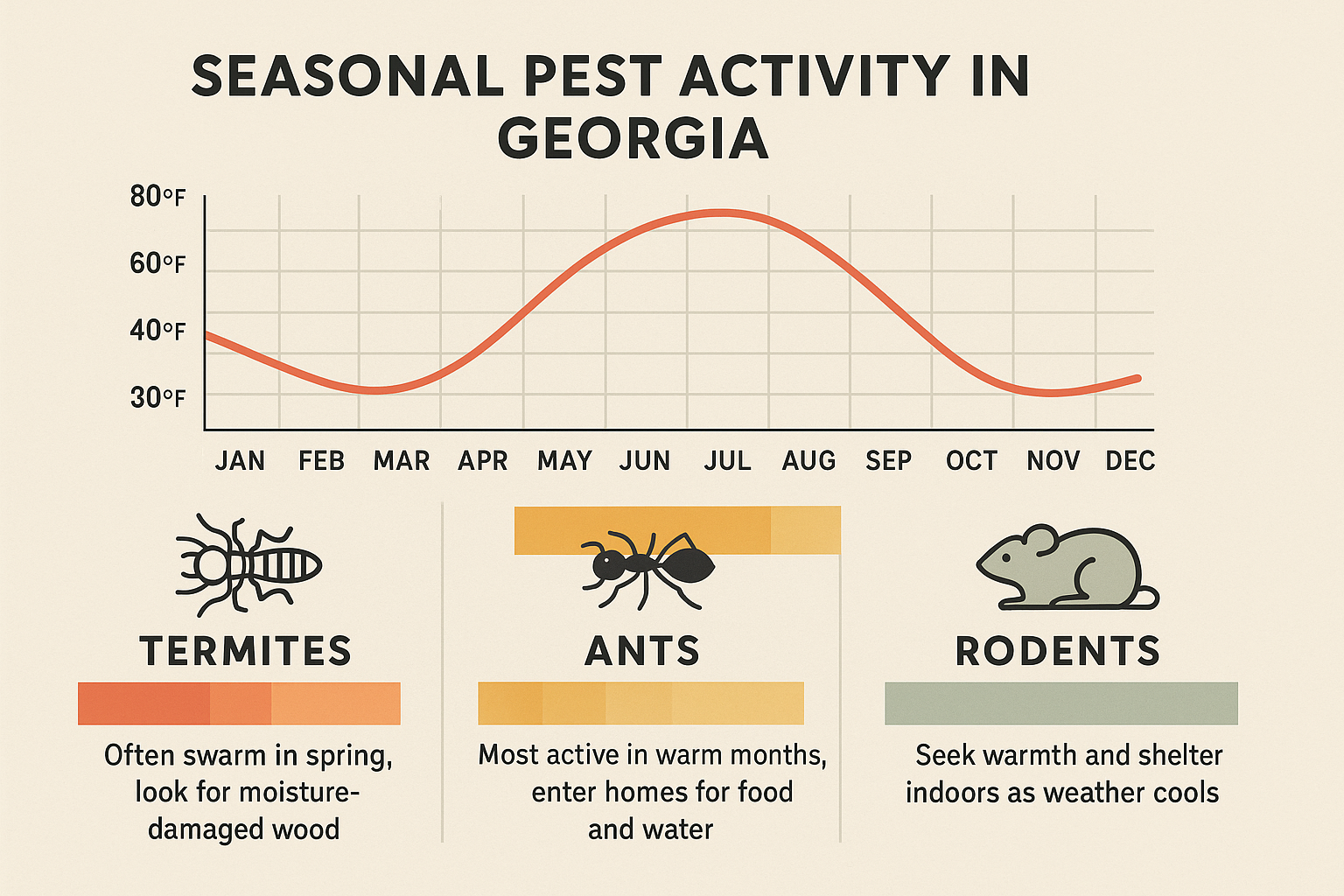
Understanding when termites are most active in Georgia is the first step toward effective termite control Decatur homeowners can rely on. Unlike many pests that appear only after a rainstorm or during a heat wave, subterranean termites follow a predictable seasonal rhythm driven by temperature, moisture, and soil conditions. Knowing this rhythm lets you schedule inspections and treatments before the insects even think about invading your foundation.
Climate Influence on Subterranean Termites
Georgia’s climate is a blend of humid subtropical warmth and occasional cold snaps. Subterranean termites thrive in soil that stays above 55 °F (13 °C) for most of the year, because the colony’s fungus‑feeding workers need a stable, warm environment to digest wood. When winter lows dip below that threshold, termite foraging slows dramatically, but the colony remains alive underground, ready to surge once the soil warms.
Peak Activity Months
In the Peach State, the high‑risk window stretches from late April through early October. During this period, average daily temperatures hover between 70 °F and 85 °F (21 °C‑29 °C), and soil moisture stays elevated thanks to summer rainfalls. These conditions accelerate termite metabolism, prompting workers to expand tunnels, search for new food sources, and increase swarming events in late summer.
Specifically, May‑June sees the first wave of foraging expansion, July‑August brings the greatest swarm activity, and September‑early October marks the final push before cooler soil temperatures slow the colony down again. Homeowners who miss this window often face larger, more entrenched colonies that are harder and costlier to eradicate.
How Termites Compare to Other Common Pests
While ants and rodents also enjoy Georgia’s warm months, their activity peaks differ. Ants typically peak in midsummer when surface heat drives them indoors, and rodents are most noticeable in the cooler months as they seek shelter from the cold. Because termites operate below ground, they can begin damaging structural wood weeks before you notice any surface signs, making early detection far more critical than with ants or mice.
Monitoring Seasonal Cues
- Soil temperature: Use a garden thermometer to check the top 6‑12 inches of soil. Consistent readings above 55 °F signal that termites are likely foraging.
- Humidity levels: Prolonged periods of high humidity (above 70 %) keep soil moist, a perfect environment for termite colonies.
- Rainfall patterns: Heavy spring and summer rains increase soil moisture, often prompting a surge in termite activity.
- Wood moisture content: If indoor wood feels damp or shows signs of swelling, it may be attracting termites.
Why Early Prevention Pays Off
Scheduling a preventive treatment before the high‑risk period begins—ideally in early March or late February—creates a chemical barrier that deters termites as they emerge from winter dormancy. This proactive approach not only reduces the likelihood of a full‑blown infestation but also saves homeowners up to 30 % on treatment costs compared to emergency services after damage has occurred.
At Anthem Pest Control, our licensed technicians perform a thorough pre‑season inspection, identify vulnerable entry points, and apply a targeted termiticide that remains effective throughout the active months. By acting before May, you give your home the best defense against the relentless foraging of Georgia’s subterranean termites.
Choosing the Right Termite Treatment for Your Home
When termites start chewing through your foundation, the first decision you’ll face is how to stop them. In Decatur, Georgia, most professionals rely on two core strategies: liquid termiticides and bait stations. Both create a barrier against foraging termites, but they do so in very different ways. Understanding the mechanics, strengths, and drawbacks of each method helps you match the solution to your home’s construction, the severity of the infestation, and your budget.

Liquid Termiticides: Creating an Invisible Shield
Liquid termiticides are applied directly into the soil surrounding a home, forming a continuous chemical barrier that termites cannot cross without dying. The process typically involves three steps:
- Trenching: A narrow trench is dug around the perimeter, allowing the product to be poured directly onto the soil surface.
- Injection: For deeper or hard‑to‑reach areas, a high‑pressure injection gun pushes the termiticide into the soil at a depth of 12‑18 inches.
- Soil Barrier Formation: Once the product settles, it bonds with the soil particles, creating a long‑lasting, invisible wall that repels or kills termites on contact.
The active ingredients—often non‑repellent chemicals like fipronil or imidacloprid—work by disrupting the termites’ nervous system. Because they are non‑repellent, termites can’t detect the barrier and will inadvertently transport the toxin back to the colony, amplifying the effect.
Bait Stations: Turning Termites Into Their Own Delivery System
Bait stations are placed discreetly in the soil or along the foundation, each containing a cellulose matrix infused with a slow‑acting toxin such as hexaflumuron. Foraging termites are attracted to the wood‑like bait, consume it, and share the contaminated material with nest mates through trophallaxis (mouth‑to‑mouth feeding). Over weeks, the toxin spreads through the colony, eventually collapsing it from within.
The key advantage of baiting is its targeted nature: you’re not saturating the entire yard with chemicals, and the system continuously monitors termite activity. Modern monitoring devices send alerts when termite traffic is detected, allowing homeowners to stay informed and pest professionals to adjust the bait matrix as needed.
Pros and Cons at a Glance
| Method | Coverage | Longevity | Maintenance | Environmental Impact |
|---|---|---|---|---|
| Liquid Termiticides | Full perimeter barrier (continuous) | 5‑10 years (depends on product) | Minimal after initial install; occasional re‑inspection | Potential soil residue; non‑repellent chemicals are low‑toxicity to humans |
| Bait Stations | Spot‑treated zones; relies on termite foraging paths | 3‑5 years (requires bait replacement) | Regular monitoring and bait refresh every 6‑12 months | Very low environmental load; toxins confined to bait matrix |
Liquid termiticides excel when you need immediate, comprehensive protection—especially for new construction or homes with extensive underground utilities. Bait stations shine in established properties where homeowners prefer a less invasive approach and want ongoing colony monitoring. Budget considerations also play a role: the upfront cost of a liquid barrier can be higher, while bait stations spread expenses over time through periodic servicing.
Supplemental Options: Fumigation and Spot Treatments
In severe infestations, especially those involving dry‑wood termites or extensive structural damage, additional tactics may be warranted. Structural fumigation—often called “tenting”—encloses the entire building in a sealed tarp and releases a gas that penetrates wood, eradicating hidden colonies in a single, swift operation. Localized spot treatments involve drilling directly into infested wood and injecting termiticides, useful for isolated hot spots that don’t justify a full perimeter barrier.
Real‑World Example: A Smoke Fumigation Operation in Decatur
Last summer, a historic home in Decatur required smoke fumigation after an inspection revealed an active dry‑wood termite colony deep within the attic framing. The process began with a thorough evacuation and sealing of all openings to prevent gas leakage. Technicians then introduced sulfuryl fluoride, a colorless, odorless fumigant, into the sealed enclosure. The house remained under fumigation for 24 hours, after which the gas was aerated using industrial fans. Post‑treatment inspections confirmed zero termite activity, and the homeowner received a detailed safety report outlining the steps taken to protect family members and pets.
Comparing Costs and Benefits of Termite Treatment Options
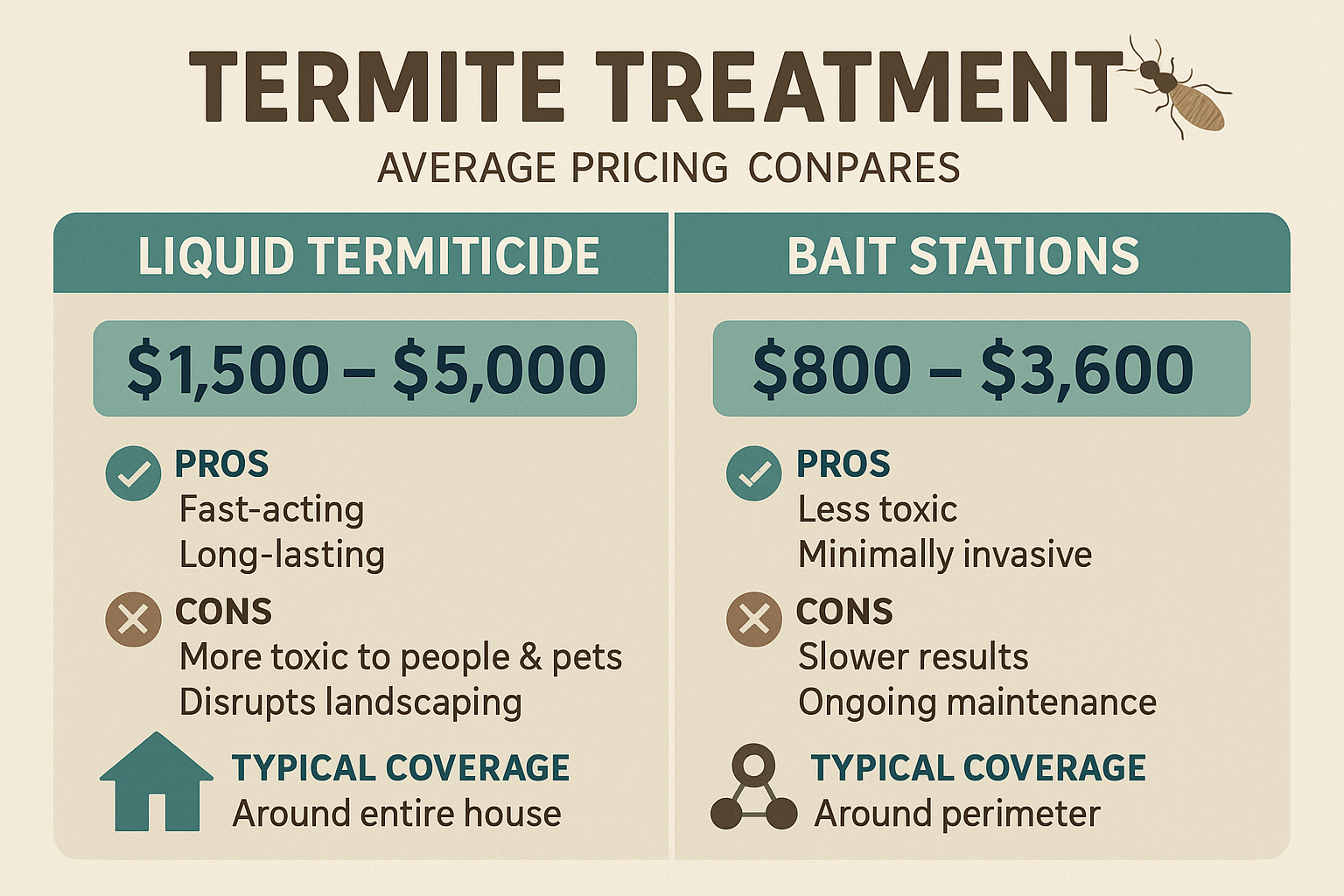
When it comes to protecting your Decatur home, the two most common termite control Decatur professionals recommend are liquid termiticides and bait-station systems. Both can be effective, but they differ markedly in price, coverage, and ongoing maintenance. Below is a concise breakdown to help you budget wisely.
Average Price Ranges
- Liquid Termiticides: Low ≈ $1,200, Median ≈ $2,200, High ≈ $3,500.
- Bait Stations: Low ≈ $1,500, Median ≈ $2,800, High ≈ $4,000.
These figures reflect typical residential jobs in the Decatur area and include material and labor but not optional extras.
Typical Coverage Area
- Liquid Termiticides: One full‑service application usually protects up to 5,000 sq ft of foundation and perimeter.
- Bait Stations: A standard bait‑station network can cover 8,000–10,000 sq ft, depending on layout and soil conditions.
Additional Costs to Expect
- Pre‑inspection: $100 – $250 (required to determine infestation severity).
- Follow‑up visits: $75 – $150 per visit (most plans include at least two in the first year).
- Warranty extensions: $200 – $500 for 5‑year protection beyond the standard guarantee.
Benefits vs. Drawbacks
| Aspect | Liquid Termiticides | Bait Stations |
|---|---|---|
| Longevity | Typically 3‑5 years with a single application. | Effective as long as stations are monitored and refilled (often 5+ years). |
| Invasiveness | Requires trenching or drilling around the foundation. | Minimal disruption; stations are placed in discreet locations. |
| Homeowner Involvement | Low after initial treatment. | Requires periodic checks and occasional station replacement. |
| Cost Predictability | One‑time upfront cost. | Ongoing maintenance fees. |
| Effectiveness in Difficult Soil | Works well in clay or sandy soils when applied correctly. | May need more stations in porous soils to maintain a feeding line. |
Factors That Influence Final Cost
While the ranges above give a solid baseline, three key variables can shift your quote:
- Home Size: Larger square footage or multi‑story structures often need additional treatment zones or more bait stations.
- Soil Type: Rocky or highly porous soils can increase labor time for liquid applications and may require extra bait stations to ensure a continuous feeding path.
- Infestation Severity: A light, early‑stage problem may be handled with a single bait‑station setup, whereas a heavy colony often calls for a full‑scale liquid barrier plus supplemental stations.
Next Steps
The most accurate way to determine your exact investment in termite control Decatur homeowners need is to schedule a professional inspection. Our certified technicians will assess your property, discuss the pros and cons of each method, and provide a personalized quote that reflects your home’s unique needs.
Protect Your Home with Anthem Pest Control Today
Why early inspection, timing, and treatment choice matter
Termites work silently, and a small colony can become a structural nightmare in months. Catching them during the spring or early summer—when they’re most active—gives you a critical window to intervene before damage spreads. Choosing the right treatment—whether a liquid barrier, bait system, or foam—ensures the infestation is eliminated at its source rather than just masking the symptoms.
Anthem Pest Control’s Georgia expertise
Our certified technicians have spent years navigating Georgia’s unique climate and soil conditions, which influence termite behavior. While we’re rooted in Decatur, our nationwide network means you benefit from the latest research, advanced products, and a support system that extends far beyond local borders.
Safe, effective, and affordable solutions
Transparency is at the core of our service. You’ll receive a clear, itemized quote that outlines every step of the process, from inspection to post‑treatment monitoring. All our methods comply with EPA standards, protecting your family, pets, and the environment while delivering the results you expect.
Schedule a complimentary inspection
We invite you to book a free, no‑obligation inspection. During the visit, a technician will assess your property, identify any termite activity, and craft a customized treatment plan that fits your budget and timeline. There’s no pressure—just expert guidance to help you make an informed decision.
Ready to safeguard your home from costly termite damage? Call Anthem Pest Control now at 877‑371‑8196 for a free quote. Our team will explain the best treatment options and create a plan tailored to your needs.
Visit Anthem Pest Control to learn more about professional termite control Decatur homeowners trust and schedule your inspection today.